

How an Investigation Triggered a Campaign, Not a Debate
When scrutiny becomes danger and journalism invites sanction, the response does not weaken an investigation; it completes it, revealing the coercive logic it set out to document.

After the Kosovo War Veterans Organisation (KWV) published its statement on social media1, the terrain shifted almost immediately2. What followed was not a spontaneous outpouring of disagreement, nor a pluralistic debate about evidence or interpretation. It was a sequence. Each stage arrived on time, in order, and with internal coherence.
The statement itself framed the investigation not as a journalistic act, but as a moral offence against the war. It did not specify factual inaccuracies. It did not challenge documents. It did not identify methodological errors. Instead, it asserted injury, collective insult, and national harm. That framing mattered, because in Kosovo’s post-war political culture, the charge of harming the war does not operate as criticism. It operates as authorisation.
Within hours, the response migrated from the Organisation’s page into a wider network of accounts, pages, and media figures. The pattern that followed mirrors, with striking fidelity, the escalation sequence documented in our 4 February investigation3.
The first external escalation came through a Facebook account operating under the name “Faton Faton”, which on 5 February published a video accusing me of being a Serbian and Russian intelligence asset4. The post did not emerge in isolation. It was immediately shared by Milaim Zeka, a public figure with a long record of involvement in narrative warfare surrounding the Kosovo Specialist Chambers5.
Zeka’s caption did not hedge. It declared me a fugitive, alleged sexual crimes involving children, and recast my reporting as persecution of the war and of those allegedly victimised by Serbia. These are not random accusations. In disinformation operations, allegations of sexual deviance and child abuse are used precisely because they are reputationally terminal. They do not invite rebuttal. They invite expulsion.
The video itself warrants precise description. It presented itself as investigative. It named a fictitious outlet, claimed possession of “seven hours and forty-two minutes” of recordings, and promised imminent publication. It alleged meetings in specific hotels, named intelligence chiefs, invented sexual partnerships, and attributed institutional protection to international prosecutors.
None of this material was produced. No recordings followed. No outlet surfaced. We conducted an exhaustive search for “Mediumi Demaskimi” across domain registries, media registers, archived platforms, and social media histories. There was no trace of its existence.
The audio narration showed characteristics consistent with artificial intelligence voice synthesis. The cadence, tonal uniformity, and absence of natural speech variance matched known AI-generated voice patterns. This matters because synthetic media is not used to persuade skeptics. It is used to flood the information space quickly, cheaply, and repetitively.
Milaim Zeka’s Double Account Video Below:
Within hours, the same video appeared on at least ten other accounts. Several had minimal personal content. Others were closely linked to figures publicly loyal to Hashim Thaçi. The effect was multiplication, not corroboration. A single fabrication was rendered plausible through repetition.
This escalation cannot be understood without context.
In February 2025, Milaim Zeka’s associate, Halit Sahitaj, attempted to induce me to publish fabricated intelligence6 material targeting the Kosovo Specialist Chambers via another well known figure, former Trump Administration I deputy chief of national intelligence Richard Grenell, also involved in undermining Kosovo’s Specialist Chambers in the Hague. Money was offered. When refused, the offer was reframed as support. I documented the interaction, verified the documents, and exposed the attempt as a kompromat operation designed to undermine The Hague process. That exposure collapsed the quiet route.
What followed in February 2026 was the loud route.
The next phase introduced visual contamination. Nexhmi Muçiqi published a video7 in which footage of me speaking was edited alongside Serbian-language commentary describing the Kosovo Liberation Army as a terrorist organisation. The juxtaposition was deliberate. It was designed to imply alignment, not argument.
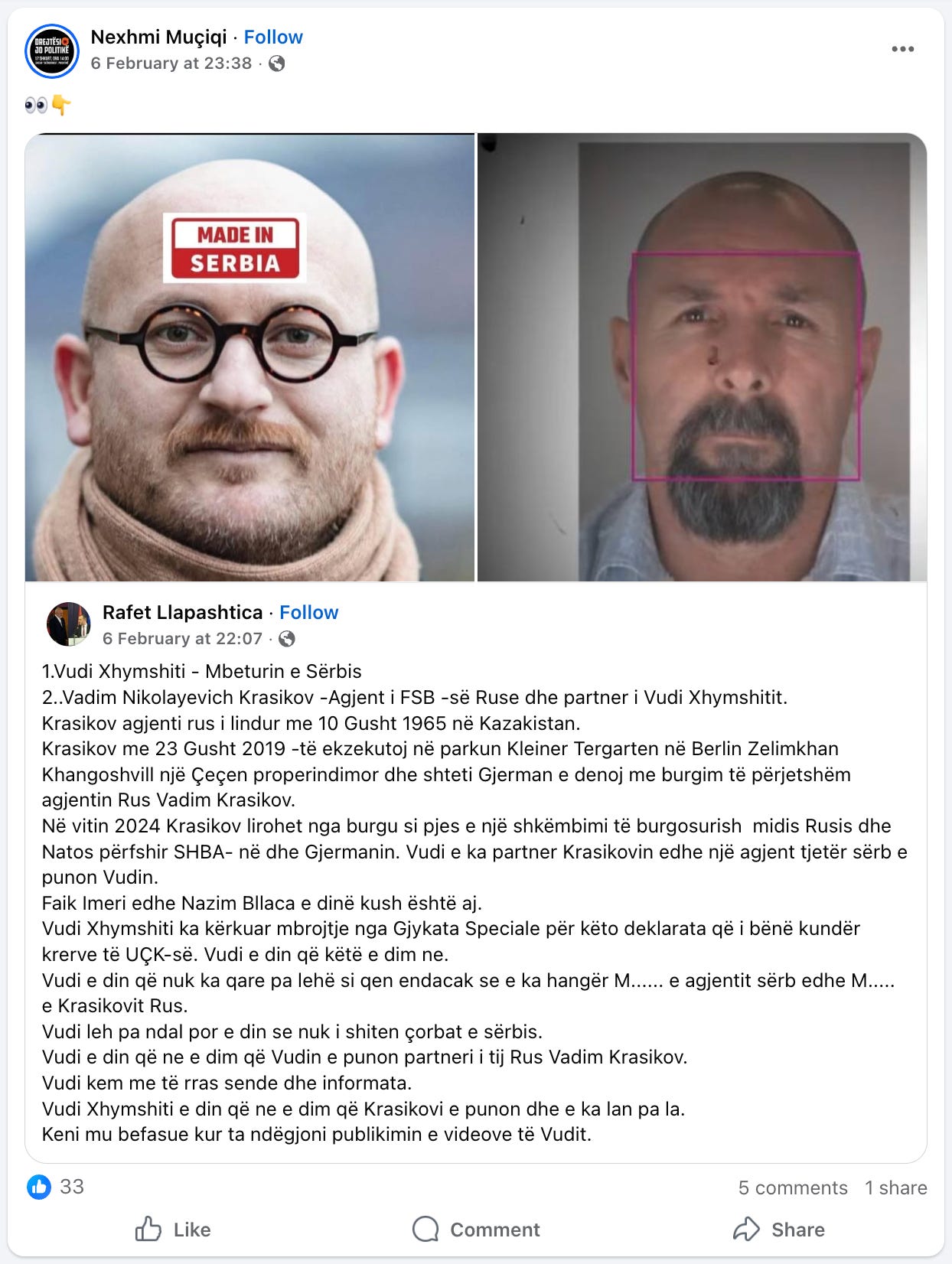
Muçiqi then shared an image8 of my face marked with the phrase “Made in Serbia”, accompanied by text alleging partnership with a Russian intelligence officer, threats of future “revelations”, and claims of protection by international courts. The language was not analytical. It was degrading, sexualised, and explicitly threatening. The function was to strip personhood and make harm thinkable.
At this point, the campaign diversified roles.
Agim Dreshaj, a figure publicly aligned with the Democratic Party of Kosovo and loyal to Hashim Thaçi, intervened by framing my work as betrayal rather than error. His contribution did not contest facts. It reinforced exclusion9. This is a classic legitimising move: when identifiable political loyalists signal alignment, peripheral actors feel authorised to escalate.
Sali Rexhaj assumed a different function. His activity focused on monitoring. Screenshots show him tracking who interacted with my posts, who liked them, and who engaged10. This behaviour is not rhetorical. It is disciplinary. Surveillance of association creates chilling effects without issuing threats.
Simultaneously, sock-puppet amplification intensified. An account named “Shkodran Shkodra” was verified as a fake persona linked to Milaim Zeka. This account repeated core accusations11, lending the appearance of independent confirmation. This technique, known in disinformation studies as false plurality, creates consensus illusion without evidence.
Another account, “Nusret Mulaku”, introduced a misrepresentation tactic. He shared a screenshot12 from one of my online mentoring sessions and claimed it showed Russian participants. In fact, the image was from a professional safety and reporting workshop delivered to Ukrainian photojournalists covering the war. The participants were Ukrainian. The subject was safety, ethics, and documentation.
This manoeuvre is instructive. Disinformation rarely fabricates everything. It repurposes authentic material, strips context, and reinserts it as proof of the opposite claim. This allows falsehood to piggyback on reality.
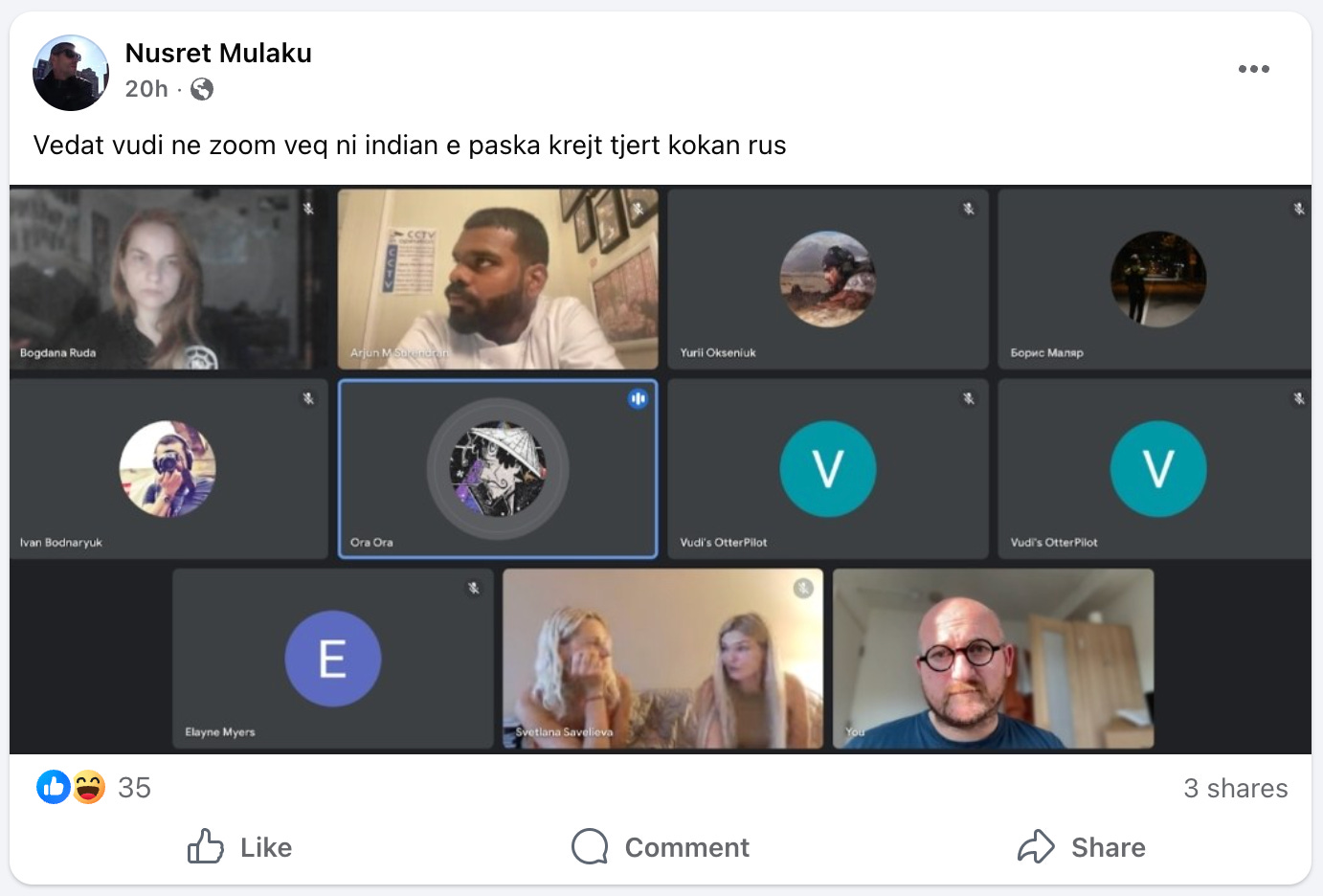
On 5 February, the campaign acquired academic cover.
Ragip Gjoshi, a university professor, published a lengthy essay attacking our investigation13. He framed it as dangerous to Kosovo, accused it of functioning as a parallel court, and warned that it could be weaponised internationally. His text focused heavily on optics, reputation, and timing.
What it did not do was engage substantively with the documented patterns, the evidentiary architecture, or the historical record of unresolved political assassinations. Instead, it displaced scrutiny itself as the problem. This is a critical move. Once inquiry is framed as national risk, suppression becomes duty.
On 7 February, the escalation entered a second synthetic phase. Another AI-generated video circulated14, this time from an account named “Ardi Ardi”, again linked to Milaim Zeka15. The video suggested that a Serbian minister admired my work for attacking the KLA. The implication was simple: foreign praise equals treason.
This is loyalty-test propaganda. It collapses complexity into reflex. If the enemy agrees with you, you must be eliminated.
The final stage involved media laundering.
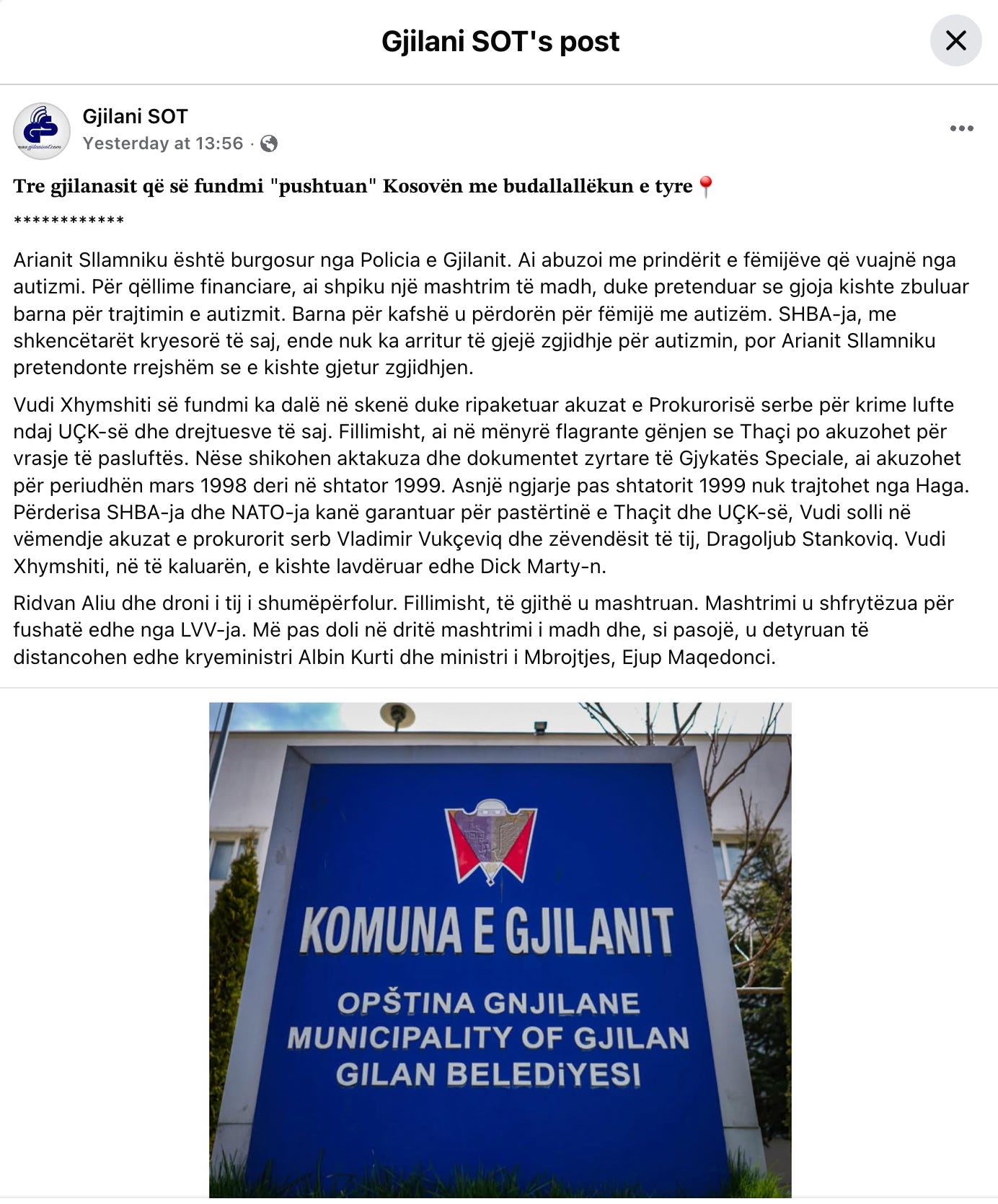
A local Facebook portal page, Gjilani SOT, published a post16 bundling unrelated scandals with an attack on me, accusing me of recycling Serbian prosecution narratives, lying about indictments, and insulting NATO and the United States. The structure was important. By placing my name alongside unrelated wrongdoing, the article normalised guilt by association.
A portal from my hometown, Zerogjasht17, followed with a similar article18. It repeated the same core claims, added unverified financial allegations, and framed my work as hostile to Western interests. The language was categorical. It did not invite reply. It pronounced judgment.
At this point, the sequence was complete.
A veterans’ statement framed scrutiny as betrayal. Synthetic media introduced terminal accusations. Fake accounts multiplied them. Loyalist figures normalised sanction. Academic critique reframed inquiry as danger. Media outlets laundered the narrative into permanence.
This progression is not accidental. It mirrors precisely the methodology documented in our 4 February investigation.
First comes delegitimisation. The target is stripped of national belonging.
Second comes contamination. The target is linked to foreign enemies and deviance.
Third comes consequence talk. Arrest, prosecution, silencing.
Fourth comes laundering. Media repetition converts accusation into ambient truth.
This is not uniquely Kosovar. Scholars of political intimidation have documented identical sequences in other post-conflict societies.
Zeynep Tufekci has described how networked publics are converted into enforcement crowds.
Jason Stanley has shown how propaganda reframes criticism as treason.
Kathleen Hall Jamieson has demonstrated how repetition substitutes for verification.
What matters here is not whether every participant coordinated consciously. Coordination does not require central command. It requires shared scripts, aligned incentives, and permissive authority.
The War Veterans Organisation did not issue threats19. It did something more consequential. It framed scrutiny as sacrilege and then declined to moderate a single hateful or threatening response. In doing so, it created an enabling environment.
That environment matters because it exists within a context where intimidation has already crossed into physical space. My family home was vandalised. Property was targeted20. The National Union of Journalists condemned the attack21. No one was held accountable.
Against that backdrop, calls for arrest, imprisonment, and exposure are not abstract. They are part of a continuum.
The incentive structure is clear. If prosecutorial scrutiny expands into unresolved political assassinations, if long-silenced cases reopen, those associated with post-war consolidation face existential risk. The fastest defence is not rebuttal. It is to make scrutiny dangerous.
This is why the response matters. It does not weaken our reporting. It corroborates it.
The investigation described a method. The reaction enacted it22.
In the next section below, we will document how established national media outlets and senior public figures responded once this campaign entered the mainstream information space, and how silence, amplification, and selective outrage functioned not as neutrality, but as alignment.
The Moment Scrutiny Became Disloyalty
When this campaign entered the mainstream media space, it did not soften. It hardened. The language became more disciplined, the accusations more standardised, and the objective clearer. This was no longer only about delegitimising a journalist. It was about constructing a public framework in which the mere act of reading, liking, or referencing our reporting was treated as political deviation.
On 6 February 2026, Gazeta Express, a media outlet widely known for its proximity to Hashim Thaçi’s political circle, opened23 this phase with a message that appeared defensive on the surface but was punitive in substance. On the programme Kosova Live, activist Elena Uka declared that neither I nor Adem Salihaj “can defeat the KLA”. She did not speak about evidence. She did not reference documents. She did not engage with a single element of the investigation. Instead, she invoked a symbolic formula: the Kosovo Liberation Army as an indestructible body, and any scrutiny as an enemy attempt to “defeat” it.
The reference to “America’s greatest generals” was not incidental. It functioned as an appeal to authority, a protective shield placed over a debate that was never about the war itself, but about post-war political assassinations and mechanisms of power. In this formulation, facts ceased to matter. They were dismissed as “scenarios” and “speculation”, while “the truth” was presented as something fixed, unquestionable, and safeguarded by the moral weight of the war and its alliances.
That same day, Periskopi.com shifted the focus away from the substance of the reporting and towards a different target altogether: who had liked it. The article24 did not interrogate what had been written, but instead highlighted that Suzana Gërvalla, the mother of Foreign Minister Donika Gërvalla, had shown approval for the article. This act was framed as a “scandalous stance”, while I was described as a “self-proclaimed journalist”, without a platform, without an editorial office, without an address.
This was a telling move. The media was no longer attempting to persuade the public that the reporting was false. It was signalling that anyone who expressed interest or sympathy for it should be exposed and placed under suspicion. The article went further, embedding the issue within a broader political narrative, casting doubt on Donika Gërvalla’s positions and invoking the trial in The Hague. In this way, our reporting was instrumentalised as a pressure tool against other political actors.
On the same day, Gazeta Blic, a media outlet close to the circle of Sami Lushtaku and segments of the LDK, reproduced Elena Uka’s statements almost verbatim. The structure was identical25. The message was identical. The KLA cannot be “defeated”. The accusations are speculation. The truth is elsewhere, though never specified. This mechanical repetition demonstrated that the narrative had already been standardised and was circulating as formula rather than analysis.
On 7 February, Veriu.info deepened this logic by identifying yet another supposed transgression: a former Vetëvendosje candidate for parliament, Luan Gacaferri, had liked the article26. Again, the content was irrelevant. The act of liking was treated as a political act. A single click was elevated into proof of ideological deviation. The article described the piece as “without any support” and once more labelled me a “self-proclaimed journalist”, completing the cycle of personal delegitimisation.
Gazetametro.net took the same material and packaged it in more aggressive language, adding ridicule and ideological labelling27. Once again, the object was the same: who had liked the article and what that implied about their political loyalty. This form of discourse is not designed to persuade. It is designed to intimidate. The implicit message is unmistakable: reading and reacting are acts under surveillance.
Nacionale.com, the platform run by Berat Buzhala, elevated this logic further. Its article28 did not stop at Suzana Gërvalla. It constructed a familial and political narrative, linking the actions of the mother to the work of the daughter and presenting both as part of a “propaganda” effort against the KLA. PDK MP Artan Behrami was quoted publicly mocking the situation and suggesting that Donika Gërvalla should never be entrusted with key state positions.
Here, our reporting became a pretext for a coordinated political attack. It was used to strike opponents, to delegitimise institutions, and to reinforce a rigid boundary between “us” and “them”. There was no attempt to verify our claims. No engagement with methodology. Only an interest in discipline.
Sinjali.com, another outlet closely linked to powerful political and legal networks, repeated the same scheme. Its article29 mirrored the structure and language of Periskopi almost exactly. I was again described as a “self-proclaimed journalist”, without credentials or platform, while Suzana Gërvalla’s approval was framed as unacceptable conduct. The article concluded by emphasising that the trial in The Hague was in its final phase, implicitly suggesting that any public discussion at this moment was suspect and harmful.
Read individually, these articles might appear as separate reactions. Read chronologically, they reveal something else entirely. They reveal a deliberate shift away from debating facts and towards regulating public behaviour. The media was no longer asking “is this true?”. It was asking “who liked it?” and “why did they like it?”.
This is the stage at which silence becomes strategy and amplification becomes enforcement. Those who remain silent legitimise the campaign. Those who amplify it discipline others. Those who display selective outrage declare alignment.
At this stage, the campaign no longer required synthetic videos or fake accounts. It had entered the bloodstream of the media itself. And when media assumes the role of guardian of loyalty, the boundary between information and coercion collapses.
This was not neutrality. It was positioning.
And it is here that the model we documented on 4 February closed into a full circle. The investigation was framed as a threat. The journalist was framed as a problem. The reader was framed as suspect. And the media, rather than illuminating, chose to align.
Thaçi’s Assassination Manual

In April 2025 our newsroom began pulling at a thread that kept resurfacing in different forms and different places. It was a claim that a Russian Serbian Kosovan entangled network had been tasked, by Hashim Thaçi and associates, with undermining the Kosovo court process in The Hague. That work started as a national security story and it stayed one. But as we mapped names, timelines and incentives, we kept returning to an older question that Kosovo never fully answered after the war. How did power consolidate so quickly, and what did it cost.
The Response That Confirmed the Reporting
By triggering punishment instead of debate, the War Veterans Organisation validated our reporting, behaving not as critics but as participants in the Hashim Thaçi’s assassination manual we documented. — The GPC I Unit.
Thaçi’s Assassination Manual
Thaçi’s strategy transformed Kosovo into a coercive state, where “assassination atmospheres” were manufactured to justify neutralising opponents and trapping loyalists in a cycle of debt. — The GPC I Unit.
“Faton Faton” Video Facebook Post, Feb 5, 2026.
The Conspiracy Against Kosovo’s Justice System Unraveled
In response to manipulated attacks, we’re granting free access to our latest investigative report, ensuring every reader sees the unfiltered truth. — The GPC I Unit.
Double Dealing: A Journalist, a Fixer, and a Master of Manipulation
Unveiling Milaim Zeka’s role in manipulating Kosovo’s narrative, targeting the KSC in The Hague with a campaign of disinformation and deceit utilising Russian secret service assets and criminal ties. — The GPC I Unit.
Inside the Plot to Dismantle Kosovo’s War Crimes Tribunal
How a simple Facebook bribe unravelled into a scandal, unveiling a clandestine effort to sabotage Kosovo’s Special Chambers and destabilise a nation. — The GPC I Unit.
Nexhmi Muçiqi Facebook Video Post, Feb 7, 2026.
Nexhmi Muçiqi’s Facebook Photo Post, Feb 6, 2026.
Agim Dreshaj Facebook Post, Feb 5, 2026.


There are growing indications of a coordinated effort to monitor who engages with my posts, followed by targeted hit campaigns against those individuals, particularly public figures who are critical of Hashim Thaçi and who openly challenge his political worldview of a Kosovo subordinated to Serbia’s influence.
Dreshaj appears to be operating or aligning himself with a fake account, Zoran Jovic, while overlooking a basic fact: he is a mutual friend with that account. This is a clear case of deflection and disinformation in response to documented reporting.
Sali Rexhaj’s Facebook Surveillance Post, Feb 6, 2026.


Shkodran Shkodra Fake Account Facebook Posts, Feb 6, 2026.


Evidence of Shkodra Shkodra account links to Lirim Mehmetaj.
Shkodra Shkodra fake account repeating Milaim Zeka’s video post.
Nusret Mulaku Facebook Post Screenshot of my Mentoring Session.


Ardi Ardi Video Facebook Fake Account Post, Feb 7, 2026.
Milaim Zeka’s amplification of his fake account “Ardi Ardi” Video Post, Feb 7, 2026.
Gjilani Sot Facebook Post, Feb 7, 2026.
Zerogjashte.com Facebook Post and on their website, 7 Feb, 2026.
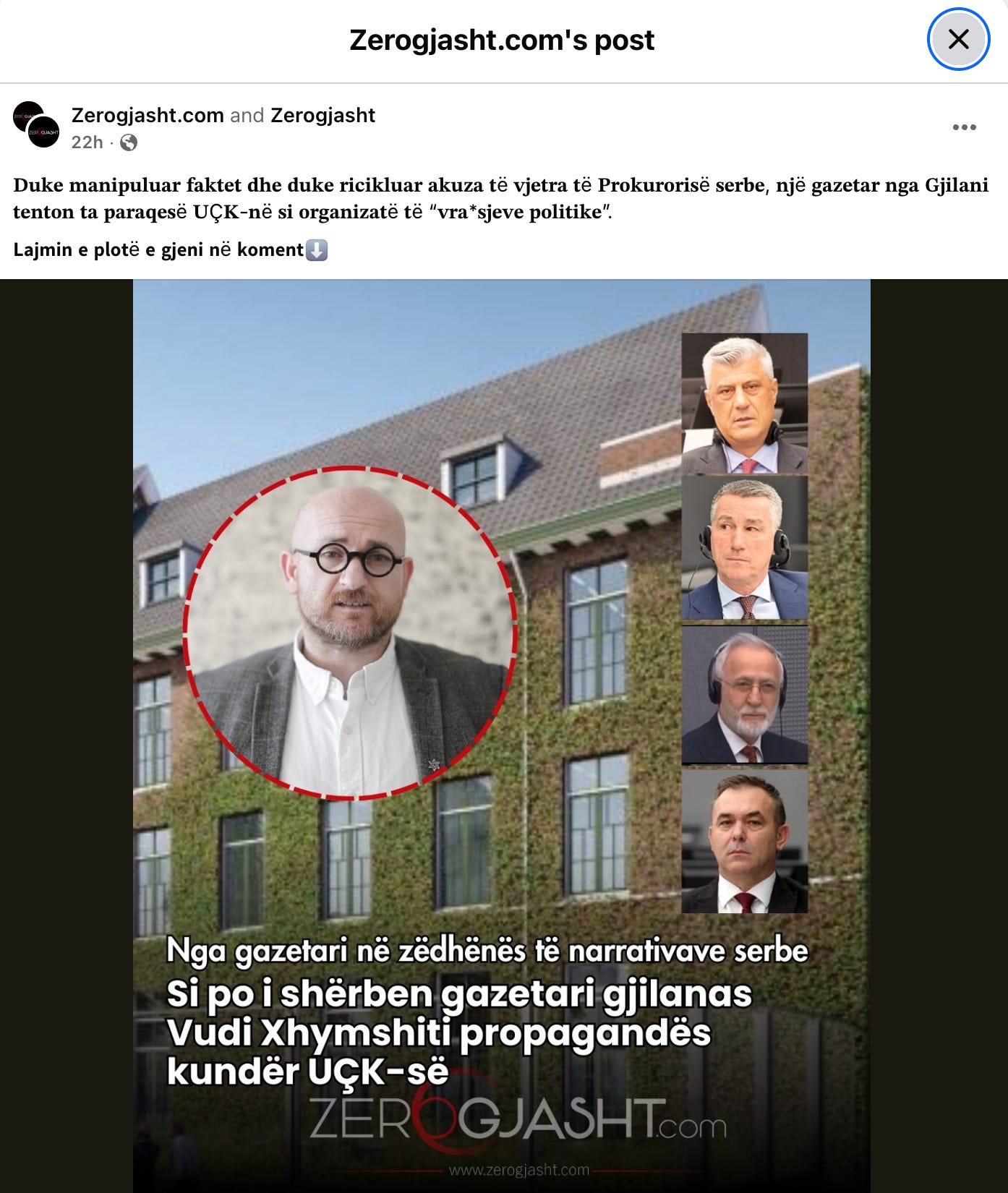
Nga gazetari në zëdhënës të narrativave serbe: Si po i shërben gazetari gjilanas Vudi Xhymshiti propagandës kundër UÇK-së — ZeroGjasht.
The Response That Confirmed the Reporting
By triggering punishment instead of debate, the War Veterans Organisation validated our reporting, behaving not as critics but as participants in the Hashim Thaçi’s assassination manual we documented. — The GPC I Unit.
STATEMENT: Kosovo Attack Tied to Investigations Exposing Espionage and Disinformation
The Gunpowder Chronicles confirms the Kosovo attack on Chief Editor Vudi Xhymshiti’s family home is a direct retaliation for investigations exposing espionage, corruption, and disinformation networks. — The GPC Official Dispatch.
NUJ condemns vandalism at Kosovo home of London-based journalist
Britain’s journalists’ union condemned vandalism at Vudi Xhymshiti’s family home in Kosovo, urging a inquiry into intimidation allegedly linked to his reporting on espionage networks. — The GPC Media Watch.
Si Reagon Manuali i Hashim Thaçit Kur Ekspozohet
Reagimet e Granit Gecit pas publikimit të gjetjeve tona aktivizuan manualin e atentateve politike të Hashim Thaçit, fyerje, dehumanizim, zhvendosje identiteti, presion publik, heshtje faktesh. — Kronika B Hulumtim.
Donika Gërvalla’s mother with a scandalous stance: She likes the claims that Hashim Thaçi had organized a murder scheme — Periskopi.
Uka: Nuk mundet UÇK-në me e mposhtë as Adem Salihaj, as Vudi Xhymshiti — Gazeta Blic.
Ish-kandidati i Kurtit për deputet e ‘pëlqen’ shkrimin me shpifje kundër Hashim Thaçit — Veriu.info.
Gërrnaçizëm: Edhe Luan ‘fataliteti i natalitetit’ Gacaferi pëlqen rrenat për Hashim Thaçin — Gazeta Metro.