

Thaçi’s Assassination Manual
Thaçi’s strategy transformed Kosovo into a coercive state, where "assassination atmospheres" were manufactured to justify neutralising opponents and trapping loyalists in a cycle of debt.


In April 2025 our newsroom began pulling at a thread1 that kept resurfacing in different forms and different places. It was a claim that a Russian Serbian Kosovan entangled network had been tasked, by Hashim Thaçi and associates, with undermining the Kosovo court process in The Hague. That work started as a national security story and it stayed one. But as we mapped names, timelines and incentives, we kept returning to an older question that Kosovo never fully answered after the war. How did power consolidate so quickly, and what did it cost.
What follows is an account of a methodology rather than a verdict. It is built from matching information from at least four sources, two of them international, as well as publicly available evidence in Kosovo that we have verified through documents, broadcast material and institutional records. A fifth source is an on the record interview we conducted with Gazmend Halilaj, who describes himself as a former KLA member, later Kosovo Protection Corps and Kosovo Police investigator, and who says he became an assassination target after speaking publicly about alleged wartime fund theft and intimidation linked to Sami Lushtaku. We treat his testimony as testimony, not as proof of every allegation it contains. We also treat the public record as a spine, and what sources describe as muscle, the part that moves when nobody is supposed to be watching.
The record begins before the peace. In the late nineteen nineties Kosovo was not only fighting Serbia, it was also deciding who would inherit the state that did not yet exist. That is not a romantic way to put it. It is simply the political reality of insurgencies. Command becomes currency. Loyalty becomes a career. Rivalry becomes a security problem. In that environment the line between political strategy and personal survival is thin enough to step over without noticing.
After June 1999 the world changed faster than institutions could. The international presence arrived, first as a promise, later as a bureaucracy. UNMIK took on a state building role in a society where weapons were plentiful and authority was fragmented. EULEX would follow, tasked with rule of law in a country where rule of force had not fully receded. In that gap, according to sources, a particular kind of violence emerged. It was not random. It was selective. It did not aim to terrorise a whole population. It aimed to reorganise elites.
One killing is often described as the first post war political murder in Kosovo. It was the murder of Haki Imeri on 2 November 1999. In the account provided to us by a source who says they were inside Thaçi’s inner circle and who now lives between Kosovo and Switzerland, Imeri was not only a local Lidhja Demokratike e Kosovës organiser and respected teacher. He was also socially embedded in the Drenica landscape that produced many of the war’s commanders and much of its post war political leadership. He had taught Thaçi. He had known the families. He was a figure whose continued independence could not be easily managed.
The source describes a sequence that matters more than the brutality. First came the approach framed as a conversation. A meeting. An invitation that felt legitimate because the war had normalised command structures and made certain men the arbiters of movement. Then came a staged authority. Men presenting themselves as KLA military police. The phrase is crucial. It signals that the operation, if the account is accurate, relied on the symbolic residue of wartime institutions to create compliance. You do not need a badge if the fear already recognises you.
From there, according to the source, the operation shifted into a second phase that appears repeatedly in later accounts. Narrative placement. The body, they claim, was moved in a way intended to attach guilt elsewhere. Blame as a weapon. Not merely to protect perpetrators, but to damage a rival. The rival named in these accounts is Rexhep Selimi2.
This was not, in the telling, a single deception. It was a long term one. The claim is that for years Selimi was positioned as the shadow behind multiple post war crimes, including the murder of Xhemajl Mustafa3, the assassination attempt on Fetah Rudi4, and the killing of Ekrem Rexha5. The mechanism described is consistent. Feed decontextualised intelligence into international investigators. Let the system do what it does. Create a paper trail that looks official enough to repeat. According to these sources, SHIK6, described as an intelligence structure linked to Thaçi’s circle, was central both to operations and to disinformation.
This is where our international sources enter. The first is the institutional record around Mustafa’s murder. On 23 November 2000 Mustafa was killed in front of his apartment in Prishtina. UNMIK issued a statement7 expressing outrage at the killing and identifying him as a senior LDK adviser. A later account from Prishtina Insight8 notes that no suspect has been charged and that the case remains one of Kosovo’s most consequential unresolved political murders. This is not a minor detail. A vacuum in accountability becomes usable. When no one is convicted, everyone can be implicated. When everyone can be implicated, whoever controls the flow of insinuation controls the boundaries of fear.
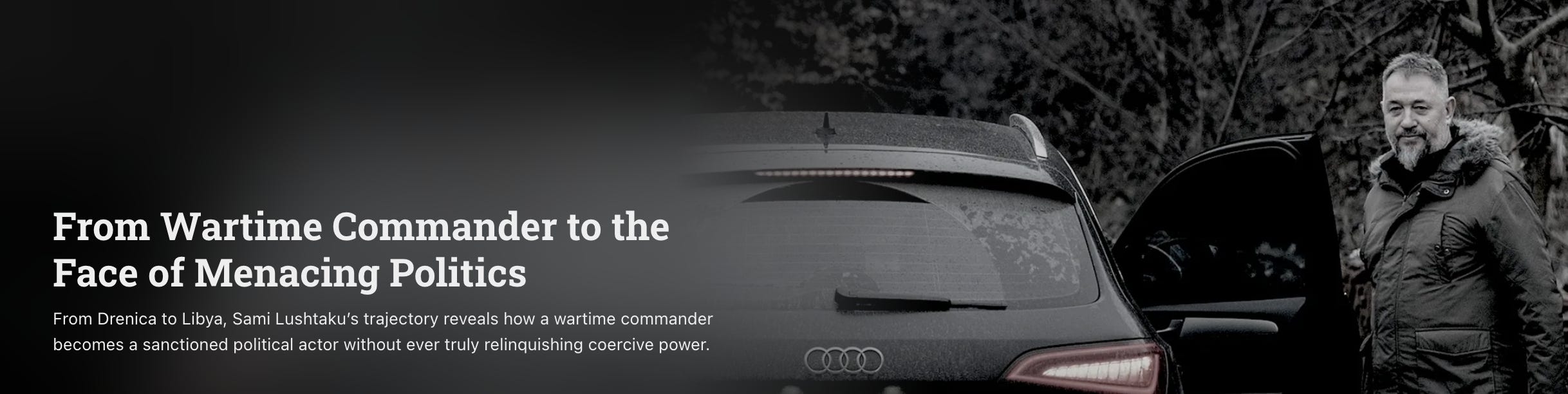
The second international strand is the record of wartime crimes and post war power. In May 2015 an EULEX panel at the Basic Court in Mitrovica convicted Sami Lushtaku of murder and sentenced him to twelve years’ imprisonment in the Drenica cases9. This judgment is not proof of later political killings. But it establishes a relevant fact about the type of actor he was, the kind of environment he operated within, and the seriousness with which international and local judicial structures, at least in that instance, treated allegations of violence. It also offers a bridge between two worlds. The wartime commander and the post war political enforcer are not separate roles. They are consecutive ones.
That bridge becomes central to the methodology described by sources. Their claim is not that Thaçi personally carried out killings. It is that he shaped a system where killings, threats and reputational destruction were instruments of political consolidation, and where specific men, including Lushtaku, functioned as implementers.
This is where chronology matters.
First, eliminate or neutralise opponents in the volatile early post war period, when international missions are still learning the terrain and local policing is weak.
Second, consolidate party structures.
Third, formalise informal networks inside security and intelligence.
Fourth, when scrutiny intensifies, shift from violence alone to a mixture of violence, legal manipulation and disinformation.
The sources provide a blunt summary, and it is worth quoting because it captures the claimed logic in plain language. Hashim gives the order, SHIK executes, and the disinformation department attributes crimes to others so the clan dominates and profits politically and materially. It is a neat sentence. It is also, if true, a description of state capture in miniature. But we cannot treat it as true simply because it is neat. We can only trace where it intersects with verifiable events.
One intersection is the claim that Thaçi privately acknowledged responsibility for Mustafa’s killing to Fatmir Limaj10 on the day of the murder, allegedly saying, “This is our work.”
We cannot independently verify that conversation. No recording is publicly available, and none was provided to us. We therefore present it as an allegation from a source who claims proximity to SHIK at the time. The value of the allegation is not its dramatic quality. Its value is that it fits the broader described method. The method requires a small circle to know enough to coordinate, while the public knows only enough to fear.
The disinformation element becomes clearer in a second set of claims that we have now received from another source. They say that after Mustafa’s murder, information was channelled to international missions11 suggesting that Selimi was behind Mustafa’s killing, Rudi’s assassination attempt and Rexha’s killing. The objective, they claim, was to weaponise international institutions as unwitting amplifiers. This would be a sophisticated tactic because it uses the credibility of outsiders to launder internal factional warfare. It also matches a broader pattern observed in other contexts. When a system is partially internationalised, influence operations often target the interface. The translator. The liaison. The report.
We have not seen the alleged intelligence submissions themselves. We have, however, seen public reporting that indicates investigations were plagued by conflicting leads and by claims of knowledge within international missions. For example, an account12 attributed to the Journalists Association of Serbia claims that EULEX investigators believed they knew who was responsible for Mustafa’s murder and names a suspect. We do not treat that as definitive. But it supports the broader point that the case has long been surrounded by assertions of hidden knowledge and institutional paralysis, an environment in which disinformation thrives.
Another intersection is the way internal rivals are described. The second source claims that Thaçi’s motive for seeking Selimi’s imprisonment and elimination was that Selimi had knowledge from wartime about the killing of another figure, allegedly linked to Thaçi. Whether that specific wartime claim is provable is beyond what we can establish here. What we can establish is the plausibility of the incentive structure. In systems of clandestine violence, knowledge is liability. A man who knows too much and cannot be reliably controlled becomes a threat, even if he is loyal in other respects. The removal of such a man can be framed as justice or necessity. The framing is the point.
This brings us to another tool alleged to have been used for two decades. Komunikata 59. In Kosovo, communiques issued in the name of the KLA during the war carried enormous symbolic authority. In the post war period, invoking them could function as a retroactive verdict. A person labelled a traitor in a wartime communique could be socially condemned, economically isolated and physically endangered, even if no court ever found wrongdoing. In that sense, Komunikata 59, if used as described, would be less a document than a weapon.
The claim from the source is that Thaçi circulated Komunikata 59 against Gani Geci13 while presenting it in his media circles as the work of Selimi. The claim continues. Selimi publicly stated14 that Thaçi drafted and issued the communique, and that Selimi asked him not to publish it because it contained falsehoods about Geci.
The alleged consequence is serious. The source says that after the communique circulated, several people were killed and Geci was wounded. We cannot verify the causal chain as stated. But we can identify the method being alleged.
Step one, publish a delegitimising narrative in the language of wartime loyalty.
Step two, allow that narrative to produce social licence for violence.
Step three, when consequences follow, attribute authorship to a rival.
In this scheme the communique is not simply propaganda. It is an ignition.
Around this point in chronology the party apparatus consolidates. Thaçi moves through roles, from war leadership to political leadership, establishing Partia Demokratike e Kosovës — PDK15 dominance and holding top state offices. In parallel, sources allege the embedding of intelligence structures that are informal yet effective, described as SHIK, linked to party power, staffed by wartime loyalists, and tasked not only with surveillance but with enforcement. Such claims have long circulated in Kosovo and have been the subject of reporting and political argument. We will not rest them as fact. But we note that the persistence of the SHIK narrative itself speaks to an institutional deficit. When a society believes a shadow structure exists, that belief shapes behaviour whether or not the structure is as powerful as claimed.
Then, as institutions begin to stiffen, the method described shifts from pure violence toward a blended approach. This is where the fifth source, our interview with Halilaj, becomes especially relevant because it illustrates the alleged mechanics of intimidation and attempted neutralisation in a later period, when courts, police and media are all part of the ecosystem.
We interviewed Gazmend Halilaj on the record in Drenas in late December 2025, with his explicit permission to record and publish. In his account, the early post war period was defined by impunity. He says he survived two assassination attempts. Halilaj describes a climate in which dissenters were first denigrated and labelled pro Serb, and, when that failed, targeted with violence. Separately, an assassination attempt against Halilaj on 14 April 2020 is documented16 in Kosovo media reporting and later court coverage.
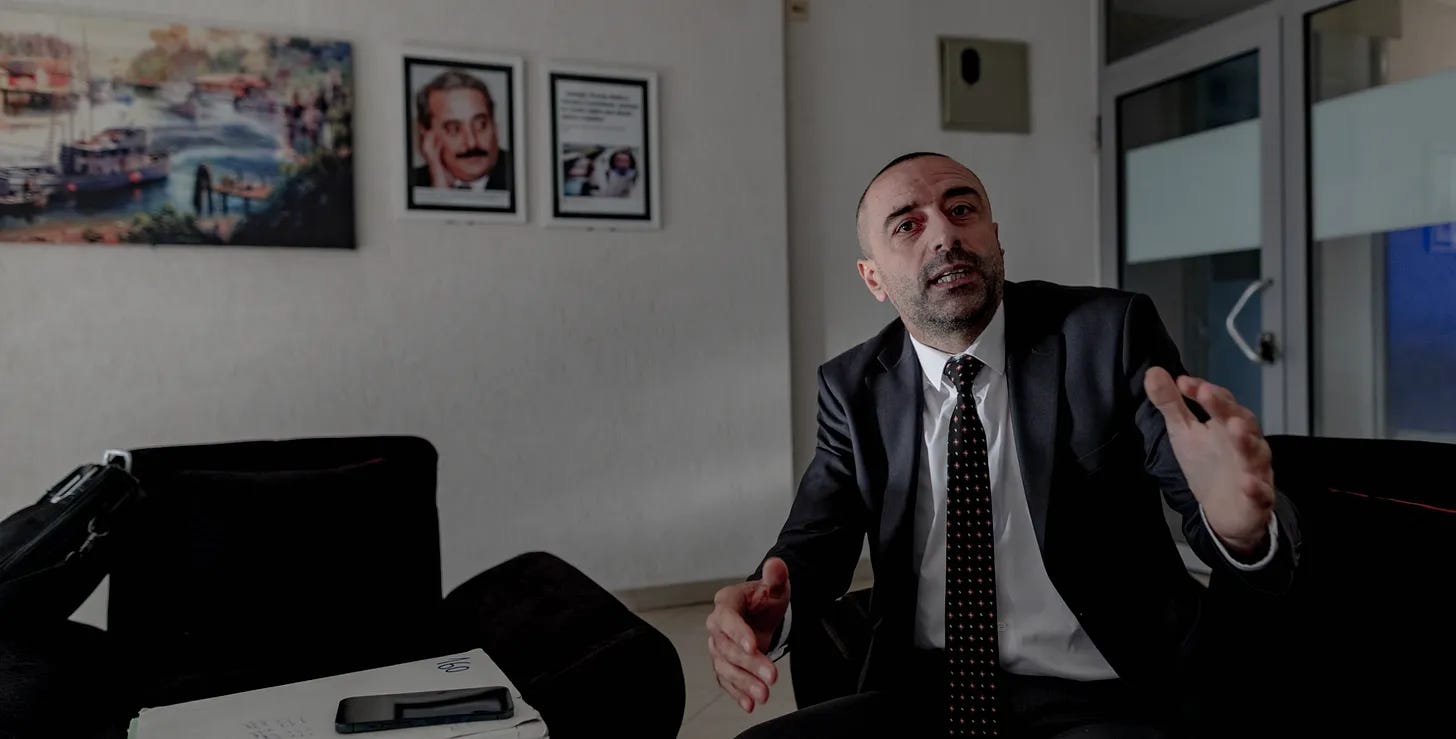
We do not repeat the most graphic details of his account. But we can summarise the structure of what he claims happened to him in April 2020, because the structure is the heart of this piece. He says he publicly spoke about alleged theft of wartime funds linked to Lushtaku, and that soon afterwards he noticed surveillance and changes in police patrolling patterns near his home. He claims that on 14 April 2020 he was attacked by armed men, escaped, and that a key struggle afterwards involved not only identifying the attackers but preventing an institutional narrative from being constructed that blamed him. In his words, the goal was to present the incident as self inflicted, to make him a criminal rather than a victim, and to destroy his credibility.
This is the modern version of a very old tactic. If you cannot silence a person quietly, you can discredit them publicly. If you can discredit them publicly, you can isolate them socially. If you can isolate them socially, you can make violence against them easier, or make their disappearance less costly. Halilaj claims that video evidence existed and that there were attempts to erase or manipulate it. He says that only the intervention of external actors, including embassies, forced arrests that did not match what he believes is the truth of who attacked him. He further claims that legal outcomes were wildly disproportionate, including a fine for intimidation where, in his view, the conduct amounted to attempted murder. We cannot adjudicate these claims. What we can do is note how precisely they fit the method described by the two sources about Thaçi. A cycle of delegating violence, then using institutions, media and paperwork to rewrite authorship and blame.
Halilaj’s account also contains another element that aligns with the earlier claims. Debt creation. He describes a system where people are pulled into wrongdoing through incentives and then controlled through kompromat17. The person who does the dirty work becomes dependent. The dependency can then be exploited for further acts, until the dependent becomes a risk, at which point they too can be discarded. This logic mirrors the comment we received during our northern Kosovo reporting in late 2025, from an interlocutor who put it this way.
According to a source described as part of Hashim Thaçi’s inner circle, the former Kosovo leader allegedly employed a method of indirect coercion in which perceived opponents were framed as threats to third parties, who were then encouraged to “neutralise” them in exchange for protection.
“If Thaçi wanted you dead, he would find someone else and convince them that you were a danger to them,” the source claims. “He would then promise protection if they removed you. Once that happens, the person becomes indebted and can be pressured into further removals, until they themselves become a liability and are replaced. It’s a conveyor belt of coercion.”
The same source claims that Sami Lushtaku has not maintained good relations with Hashim Thaçi for more than a year, allegedly due to fears that Thaçi currently detained in The Hague, may speak openly about past events and implicate former associates.
According to the source, Lushtaku allegedly fears that Thaçi could reveal details of his involvement if cooperation with prosecutors were to occur. The source further claims that Lushtaku remains among the most dangerous political figures in Kosovo due to his alleged access to armed networks and continued political protection linked to Democratic Party of Kosovo (PDK).
The source alleges that Lushtaku was previously used in operations employing the same methodology described above and claims he is prepared to use lethal force against anyone perceived as a threat, though these allegations have not been independently verified.
The source has agreed to provide documentation intended to substantiate the reasons and circumstances under which he claims to have had access to this information. He states that he is not from northern Kosovo, but deliberately chose the region as a temporary safe zone from which to speak. We have verified that the source is an ethnic Albanian and a citizen of Kosovo, but are withholding further identifying details due to credible concerns for his safety.
In that scheme, Lushtaku’s alleged role becomes clearer. He is not merely a violent man, in the popular caricature. He is an organiser of coercive capacity. His public record includes a major wartime conviction in a case heard under EULEX judicial authority18. And his international status includes listing by the United States Treasury on the Balkans sanctions programme19, with his identifying details on the OFAC sanctions search database. Sanctions are not convictions. But they are formal determinations by a foreign government that an individual is implicated in conduct that threatens stability or governance. In Kosovo’s post war context, a sanctioned political actor can still retain local influence, which tells you something about the resilience of informal power.
So how, exactly, does the alleged methodology work, when put in chronological order.
First, identify targets based on power not ideology. In the early post war period, sources say the targets were often LDK figures and internal rivals within the former KLA sphere, people whose presence complicated the consolidation of a single post war centre of authority. Haki Imeri fits this pattern in their telling. So do other names that circulate in Kosovo’s memory of that era.
Second, approach under the cover of legitimacy. The invitation to talk. The meeting framed as a political or security necessity. The use of wartime labels such as military police. The goal is to ensure the target moves voluntarily into vulnerability.
Third, execute through intermediaries. The sources do not depict Thaçi as a gunman. They depict him as a director who keeps plausible deniability by using trusted operators and by distributing knowledge so that no one person can fully reconstruct the chain.
Fourth, stage blame. This is where placement becomes crucial. If a murder can be made to point toward a rival, the murder becomes a dual weapon. It removes the victim and wounds the rival. The claim that Imeri’s body was moved to implicate Selimi is a quintessential example. The claim that international missions were fed intelligence pointing at Selimi in other cases is the institutional version of the same act.
Fifth, reinforce the blame through repetition and artefacts. Komunikata 59, in this reading, is a durable artefact used to fix an enemy identity onto a person, so that future violence appears to arise organically from public hatred rather than from orchestration. This is why the communique matters even decades later. It is not only about who wrote it. It is about what it allowed.
Sixth, neutralise investigators and witnesses not only by threatening them but by corrupting the processes around them. Halilaj’s account centres on this. He describes pressure on police, manipulation of evidence, and a media ecosystem used to shame and isolate. In his words, the most powerful weapon is not the gun. It is humiliation backed by the state’s voice.
Seventh, when scrutiny increases, shift tactics. The creation of the Kosovo Specialist Chambers in The Hague changed the atmosphere. People began calculating risk differently. In the earlier account we received, Thaçi is described as visiting a victim’s family after many years, offering partial information and redirecting blame, a form of pre emptive damage control. In other words, when a court appears capable of imposing consequences, the system adapts. It does not dissolve.
This is the point where our April 2025 national security line of inquiry connects back to the post war killings methodology. If a network exists, as our reporting has investigated and revealed involvement of figures such as Richard Grenell, Edi Rama, Halit Sahitaj, Milaim Zeka, Berat Buzhala, Artan Behrami and others that aims to undermine the court process in The Hague, it would not be a new idea. It would be an extension of an older practice, the use of information operations to shape justice outcomes. The actors change uniforms. The logic remains familiar.
None of this establishes criminal guilt. It establishes a model alleged by multiple sources, and it shows how that model coheres with certain verified realities. Kosovo has unresolved political murders. Kosovo has a documented history of wartime crimes adjudicated with international participation. Kosovo has a political ecosystem where a sanctioned individual can still operate as a public actor. Kosovo has a long record of public disputes over authorship of wartime communiques and responsibility for post war violence.
The most important part, though, is not any single fact. It is the consistency of the described mechanisms across time and across sources.
In the nineteen nineties, Halilaj says, the method was straightforward. Speak against the powerful and you are labelled a traitor. If the label sticks, you are socially dead. If you persist, you may become physically dead. In the two thousands, according to sources, the method becomes more complex. Killings still happen, but so do narrative operations. Bodies are placed. rivalries are scripted. International missions are fed leads that redirect suspicion. In the twenty tens and twenty twenties, the system, if the accounts are accurate, becomes even more integrated. Media partners, corrupted officials and institutional capture are used to achieve outcomes that once required a gunman in the dark.
Halilaj himself offers a line that captures this evolution. He says that after denigration comes physical elimination, and after physical elimination comes reputational killing, the destruction of the name. That is the logic of a system that expects to survive. If the victim dies and the story dies with them, fine. If the victim survives, the story must still be broken.
There is a temptation, when confronted with accounts like these, to reach for a grand analogy. People in the Balkans do this often. They invoke Stalin. They invoke the Kremlin. They invoke hybrid warfare. Sometimes they do it because it is true. Sometimes they do it because it is emotionally satisfying, a way of turning local pain into a global narrative. The safer approach is narrower. Focus on method, not metaphor.
The method described here is a politics of delegated violence and delegated blame. It depends on intermediaries. It depends on the creation of debts. It depends on the laundering of accusations through institutions that appear neutral. It depends on media that can amplify smear and suppress context. And it depends on the international community’s chronic weakness in post conflict environments, the preference for stability over confrontation until it is too late.
You can see this preference in the historical posture toward powerful local actors. International missions often delay action when they fear unrest. They gather evidence slowly. They hope the men with guns will become men with suits. Sometimes they do. Sometimes they become men with suits who still command guns.
In the story of Mustafa’s murder, this tension is visible in the simplest fact of all. Two and a half decades on, the family still waits for a charge. When justice does not arrive, power learns that it can take time. When power can take time, it can also take witnesses.
If the accounts from our sources are accurate, then the central feature of Thaçi’s alleged methodology is not a particular killing. It is the conversion of violence into political architecture. Each death, each smear, each misdirected investigation becomes a brick. The structure built from those bricks is a system in which rivals are removed, loyalists are bound, and the public is taught to confuse fear with patriotism.
There is a final detail that returns us to the present. Halilaj says he supported the Kosovo Specialist Chambers openly and called it a national asset. He describes threats for doing so. Whatever one thinks of the court, his position highlights something Kosovo has struggled to articulate. A society that cannot investigate its own liberation movement is not protecting its liberation. It is protecting the people who exploited it.
The question our reporting keeps returning to is not whether every allegation is true. The question is what it means that so many independent accounts, from different angles, describe the same machinery. The names change in each telling. The gears do not.
In that sense, the most hard hitting detail is also the most banal. A murder. A file. A rumour. A communique. A televised accusation. A police report that goes nowhere. A court process delayed. A witness intimidated. None of these alone prove a system. Together, they describe the environment in which a system can exist and in which, according to our sources, it did.
We will continue to verify what can be verified. We will continue to separate what is documented from what is alleged. But we will not pretend that allegation is meaningless in a country where silence has so often been the condition of survival.
Inside the Plot to Dismantle Kosovo’s War Crimes Tribunal

The Bribe That Unveiled a Conspiracy: In January, a deceptive outreach from a Facebook user named 'Laky Laky' quickly escalated beyond simple flattery about my investigative work. What began as praise for my reports on geopolitical manoeuvring soon revealed a sinister attempt to manipulate my reporting with fabricated intelligence.
The Conspiracy Against Kosovo’s Justice System Unraveled
In response to manipulated attacks, we’re granting free access to our latest investigative report, ensuring every reader sees the unfiltered truth. — The GPC I Unit.
Rexhep Selimi (born 15 March 1971 in Skenderaj Kosovo) is a Kosovar politician and former commander of the Kosovo Liberation Army and a founding member of the organisation. A senior figure during the 1998-1999 war he served on the KLA General Staff and later entered postwar politics becoming a leading member of the Vetëvendosje Movement and head of its parliamentary group in 2020. Since November 2020 he has been detained in The Hague where he stands trial before the Kosovo Specialist Chambers on charges of war crimes and crimes against humanity which he has denied.
Xhemajl Mustafa (1954–23 November 2000) was a Kosovar Albanian journalist writer and senior political adviser closely associated with President Ibrahim Rugova and the Lidhja Demokratike e Kosovës. A key voice of Kosovo’s peaceful resistance during the 1990s he worked at Rilindja and the Kosovo Information Center before serving as Rugova’s adviser and spokesperson from 1997 to 2000. He was assassinated outside his home in Pristina in November 2000 in a killing that remains unresolved and is remembered as a symbol of nonviolent political commitment integrity and democratic advocacy.
Fetah Rudi (born 10 August 1964 in Rud Malishevë) is a Kosovar politician and long standing member of the Lidhja Demokratike e Kosovës closely associated with Ibrahim Rugova’s nonviolent state building tradition. A former teacher and political activist he survived an assassination attempt in December 2000 that left him permanently paralysed after which he became a symbol of political perseverance in postwar Kosovo. He served as a deputy in the Assembly of Kosovo from 2019 to 2021 and has remained a prominent advocate for the rule of law accountability for political violence and Kosovo’s pro Western orientation.
Ekrem Rexha (14 August 1961–8 May 2000), widely known as “Komandant Drini”, was a Kosovo Liberation Army officer and one of the most prominent commanders of the war for Kosovo’s liberation. A former Yugoslav army officer with formal military and political education he became commander of the Pashtrik Operational Zone in 1998 and later led the KLA Military School and Doctrine structures, earning a reputation for discipline and professionalisation. He was assassinated outside his home in Prizren in May 2000 in an unresolved killing and is commemorated as a key military and intellectual figure of the KLA through public memorials and institutions bearing his name.
SHIK known as Shërbimi Informativ i Kosovës was an informal intelligence structure that operated in the late 1990s and early 2000s closely linked to the leadership of the Democratic Party of Kosovo. Emerging from wartime and postwar security networks it was never established by law nor subject to parliamentary oversight and was officially dissolved in 2008. SHIK has been repeatedly accused by political opponents journalists and international reports of involvement in political intimidation surveillance and targeted violence against rivals particularly figures associated with the Democratic League of Kosovo though its former leaders have consistently denied operating as a criminal organisation and no comprehensive judicial reckoning has taken place.
Besian Mustafa: Our family’s last hope lies with the Special Court — Prishtina Insight.
Fatmir Limaj (born 4 February 1971 in Banjë Malishevë) is a Kosovo Albanian politician and former Kosovo Liberation Army commander known during the war by the nom de guerre Çeliku. Trained in law he emerged as a senior KLA figure in the Malishevë Gllogoc area during the 1998-1999 conflict and later became a central actor in postwar politics serving as minister of transport deputy prime minister and founder of Nisma Socialdemokrate. Limaj was indicted by the ICTY over alleged wartime abuses but was acquitted in 2005 with the verdict upheld on appeal in 2007 and was later cleared in further domestic cases. A resilient and polarising figure he continues to shape Kosovo’s political landscape admired by supporters as a disciplined wartime commander and pragmatic leader while facing sustained criticism over governance and patronage.
Fatmir Limaj departed from the Partia Demokratike e Kosovës in 2014 amid growing internal rifts over leadership centralisation governance style and the handling of corruption allegations that he and other senior figures argued were being politicised. Once a close ally of Hashim Thaçi Limaj increasingly positioned himself as a reformist voice critical of what he described as entrenched patronage networks within the party. Together with Jakup Krasniqi he went on to establish Nisma Socialdemokrate framing it as a centrist social democratic alternative focused on institutional accountability rule of law and coalition pragmatism while distancing itself from both PDK dominance and the rhetoric of newer opposition movements.
This article is in Albanian and is part of a series where AlbanianPost published official UNMIK documents suggesting details about the murder of Xhemail Mustafa and others. It states that the UNMIK report mentions people observed monitoring Mustafa before his killing. — Albanian Post.
New findings of the UNS on the murder of journalist Xhemail Mustafa: EULEX knows who is responsible? — JAS.
Gani Geci is a Kosovo Albanian political figure former member of the Kosovo Liberation Army and former deputy of the Assembly of Kosovo originating from the prominent Geci family of Llaushë in Drenica. Active during the 1998-1999 war and politically aligned with Ibrahim Rugova’s camp he later served in parliament with the Democratic League of Dardania and became known for outspoken criticism of former KLA leaders. His postwar role has been marked by persistent controversy and legal disputes and in 2021 he was sentenced to three and a half years in prison for the 2014 killing of Ruzhdi Shaqiri remaining a polarising presence in Kosovo’s public and political life.
Partia Demokratike e Kosovës (PDK) is one of Kosovo’s main political parties founded in 1999 by former leaders of the Kosovo Liberation Army under the leadership of Hashim Thaçi. Emerging from the KLA’s political structures it became a dominant force in postwar Kosovo advocating a centre right agenda focused on state building economic liberalisation and Euro Atlantic integration. PDK led or participated in several governments after independence in 2008 and played a central role in shaping Kosovo’s institutions though its record in power has also been marked by persistent allegations of corruption and patronage while remaining a key actor in the country’s political landscape.
Kompromat is a term of Russian origin used to describe compromising material gathered on individuals with the purpose of exerting pressure influence or control over them. It can include real or fabricated information such as personal scandals financial irregularities or alleged criminal conduct and is typically used in political intelligence or security contexts. Rather than being made public immediately kompromat is often held in reserve as leverage shaping behaviour silencing opponents or enforcing loyalty and has become associated with authoritarian power structures post Soviet politics and contemporary hybrid influence operations.
The Supreme Court of Kosovo, in a Panel composed of EULEX Judge Krassimir Mazgalov (Presiding and Reporting), EULEX Judge Arnout Louter and Supreme Court Judge Emine Mustafa as Panel members, and EULEX Legal Officer Sandra Gudaityte as the Recording Officer, in the criminal case against, among others, defendants JD, SL, SS — EULEX Court.
You can view this directly via the U.S. Department of the Treasury Sanctions List Search tool here — Sanctions List Search - OFAC (LUSHTAKU, Sami)