

The Response That Confirmed the Reporting
By triggering punishment instead of debate, the War Veterans Organisation validated our reporting, behaving not as critics but as participants in the Hashim Thaçi's assassination manual we documented.

After the War Veterans Organisation posted its statement1, the thread2 beneath it did what such threads in Kosovo have learned to do. It did not debate documents. It did not ask for clarifications. It did not challenge a single methodological point. It moved, quickly and predictably, towards social punishment.
The first wave came in short bursts. Selaci Selaci dismissed me as “Serb leftovers”. Driton Perçuku wrote, in effect, that I was nothing else but “tainted blood”. Xhavit Kosova reduced the matter to a single accusation, calling me a “spy” and asking why I was not being sued. Muhamet Rexhepi asked whether this state had no right or duty to react. Florim Kasami called me a “Serb’s child”, the phrasing designed to deny belonging, not to contest evidence.
Within that same early cluster, a second theme appeared, repeated so often it became a rhythm. Calls for prosecution. Veli R. Kryeziu wrote that this should be an alarm for the Prosecutor of the Republic of Kosovo and framed my work as “Serb incitement” against national values and the KLA. Musa Thaçi echoed it, calling for the organs of justice to act. Baki Zejnullahu called for me to be pursued in court, arguing that insult itself is a criminal offence. Later, Zenel Bahtri pressed the veterans directly, asking why they did not take the case to the prosecutor if they claimed such harm. That chorus mattered because it did not ask the prosecutor to investigate the allegations raised in our reporting3. It asked the prosecutor to investigate the reporter.
As the thread grew, the language shifted from denunciation to dehumanisation. Nazmi Bytyqi used a sexualised insult directed at my family. Sheap Beadini posted a crude insinuation about what I “eat”, the kind of phrasing used to frame a person as dirty and subhuman rather than wrong. Another commenter, Besim Hasanaj, wrote in the same register, combining slur and mockery. Kujtim Hoti attempted a softer move, arguing that I was speaking “for individuals, not for the KLA”, and asking why I was being generalised. But the tide was already running in the opposite direction. The dominant voices were not looking for distinctions. They were looking for license.
A third theme followed the prosecutorial demand, and it was more dangerous because it treated punishment as not only legitimate but urgent. Several commenters used the language of immediate detention. Driton Bytyqi wrote that I “must go to prison immediately”. Rrahim Kelmendi argued that I should be taken by the prosecutor for “propaganda”. Azem Llashtica demanded that the state issue an “international arrest” so I could be tried for “treason”. Others did not bother with legal language at all, preferring straight coercion. Muhamet Voca told me, bluntly, to “shut up”. Aziz Kastrati framed the thread as a collective lesson, writing that I was “getting what I asked for”. In one of the clearest intimidation cues, Ylber Kupina wrote that I should be dealt with in a way that invoked mass grief as justification, turning the pain of the war into permission for present hostility.
The more the thread ran, the more it became clear that the Veterans Organisation’s statement had functioned as a trigger. It framed our reporting as a stain on the liberation struggle. Many commenters took that framing as a signal that harassment was patriotic. In Kosovo, the charge of “staining the war” is not a normal insult. It is a political mechanism. It converts inquiry into sacrilege, and sacrilege into a pretext.
Some participants, identifiable and public facing, presented themselves as civic voices while still pushing the same punitive logic. Sadri Lata wrote a long comment that read like a political pamphlet, calling for the state and security institutions to act quickly and warning about “populism and Bolshevism”. The content was not evidentiary. It was mobilising. It constructed an emergency, then proposed coercive state action against speech. That is exactly the functional pathway we described on 4 February, when we argued that narrative engineering can be used to make retaliation look like necessity.
Other commenters invoked named figures to pull the thread into an existing loyalty map. Myhedin Ferizi wrote that someone from the PDK, naming Artan Behrami, or people close to Hashim Thaçi, should react to my reporting and “stop” me. Munish Haxhiu went further, alleging, without evidence, that another journalist, Lirim Mehmeti, had “clarified” that I was paid from Belgrade, and even attached a specific sum. This was not argument. It was attribution, the conversion of a contested claim into a rumour dressed as fact. Zaim Sadiku echoed the same insinuation logic, alleging I lived in Belgrade and was paid by the government, again without documentation. This pattern, the circulation of payment claims as if they were settled truth, is a recognised intimidation instrument. It marks a target as corrupt and foreign, then invites consequences.
The thread also showed classic markers of suspected inauthentic activity. Multiple accounts, with little visible personal context in the screenshots, repeated the same core claims in compressed form: “Serb agent”, “paid”, “traitor”, “should be arrested”, “should be banned”, “should be investigated”. The syntax varied slightly, but the structure did not. Several accounts used the same trigger words, sometimes in the same order, sometimes with the same misspellings. That does not prove coordination on its own. What it does show, in plain view, is convergence around a script.
In parallel, a set of comments performed a second tactic described in our 4 February investigation, the merging of individual scrutiny into collective insult. One commenter, Nexhmedin Morina, wrote that I was “not Albanian, only Albanian-speaking”, a direct attempt to deny national belonging. Luljeta Zahiti framed my work as “propaganda” and urged “carefulness”, claiming the state was at risk and asking who would defend it if parties did not. The message was not “show us the errors”. It was “this is dangerous”. This is the boundary enforcement logic, the insistence that some questions are illegitimate because they disturb unity.
The most explicit evidence of an enabling environment appeared when users posted images and memes designed to humiliate, and in some cases, to hint at violence. One post used a toilet-paper image with a caption about cleaning one’s mouth after speaking, a visual cue of contempt. Another image invoked a historical authoritarian figure, paired with text implying that “traitors” should be killed. I will not reproduce those phrases in full. Their function was clear without amplification. They were not jokes. They were permission structures.
Several comments crossed into explicit threat territory, including calls for my arrest by police and prosecutor, and at least one comment that suggested physical handling by authorities in degrading terms. Others urged prosecution and imprisonment as if it were an emergency measure. The point, again, was not whether my reporting was wrong. It was that I should suffer for publishing it.
The Organisation did not interrupt any of this. It did not post a single comment urging restraint. It did not clarify that threats and hate are unacceptable. It did not moderate. It did not challenge. It did not say, even once, that disagreement should be expressed through evidence. In practical terms, the statement operated as incitement, or at minimum it created an enabling environment for hostility. When an organisation with symbolic authority frames an investigation as a danger to the nation, then leaves a comment thread to fill with threats and hate, it is not neutral. It is permissive.
This matters more because the threats did not arrive into a blank context. My family home in Kosovo was vandalised last year4. Windows were smashed. A memorial car, tied to my late father, was desecrated. Nothing was stolen. The purpose was intimidation. The British National Union of Journalists (NUJ) condemned that attack and urged accountability5. Kosovo’s public has already been shown that intimidation can escape consequence. Against that background, comments that casually suggest my arrest, my imprisonment, and my physical targeting cannot be treated as “online noise”. They are part of a continuum, one that has already crossed from screen to property.
This is where the chronology becomes evidentiary.
On 4 February, I and my colleague Michael Sheppard published an investigation that argued power in post-war Kosovo hardened through a repeatable sequence: delegitimise, isolate, make harm thinkable, then use institutions and narrative to launder the outcome. The days that followed did not disprove that model. They supplied fresh, live examples of its early stages.
First came identity reassignment. I was labelled foreign, Serbian, traitor, agent. The purpose of that move is not to correct an error. It is to remove a person from the moral community, so that protections no longer apply.
Second came degradation, the smear and the insult designed to make someone publicly unworthy.
Third came consequence talk: arrest, prosecution, imprisonment, banning, removal, and hints of violence.
This is not speculative. It is exactly what the commenters wrote, repeatedly, across the thread.
The pattern is important because it is not uniquely Kosovar. Scholars of political harassment have mapped similar sequences in other post-conflict and polarised societies.
Zeynep Tufekci has warned that networked publics can be turned into “crowds” that enforce conformity not through persuasion but through intimidation.
Kathleen Hall Jamieson and other researchers of disinformation have shown how repetition and moral framing can make unverified claims feel “settled” through sheer volume.
Jason Stanley has written about propaganda’s reliance on collapsing complexity into loyalty tests, a move that turns criticism into treason.
The common mechanism is simple: when you cannot win on evidence, you move the contest to belonging, and you punish speech.
Kosovo’s version has its own fuel. The war retains enormous moral gravity. Veterans organisations carry symbolic capital. When that capital is deployed to frame investigative scrutiny as an insult to sacrifice, it can create instant moral panic. The panic then becomes a tool. It recruits ordinary people into hostility, and it gives cover to those who weaponise identity for political ends.
The question of coordination sits inside that broader structure. I cannot claim, as a fact, that every account in that thread was centrally directed. I do not have internal messages. I do not have authenticated instructions. But I can argue, with conviction and evidence from the thread’s language, that what unfolded appears coordinated rather than organic, or at minimum that it followed a rehearsed and mutually understood script. The repetition of the same accusations, the quick pivot to prosecutorial demands, the identical framing of journalism as treason, and the use of memes as humiliation cues are all consistent with what we described on 4th of February as “narrative engineering”.
That is why this response is not merely a reaction. It is corroboration in form.
The incentives are not mysterious. If prosecutorial attention expands into unresolved political assassinations, into the long dead cases whose files still haunt families and institutions, then those associated with post-war consolidation have reason to suppress scrutiny. Not because every accusation is true, but because the reopening of questions breaks the protective taboo. Once the taboo breaks, witnesses speak more easily, investigators face fewer social penalties, and the line between narrative and liability becomes thinner. In that context, the fastest defensive move is not to rebut documents. It is to make the act of documenting socially and professionally dangerous.
That is what this thread attempted to do. It treated reporting as an offence. It treated inquiry as betrayal. It treated intimidation as virtue. And it did so under a post whose authority was amplified by an organisation that declined to moderate a single hateful or threatening comment.
The significance is not that people were angry. In a democracy, anger is ordinary. The significance is how the anger was channelled, and what it demanded. It demanded consequences against the reporter, not answers to the reporting. It demanded enforcement, not clarification. It demanded silence.
If the central claim of our February investigation was that coercive power in Kosovo has often relied on a blend of intimidation and narrative control, then what happened after the Veterans Organisation’s statement is best understood as a contemporary demonstration of that blend. The mechanism did not need a gun. It used a thread. It used labels. It used calls for prosecutors. It used humiliation memes. It used the oldest trick in this country’s post-war political life, the transformation of scrutiny into treason.
And because my family home has already been attacked, because intimidation has already crossed into the physical world, I cannot treat the suggestions of harm as mere rhetoric. In Kosovo, history has taught us that words are often the first phase, not the last.
That is the point of this continuation. The investigation described a method. The reaction performed it.
We will continue to observe, document, and report every stage of this campaign. We cannot claim, and do not predict, whether those involved intend physical harm. What can be stated, plainly, is that the behaviour on display is dangerous, unbalanced, and revealing. The manual they appear to rely on has been exposed, stripped of mystery, and rendered visible. That exposure unsettles those who depended on it. Any regrouping by its architects would not signal strength, but escalation, with consequences not just for one journalist, but for Kosovo’s society and humanity itself. Our next reporting will document the media phase of this campaign, tracing how public figures linked to this method reacted once scrutiny replaced silence.
Thaçi’s Assassination Manual

In April 2025 our newsroom began pulling at a thread that kept resurfacing in different forms and different places. It was a claim that a Russian Serbian Kosovan entangled network had been tasked, by Hashim Thaçi and associates, with undermining the Kosovo court process in The Hague. That work started as a national security story and it stayed one. But as we mapped names, timelines and incentives, we kept returning to an older question that Kosovo never fully answered after the war. How did power consolidate so quickly, and what did it cost.
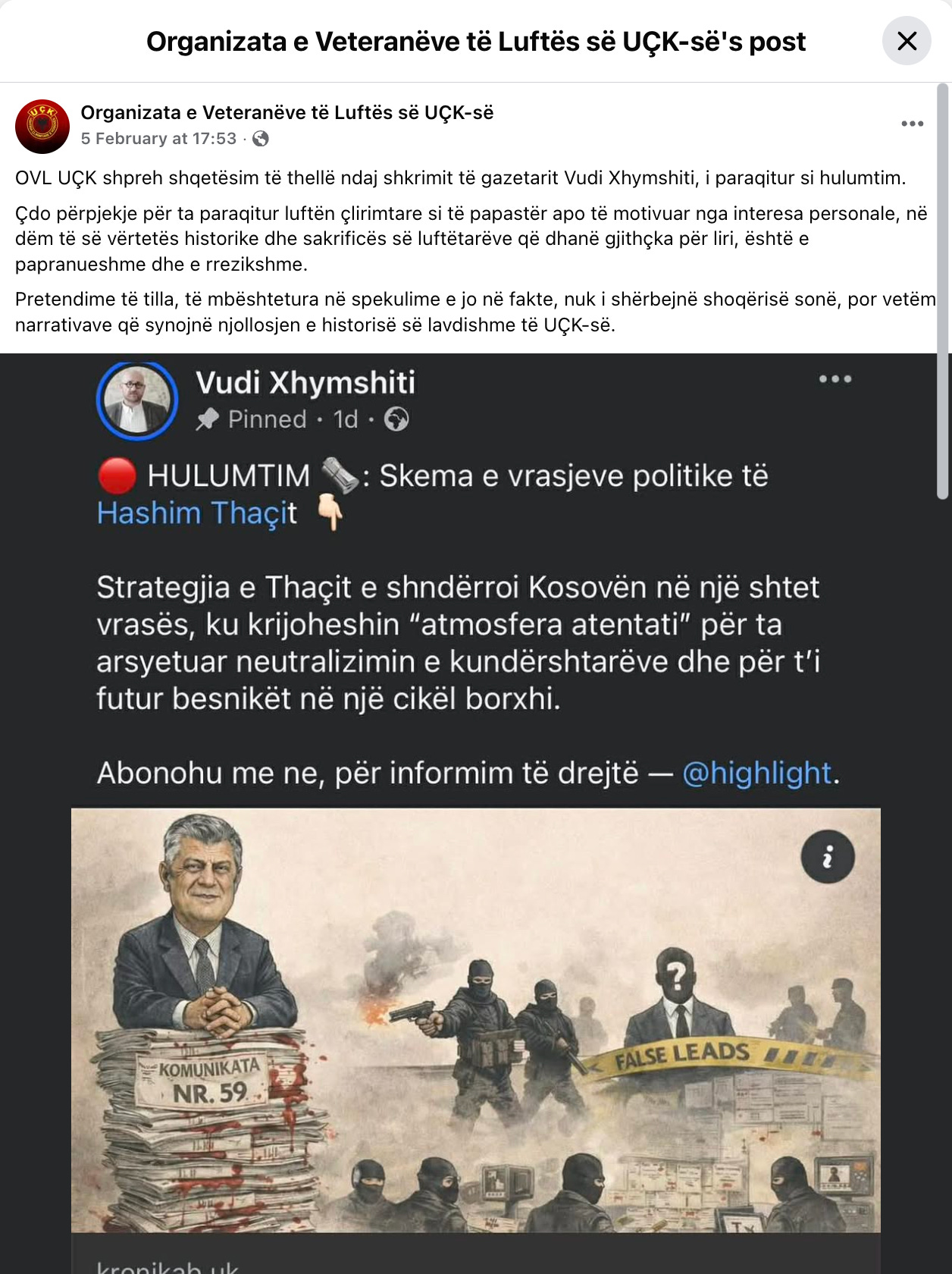


Thaçi’s Assassination Manual
Thaçi’s strategy transformed Kosovo into a coercive state, where “assassination atmospheres” were manufactured to justify neutralising opponents and trapping loyalists in a cycle of debt. — The GPC I Unit.
STATEMENT: Kosovo Attack Tied to Investigations Exposing Espionage and Disinformation
The Gunpowder Chronicles confirms the Kosovo attack on Chief Editor Vudi Xhymshiti’s family home is a direct retaliation for investigations exposing espionage, corruption, and disinformation networks. — The GPC Official Dispatch.
NUJ condemns vandalism at Kosovo home of London-based journalist
Britain’s journalists’ union condemned vandalism at Vudi Xhymshiti’s family home in Kosovo, urging a inquiry into intimidation allegedly linked to his reporting on espionage networks. — The GPC Media Watch.