The Violent Reflexes of Hashim Thaçi's Dying Political Order
By unmasking the "assassination manual," we triggered a dormant predator. The PDK’s subsequent campaign of dehumanisation is the sound of Hashim Thaçi's coercive system attempting to survive.

On 22 November 2025, months before I published our February investigation1, the pattern was already visible in plain language. Hisen Berisha, a former PDK MP closely identified with the Thaçi era, wrote that it was time to strike, directly, strongly, and institutionally, against what he called propagandistic structures recycling Serbian narratives2. He did not name me in that first post, but he named the category. Analysts and journalists, framed as internal enemies, framed as a gateway for Serbia into Kosovo’s discourse, framed as fair targets for an institutional response. That is not an argument about facts. It is a blueprint for permission, the kind that turns scrutiny into betrayal and makes punishment sound like duty.
That framing matters because it predates the reporting it would later be used to answer. It establishes the lens in advance, so that when evidence appears, the public is encouraged to process it not as documentation to be tested, but as an attack to be repelled.
On 4 February 2026, we published our investigative findings on what we described as an “assassination manual”, a methodology of power rather than a penal verdict. The core proposition was narrow and testable in its structure. When violence becomes politically costly, coercive systems adapt by delegating force, delegating blame, and manufacturing what I called “assassination atmospheres”, climates of fear and contamination in which dissenters are made to look unsafe to engage, unsafe to defend, and eventually unsafe to exist. We published it because three years of consistent investigation into Kosovo’s warlord era structures kept producing the same mechanics, different names, same gears.
Within twenty four hours, the response began to follow the sequence I had described.
On 5 February 2026, one day after the publication, Granit Geci, a PDK assembly member in Prishtina, did not contest the documentation. He did not cite a line and dismantle it. He did not offer alternative sourcing. Instead he reached for family insult and ethnic contamination, language designed to drag the debate away from evidence and into identity, honour, blood. In Kosovo this is not a casual register. It is a signalling register. It tells an audience, do not read, do not weigh, do not check, reject the person. In the logic of the manual, that is step one and step two collapsing into a single act, moral delegitimisation followed by identity displacement.
I wrote3 about that reaction at the time because it functioned as a case study. Not because it wounded my feelings, but because it demonstrated method. When a public representative chooses inherited insult over factual rebuttal, the absence of counter evidence becomes the message. The work is not being answered, it is being made socially untouchable.
Five days later, on 10 February 2026, the smear evolved from insult into artefact. Vehbi Kajtazi published4 what was presented as a list5, a bureaucratic looking object offered as institutional truth without provenance, without chain of custody, without verifiable issuing authority. The list functioned exactly as such objects do in pressure campaigns. It was faster than proof. It asked the audience to see the name first, feel the contamination first, and only then ask what the document was, where it came from, and whether it could be verified. That inversion is the trick. It makes verification feel like an excuse. It makes doubt feel disloyal.
I responded6 to that phase with the only responsible approach, forensic discipline rather than outrage. Treat the artefact as an artefact. Ask for provenance. Identify missing markers. Point out internal inconsistencies. Protect private individuals who were dragged into it. Provide an alternative, verifiable context where possible. That is what journalism is supposed to do. But the point of the list was not to win a debate. The point was to flood the space so that “maybe” becomes ambient, and once “maybe” is ambient, the target is forced to live inside suspicion.
Around the same period, the earlier November logic returned in sharper form. Berisha later amplified7 the accusation directly with crude and defamatory language, framing me as an agent and directing people toward a post that claimed, falsely, that William Walker had branded my February reporting as Serbian propaganda. The crude wording is easy to fixate on, but the more important part is the mechanism. A political figure did not attempt to disprove the investigation. He attempted to criminalise the investigator, and he attempted to outsource credibility to a revered external name.
That outsourcing became visible again through a party operator’s social media. Izmi Zeka, identified as a PDK figure in Gjilan, circulated a graphic that asserted Walker’s condemnation of my work8, presenting it as a definitive verdict rather than a contested claim to be verified. This is the laundering step. If an accusation can be dressed in the clothing of an authoritative voice, it becomes easier for audiences to repeat without checking, and easier for institutions to treat the target as radioactive.
By the third week of February, the operation had a broadcast arm.
This escalation did not occur in isolation. It forms part of the documented sequence analysed in my 9 February 2026 article9, How an Investigation Triggered a Campaign, Not a Debate, which traced the progression from delegitimisation to contamination, consequence talk, and media laundering. VOX Kosova’s 22 February segment marked the opening of a new phase: not merely portraying scrutiny as betrayal, but attempting to construct a punitive linkage between my reporting and the Kosovo Specialist Chambers themselves, implying institutional impropriety through ordinary professional communication. The broadcast10 and accompanying article deliberately distorted my name typographically, splitting it into “Xhym-shit”, an act of calculated degradation designed to signal ridicule rather than rebuttal. It further recycled the claim that the United States Department of State had “declared” me a fabricator in relation to reporting on Gabriel Escobar, omitting that Escobar’s tenure as US envoy to the Prishtina–Belgrade dialogue ended on 6 May 2024, shortly after our 24 April 2024 investigative publication11 scrutinising his diplomatic conduct and its intersections with Serbian state interests. The purpose was not evidentiary clarification. It was to recast engagement with my work as institutional contamination and to imply that proximity itself warranted sanction.
On the same day, 22 February 2026, Gani Koci posted12 the most explicit escalation yet. The screenshot captures his words. He wrote that “this species has crossed the red line”. He then called on state security organs to take measures before it becomes too late, and concluded that someone must stop me. This is not criticism. It is containment language. It is also strategic language, because it gestures toward intervention without naming a specific act, preserving deniability while manufacturing urgency.
The phrase “red line” is not descriptive, it is jurisdictional. It asserts authority over what can be said and who may say it. The phrase “before it becomes too late” manufactures imminence. It implies an emergency so severe that extraordinary steps become justified. And “someone must stop him” invites participation. It is a call for enforcement, whether institutional or social. In a country with a history of political intimidation and unresolved political violence, that combination is not normal political speech. It is a risk signal.
What followed that post was not rebuttal. It was enforcement.
The comment thread that formed beneath Koci’s words did not centre on factual dispute. It centred on removal. Arrest, extradition, imprisonment, intervention by security organs, and, in a smaller but consequential subset, elimination language. The dominant narrative frame was contamination: Serbianisation, espionage, foreign allegiance. The dominant rhetorical technique was dehumanisation.
This is the operational stage of a pressure campaign. Once a public figure invokes urgency and state security, the crowd supplies consequence language. The logic migrates from “he is wrong” to “he must be stopped”. The behavioural boundary shifts.
The quantitative distribution of that thread, including the proportion of comments demanding state sanction, invoking violence, deploying Serbianisation narratives, and using dehumanising terminology, is documented in Footnote13, together with a gallery of the archived screenshots for evidentiary transparency.
The significance is not the insult density. It is the ratio of enforcement language to argument. When sanction talk approaches deliberation in volume, the environment ceases to be spontaneous disagreement. It becomes patterned coercion.
This is why Koci’s post is pivotal in the chronology. It arrives eighteen days after the investigative publication on 4 February. It arrives after identity smears by party figures. It arrives after a fabricated artefact was deployed to seed suspicion. It arrives after a broadcaster attempted to launder insinuation into institutional stigma. And it adds the final ingredient that such campaigns seek sooner or later, the invocation of the state, the invocation of urgency, the normalisation of stopping a journalist as a public good.
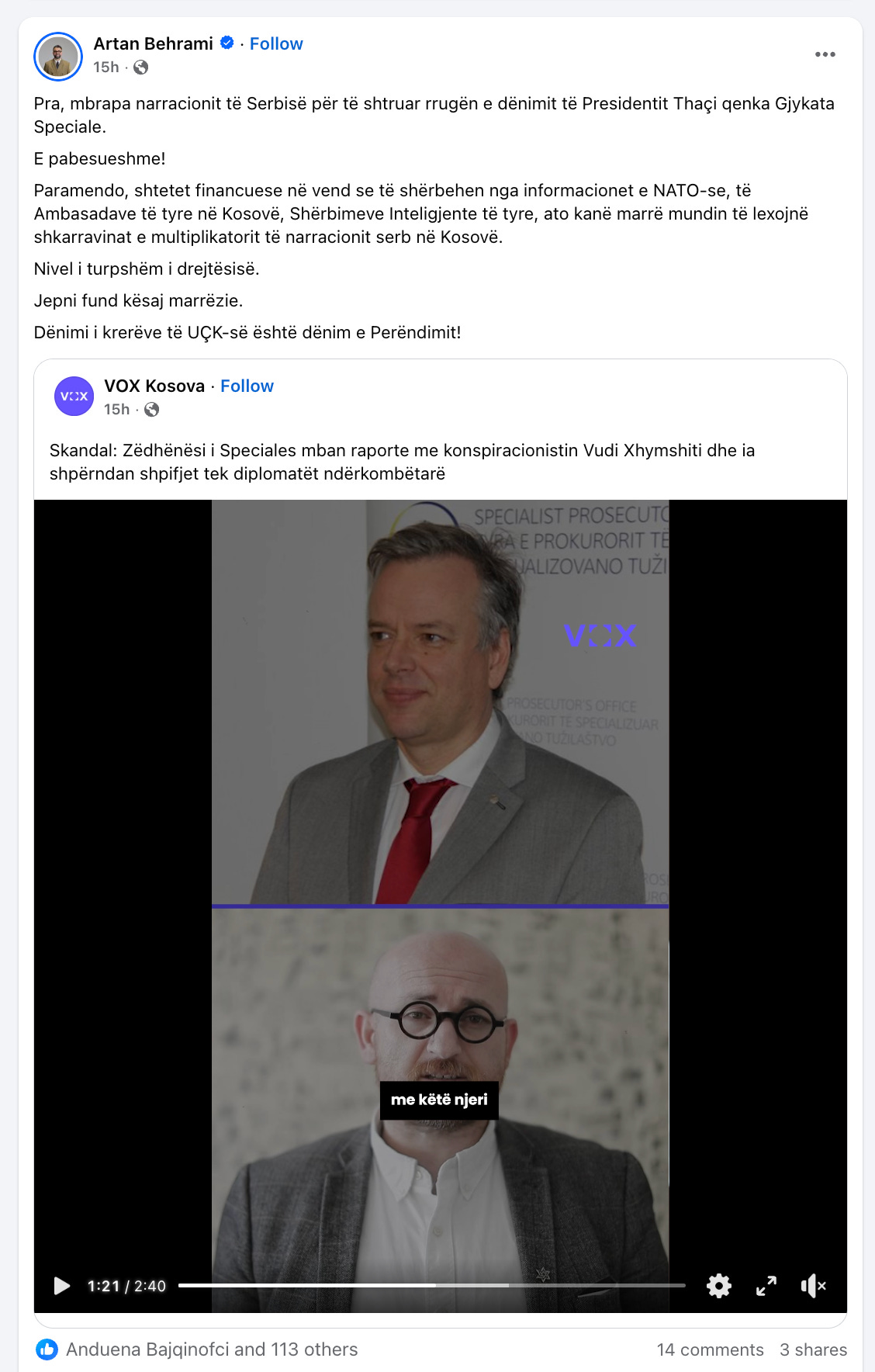
On 23 February 2026, one day after Koci’s call, Artan Behrami amplified14 the VOX segment, pushing the narrative further by framing my reporting as Serbian narration designed to clear the way for Thaçi’s conviction, and by asserting that condemning former KLA leaders equates to condemning the West. This is another known move. It relocates accountability into geopolitics, so that scrutiny becomes treason not only against local heroes but against allies. It also pressures international missions by implying they either support the narrative or betray the cause.
Put together, the timeline is not a collection of unrelated posts. It is a staged migration of coercion from fringe insult to political identity attack, to forged artefact, to broadcast laundering, to a direct call for intervention.
The most important point, for integrity, is what can be stated as fact and what must be stated as analysis.
It is a matter of record that I published investigative findings on 4 February 2026 describing a methodology of coercive power and intimidation associated with Thaçi era structures, and that I framed it as methodology rather than a criminal verdict. It is a matter of record that on 5 February a PDK assembly member responded with dehumanising identity language rather than factual rebuttal. It is a matter of record that on 10 February a media figure circulated an unverified list presented as espionage proof without provenance. It is a matter of record that on 22 February VOX Kosova broadcast a segment framing contact with me as scandal, and that on the same day Gani Koci publicly called for state security organs to act and for someone to stop me. It is a matter of record that on 23 February a political operator amplified that broadcast narrative, and that another party figure circulated a graphic claiming an authoritative external condemnation of my work.
The analysis is the sequence, and the sequence is where the danger lies.
A democratic media culture answers reporting with reporting. It disputes sources with sources. It tests claims with documents. It corrects errors with specifics. What is being demonstrated here is the opposite. When evidence appears, the response is to stigmatise the author. When stigmatise is not enough, the response is to manufacture artefacts that look like institutional proof. When artefacts are challenged, the response is to launder suspicion through broadcast. When broadcast is aired, the response is to escalate into calls for intervention.
That escalation is why I am stating, plainly, that Gani Koci is now the fifth Thaçi era PDK linked dignitary or senior party figure in this sequence to publicly signal harm, or to legitimise harm, or to call for institutional action against me instead of answering the facts. Others play supporting roles in amplification, but Koci’s post crosses into the language of stopping, the language of state security, the language of urgency. That is the hinge point where reputational sabotage begins to shade into foreseeable physical risk.
None of this requires melodrama. It requires institutional attention.
When a public figure calls me a “species” and urges state security organs to act “before it becomes too late”, the responsible reaction is not to debate my personality. It is to ask what such language is designed to produce. It is designed to make action against me feel preventative. It is designed to make inaction feel negligent. It is designed to make the public feel that stopping a journalist is a civic act.
This is how intimidation operates when it wants to look respectable. It rarely says, commit violence. It says, he is a contaminant. He is dangerous. He has crossed the line. The state must act. Someone must stop him. The details are left open so that the crowd, or a zealot, or a compromised official, can fill them in.
If I reduce this to the simplest forensic statement, the “assassination manual” I described is not only about bodies. It is about atmospheres. It is about manufacturing a social climate in which the target is isolated and harm becomes easier, legally, socially, physically. In the chronology from 22 November 2025 to 23 February 2026, you can watch that atmosphere being assembled in real time, with names, dates, posts, broadcasts, and escalations that are all publicly visible.
The public does not need to agree with every conclusion I have drawn to recognise the immediate problem. The problem is not that powerful people dislike investigation. The problem is how they are choosing to answer it. When the answer is dehumanisation, fabricated artefacts, broadcast laundering, and calls for state intervention, that is not democratic dispute. It is a pressure campaign. And when a pressure campaign reaches the stage of “someone must stop him”, the responsible moment for institutions is not after something happens, it is now, while the language is still doing its preparatory work.
Thaçi’s Assassination Manual

In April 2025 our newsroom began pulling at a thread that kept resurfacing in different forms and different places. It was a claim that a Russian Serbian Kosovan entangled network had been tasked, by Hashim Thaçi and associates, with undermining the Kosovo court process in The Hague. That work started as a national security story and it stayed one. But as we mapped names, timelines and incentives, we kept returning to an older question that Kosovo never fully answered after the war. How did power consolidate so quickly, and what did it cost.
Thaçi’s Assassination Manual
Thaçi’s strategy transformed Kosovo into a coercive state, where “assassination atmospheres” were manufactured to justify neutralising opponents and trapping loyalists in a cycle of debt. — The GPC I Unit.
The Gunpowder Chronicles Condemns the Reckless Rhetoric Endangering a British-Based Journalist
Berisha incites, Zeka amplifies, and both openly dehumanise a working journalist, language that, in this region’s history, has repeatedly preceded real violence. This escalation is dangerous. — The GPC Official Dispatch.
Si Reagon Manuali i Hashim Thaçit Kur Ekspozohet
Reagimet e Granit Gecit pas publikimit të gjetjeve tona aktivizuan manualin e atentateve politike të Hashim Thaçit, fyerje, dehumanizim, zhvendosje identiteti, presion publik, heshtje faktesh. — Kronika B Hulumtim.
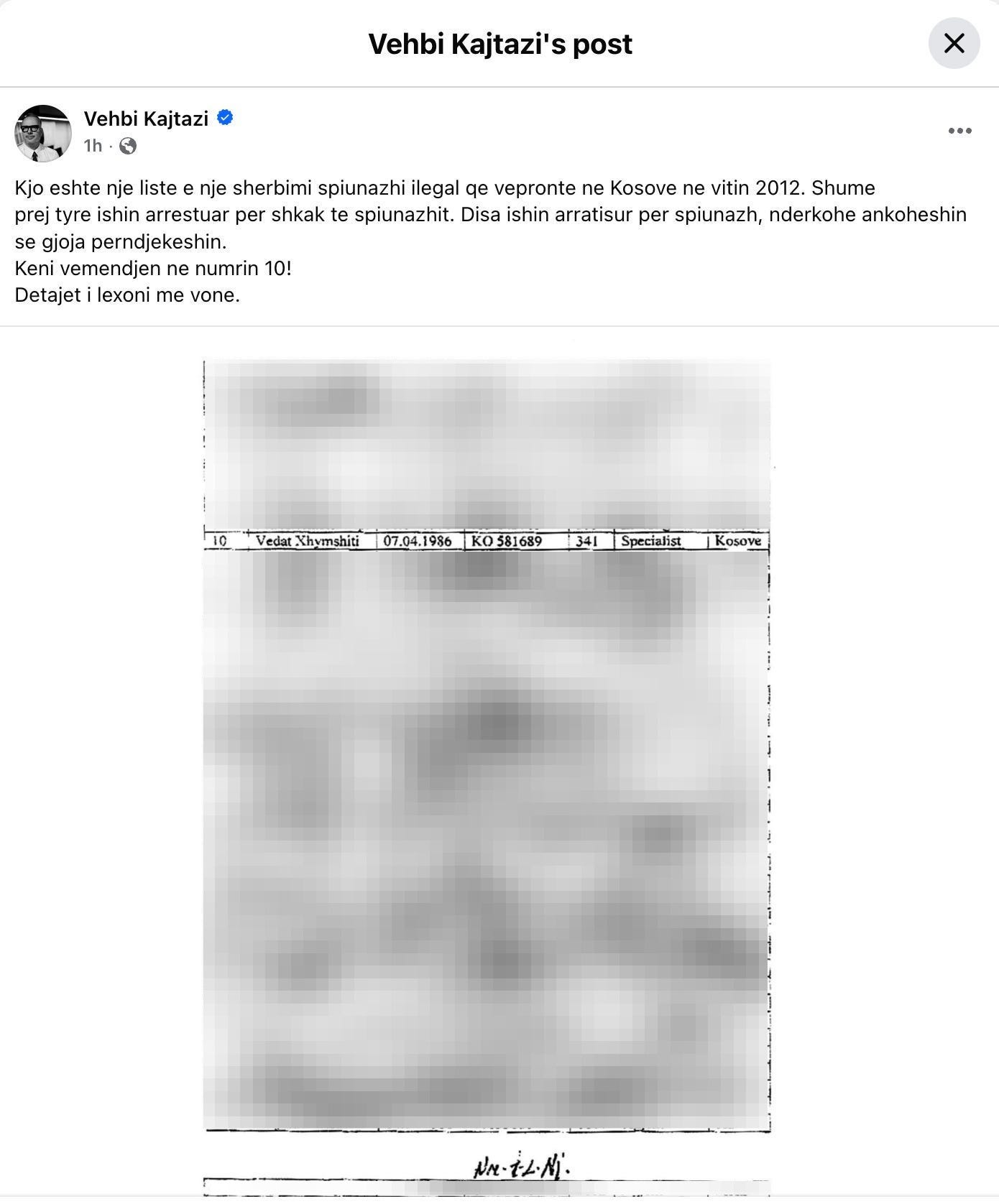
What Happened After Vehbi Kajtazi Turned a Fabricated List into an Espionage Story
Vehbi Kajtazi’s Fabricated Espionage list was followed by 479 accounts targeting our reporting, a wave of repetition that exposed the scale of digital amplification. — The GPC I Unit.
Vehbi Kajtazi and the Politics of a Fabricated Espionage List
Vehbi Kajtazi’s tactic was familiar to Thaçi’s assassination manual, isolate the critic, attach a stigmatising label, and flood the space until doubt becomes ambient, and silence appears reasonable. — The GPC I Unit.
Nov 22, 2025 Facebook Post of Hisen Berisha.
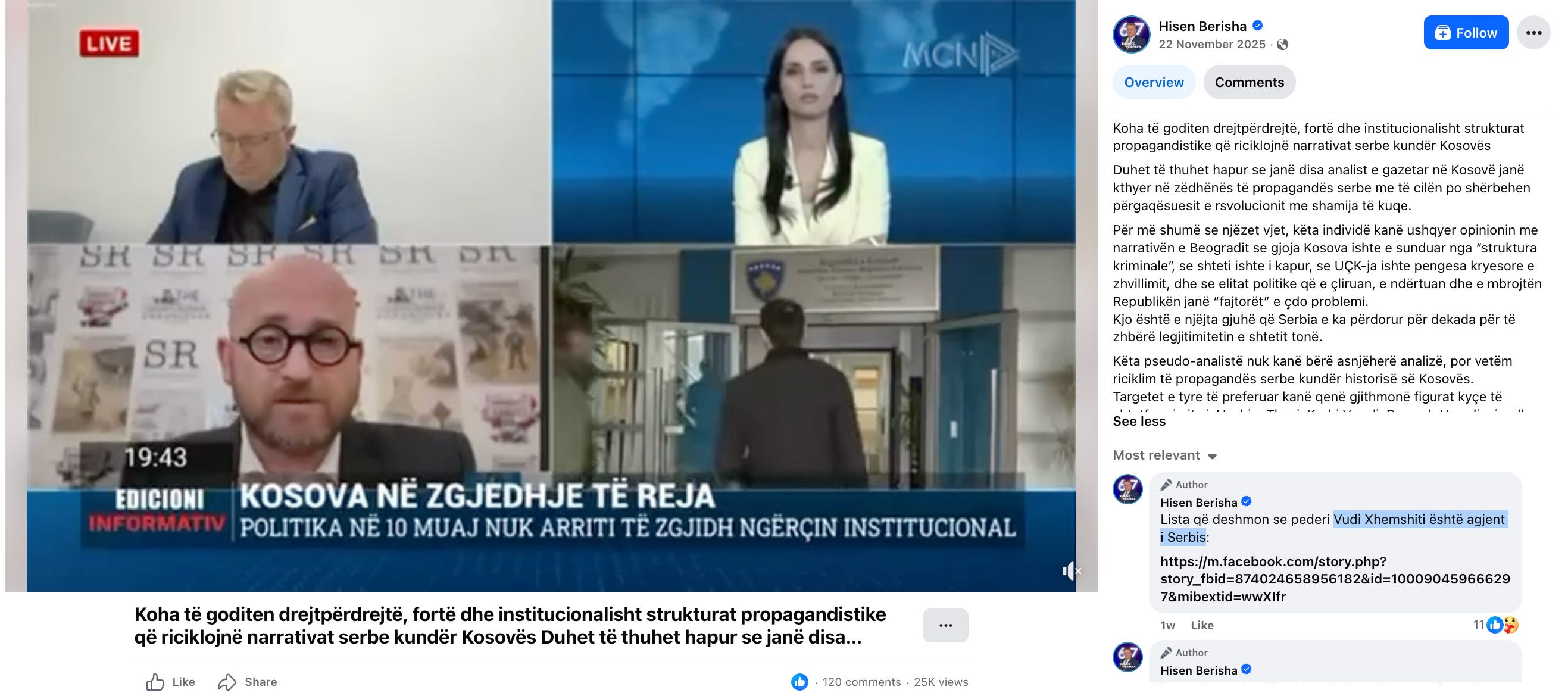
Link provided [https://www.facebook.com/vehbikajtzi/posts/pfbid02GGsPvShrmcH2JhonoZZcBs3q5MhvHR5oRLSLLtX5HtC5Pv7fZZ5euLHzArU3ryHpl?__tn__=R] by Hisen Berisha to his fans, takes to the Facebook post of Izmi Zeka, PDK chairman in Gjilan, Kosovo.
Izmi Zeka’s Feb 9, 2026 Facebook Post.
How an Investigation Triggered a Campaign, Not a Debate
When scrutiny becomes danger and journalism invites sanction, the response does not weaken an investigation; it completes it, revealing the coercive logic it set out to document. — The GPC I Unit.
Skandal: Zedhenesi i Speciales mban raporte me konspiracionistin Vudi Xhymshiti — VOX Kosova YouTube and Facebook and author Anduena Bajçinofci.
Xhym-shit Special Zëdhënësi i Speciales mban raporte me konspiracionistin Vudi Xhymshiti
Në tentim për ta përligjur komunikimin me Xhymshitin, Bennet tha se “Unë komunikoj me shumë media, si dhe me persona e organizata të ndryshme”, duke mos pasur parasysh fare faktin se Xhymshiti është shpallur shpifës edhe nga Departamenti Amerikan i Shtetit, ku pretendimet e tij për diplomatin amerikan Escobar i demantojnë duke i quajtur krejtësisht të rreme. — VOX Website Post.


Decoding Hashim Thaçi’s ‘Assassination Manual’ in Modern Pristina
VOX Kosova functions not as a newsroom, but as a predatory annex, laundering Thaçi’s “Assassination Manual” tactics into televised hits to facilitate institutional and physical erasure. — The GPC Media Watch.
Gabriel Escobar’s Diplomacy Under Fire
Findings suggest DAS Escobar’s impartiality in Kosovo-Serbia dialogue is compromised by his wife’s financial connections with Kremlin-aligned Serbia’s Foreign Affairs Ministry. — The GPC I Unit.
Shadow Diplomacy: How the U.S. State Department Muzzles Press Freedom with Proxy Propaganda
The U.S. State Department’s use of proxies to spread misinformation is not diplomacy; it’s authoritarian propaganda, betraying democratic values and undermining journalistic integrity. — The GPC Media Watch.
Gani Koci’s Facebook Post, Feb 22, 2026.
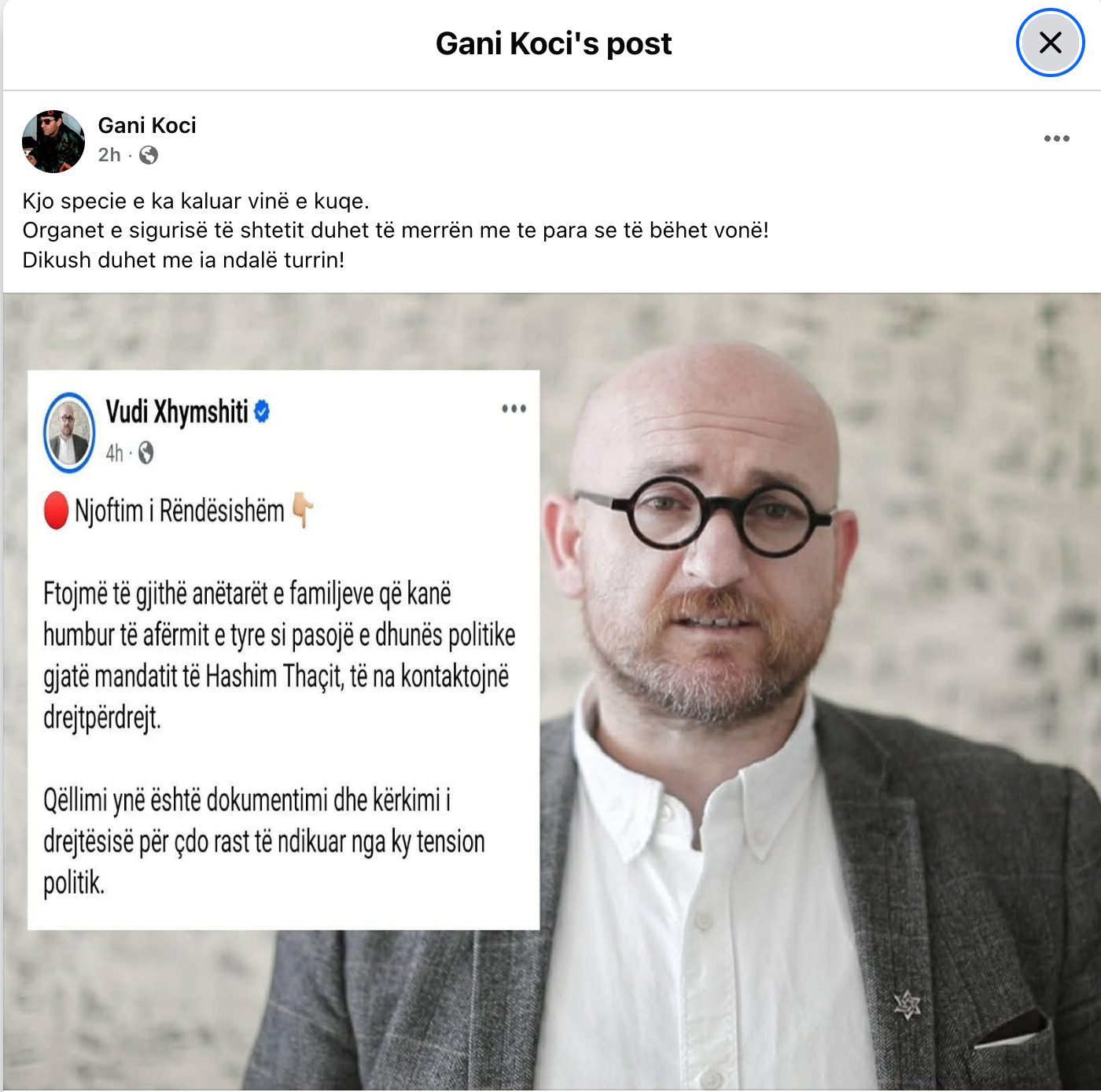
Documented comment analysis, Gani Koci Facebook post, 22 February 2026.
Across 22 archived screenshots of the public comment thread (captured 22–23 February 2026), 143 visible comments and replies were recorded. Of these:
27 (18.8%) explicitly demanded arrest, prosecution, extradition, or imprisonment.
9 (6.3%) contained direct violence or death language.
4 included explicit elimination phrasing (“plum” meaning bullet, formulations or equivalent).
41 (28.6%) framed the author as Serbian, UDB-linked, or foreign-aligned.
36 (25.1%) deployed dehumanising language, including animalisation and waste metaphors.
6 (4.1%) urged restraint or argument over abuse.
The archived screenshots, preserved in chronological sequence, are available in the evidentiary gallery accompanying this article. The purpose of inclusion is documentation of behavioural pattern, not amplification of abusive language.


Artan Behrami’s Facebook Post, Feb 22, 2026.