

Vehbi Kajtazi and the Politics of a Fabricated Espionage List
Vehbi Kajtazi's tactic was familiar to Thaçi's assassination manual, isolate the critic, attach a stigmatising label, and flood the space until doubt becomes ambient, and silence appears reasonable.

The smear arrived as a list, because a list is faster than proof.
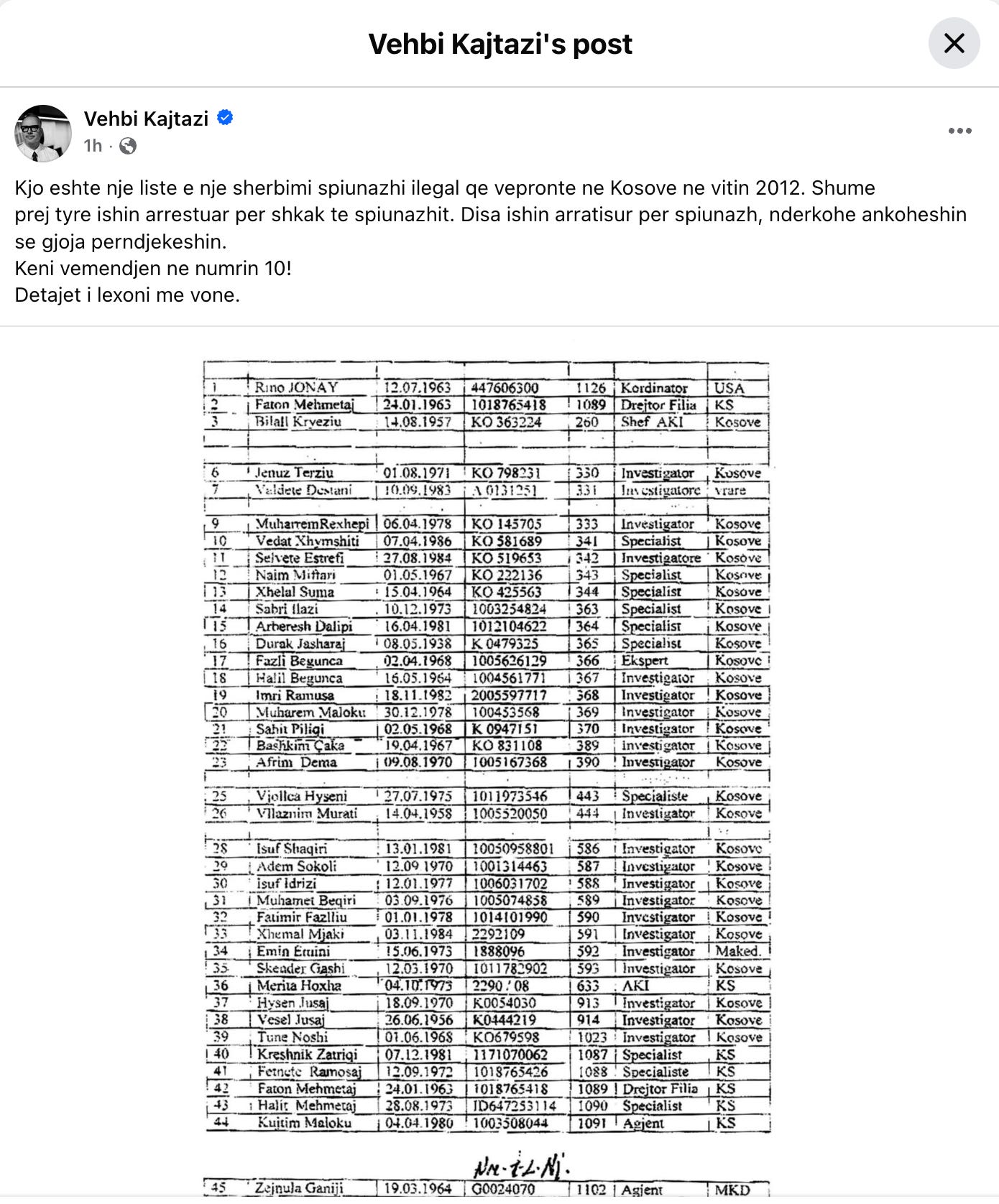
Vehbi Kajtazi began this new phase on Facebook1 with a short post and a long insinuation. He wrote that the image he was sharing was a list of an illegal espionage service operating in Kosovo in 2012. He claimed that many on the list had been arrested for espionage and that others were fugitives. Then he directed readers to a single line, number 10, and told them to read the details later. The structure was deliberate. It asked the audience to look at a name first, and only afterwards ask what the document is, where it came from, and whether it can be verified.
That choice makes sense when the underlying problem is not evidence but exposure.
Our reporting the day before did not attack him with opinion2. It confronted him with his own record. His post came after I an older televised statement beside his newer public post and showed an irreconcilable shift3. In the earlier clip he speaks with sweeping certainty about war crimes and about the purpose of a court being to indict Hashim Thaci. In the later post4, on a day of major procedural developments in The Hague, his tone becomes technical, cautious, almost clinical. Our method was simple. Quote and chronology. No embellishment, no distortion.
He did not rebut the contradiction. He changed the subject.
The list was the pivot. It was meant to turn a debate about his inconsistency into a trial of my identity.
We dismantled it the only way a responsible newsroom can dismantle a manufactured artefact. We treated it as a document and asked for provenance. Who produced it. When. Under what authority. With what chain of custody. We then provided an alternative, verifiable context, that the list is linked to a humanitarian ecosystem involving missing persons work, where identification documents are routinely collected for administrative reasons. We also made a basic ethical choice that he did not. We protected private individuals by redacting names, because people who are not public figures should not be dragged into an online punishment ritual.
That is what dismantling looks like. It is not emotion. It is discipline.
The next day, his outlet escalated from insinuation to production.
Paparaci published a video5 under a headline that presumes guilt rather than establishing it. The narration claims that an Albanian citizen, Maksim Ferra, recruited more than 50 agents in Kosovo into an illegal organisation he called an agency of research and investigation, shortened as AKI. It claims that the facsimile list was drafted by Kosovo law enforcement authorities who were monitoring those named. It claims that members of this organisation presented themselves as officers of Kosovos intelligence service and even had badges. It then singles me out. It says that number 10 on the list was the photo reporter Vedat Xhymshiti, labelled a specialist, and adds that I later changed my name to Vudi and self proclaimed as a journalist. Finally it tries to discredit our February investigation6 by implying that our work is not credible, that we have no real platform, and that our illustrations were made with artificial intelligence.
Those are not facts. They are a script.
Start with the central evidentiary claim, that this facsimile was drafted by law enforcement authorities. If that were true, the document would carry basic markers that allow independent checking. A case reference. An issuing unit. A date and context consistent with a specific investigation. A stamp or header typical of the institution. A traceable origin. The image Kajtazi posted provides none of that. It is a table of names, dates of birth, identity numbers, internal numbers, roles, and countries. The audience is instructed to treat it as state output because the narrator says so.
That is not verification. It is command.
Now look at the list itself, not as a rumour but as an object. The forensic problem is visible even in the section he highlights.
In the screenshot, the row marked 10 reads Vedat Xhymshiti, followed by a date of birth, a Kosovo document number beginning with KO, an internal number, the role Specialist, and the country marked as Kosovo. Around it are multiple similar rows, with roles such as Investigator, Specialist, Expert, Agent, and entries that appear to denote positions like branch director and head.
Even in this cropped view, several red flags appear.
First, at least one name is duplicated. Faton Mehmetaj appears twice in the visible portion, with the same date of birth. That could be duplication from sloppy copying, an attempt to pad the list, or a merged extract from different tables. None of those possibilities strengthens the claim that this is a careful law enforcement artefact.
Second, the categories are inconsistent. In one row the final column contains a word that reads like a status label rather than a country. That is not a minor typo. It is a category error. It suggests the table is either assembled without institutional discipline or repurposed from something else.
Third, the field labels are inconsistent in language and form. The roles include English terms like Investigator and Specialist alongside Albanian terms like “Drejtor Filia” and “Shef AKI”. That is not impossible, but it demands corroboration because it is exactly the kind of hybrid style produced when documents are stitched together to sound official to different audiences.
Fourth, the list has no provenance. No source line. No issuing authority. No signature. No stamp. No case number. No chain of custody. That absence is not incidental. It is the core of the deception. A document without provenance is not a document. It is a picture of a claim.
Against that, our rebuttal is anchored in time and work.
From 2009 to 2013 I was covering the Middle East during the Arab Spring period. That is a timeline that can be supported through published reporting, assignments, bylines, travel records, and professional networks. Kajtazi’s story requires the public to believe that in the same period I were operating as part of a Kosovo based clandestine organisation while simultaneously working as an international conflict reporter. He provides no mechanism for that, no verifiable record, and no evidence beyond a facsimile of unknown origin circulated on social media.
The attack also relies on a familiar move in smear campaigns. It weaponises biographical details. A name change is treated as a confession. A career is reframed as performance. Credibility is attacked through form rather than substance. If a target is made to look illegitimate, the audience is not asked to refute the reporting. It is asked to reject the person.
That is the point where this episode becomes more than a personal dispute.
Our February investigation described a method. Identify a target. Surround them with insinuation. Shift debate into loyalty tests. Flood the space with accusations that do not need to be proven to do damage. Encourage a chorus to repeat the claim until it becomes ambient truth. Kajtazi’s sequence fits that pattern with striking clarity.
The trigger was reporting that challenged a protected narrative. The response was not engagement with evidence but an attempt to contaminate the messenger. The tool was an unverifiable list presented as institutional truth. The escalation was a video package that added narrative force, identity shaming, and a claim of official monitoring without providing anything checkable. The timing was not random. It arrived immediately after our work exposed his contradiction.
That is why this matters. It demonstrates the mechanism in real time.
Finally, the claim that I rely on ChatGPT is part of the same strategy. It is not an argument about style. It is an argument about authorship, meant to detach our work from our experience and replace it with a caricature. The simple answer is the most effective. I have been writing for more than 25 years. My record is built on published work, not a tool. If anything, automated systems learn by absorbing the patterns of meticulous experienced writers. They do not erase the craft that produced those patterns.
A list without provenance is not evidence. A video without sources is not reporting. A campaign that substitutes insinuation for verification is not journalism. It is a pressure operation with a headline.
How an Investigation Triggered a Campaign, Not a Debate

After the Kosovo War Veterans Organisation (KWV) published its statement on social media, the terrain shifted almost immediately. What followed was not a spontaneous outpouring of disagreement, nor a pluralistic debate about evidence or interpretation. It was a sequence. Each stage arrived on time, in order, and with internal coherence.
Kur Gazetaria Zëvendësohet me Linçim Digjital
Pas publikimit të videos së tij, Vehbi Kajtazi reagoi jo me fakte, por me një listë të rreme “spiunazhi”, duke synuar diskreditim personal, dhe duke treguar se nuk është i aftë për debat. — Kronika B Vëzhgimi Mbi Median.
Vehbi Kajtazi’s Paparaci Video Facebook Post, Feb 10, 2026.
Thaçi’s Assassination Manual
Thaçi’s strategy transformed Kosovo into a coercive state, where “assassination atmospheres” were manufactured to justify neutralising opponents and trapping loyalists in a cycle of debt. — The GPC I Unit.