I published1 “Thaçi’s Assassination Manual” on 4 February 2026 because I kept seeing the same machinery in different places, different years, and different stories. I wrote it as an account of method rather than a verdict. I matched information across sources, treated testimony as testimony, and treated the public record as the spine of the story. The central claim I examined was not that one man personally carried out every act, but that a system can be built in which violence is delegated and blame is delegated, and in which a society is trained to confuse fear with patriotism. I described what sources told me, a sequence of approach under the cover of legitimacy, execution through intermediaries, narrative placement, and institutional laundering. I wrote about how “assassination atmospheres” can be manufactured, not as a flourish, but as a way to explain how a coercive politics sustains itself when open killing becomes costly.
Five days later, on 9 February, I published2 “How an Investigation Triggered a Campaign, Not a Debate” because the response to my reporting arrived like a script3. It did not come as a dispute over evidence. It came as moral offence, collective insult, and an implied authorisation to punish. The escalation moved quickly from denunciation to contamination. I was accused of being a “Serbian and Russian intelligence asset”. A graphic circulated marking my face with “Made in Serbia”. A public figure shared a post that did not argue with my method but tried to end me as a person, with accusations designed not to be answered but to be believed. I described how repetition substituted for verification, how sock puppet accounts simulated consensus, and how monitoring of who liked my posts functioned as discipline. The point was not that every participant needed a central command. The point was that shared scripts and aligned incentives can create coordination without a visible signature.
On 10 February, I published4 “Vehbi Kajtazi and the Politics of a Fabricated Espionage List” because the smear evolved. It became bureaucratic theatre. A list was presented as if it were state output, without provenance, without a traceable issuing authority, and without the basic markers that allow independent checking. I wrote that a list is faster than proof. I wrote that a document without chain of custody is not evidence, it is a picture of a claim. And I wrote what should be obvious in any serious media culture, if you want to accuse someone of espionage, you show your work. You do not hand an audience an unverifiable image and demand that they treat it as fact.
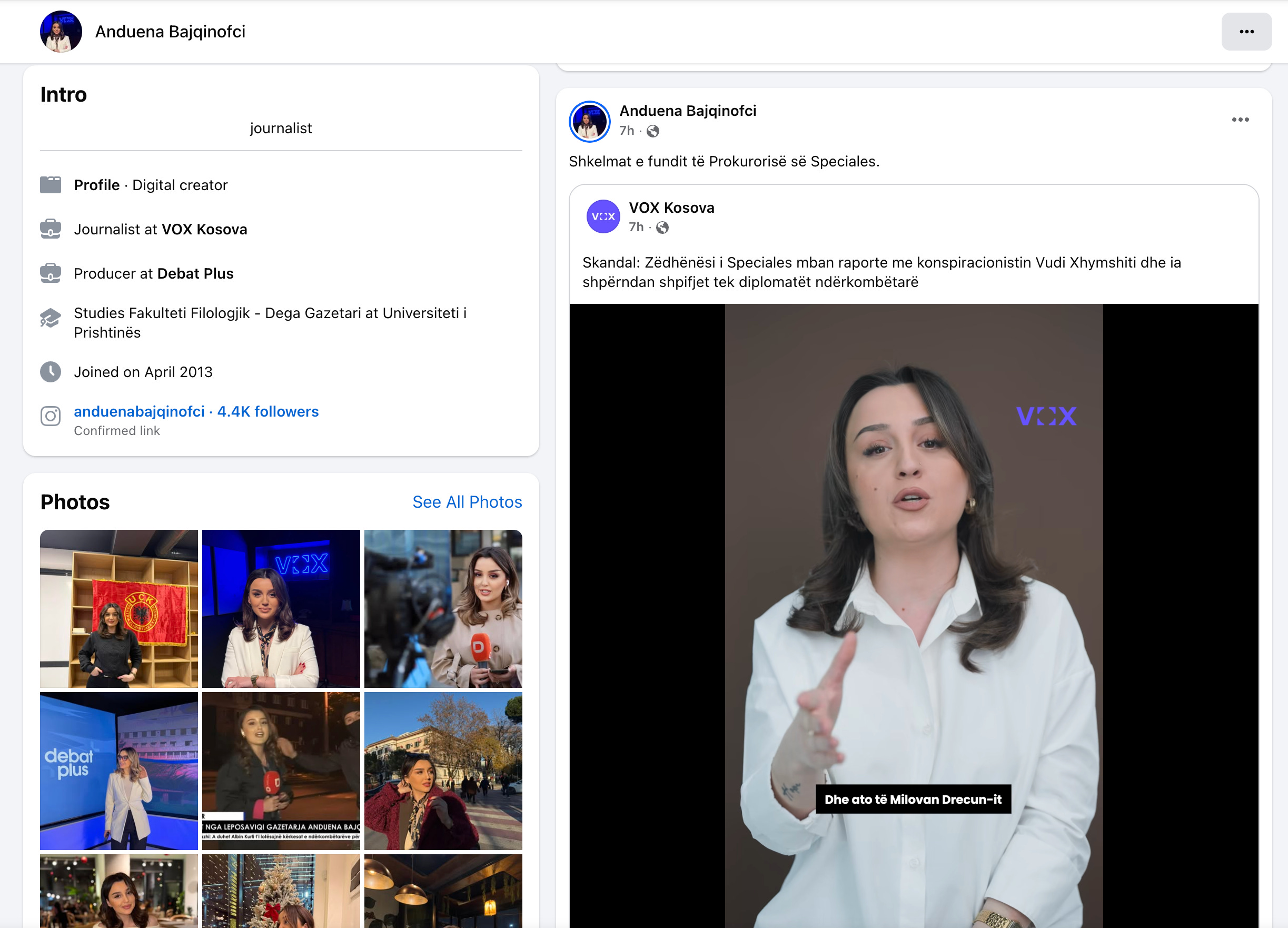
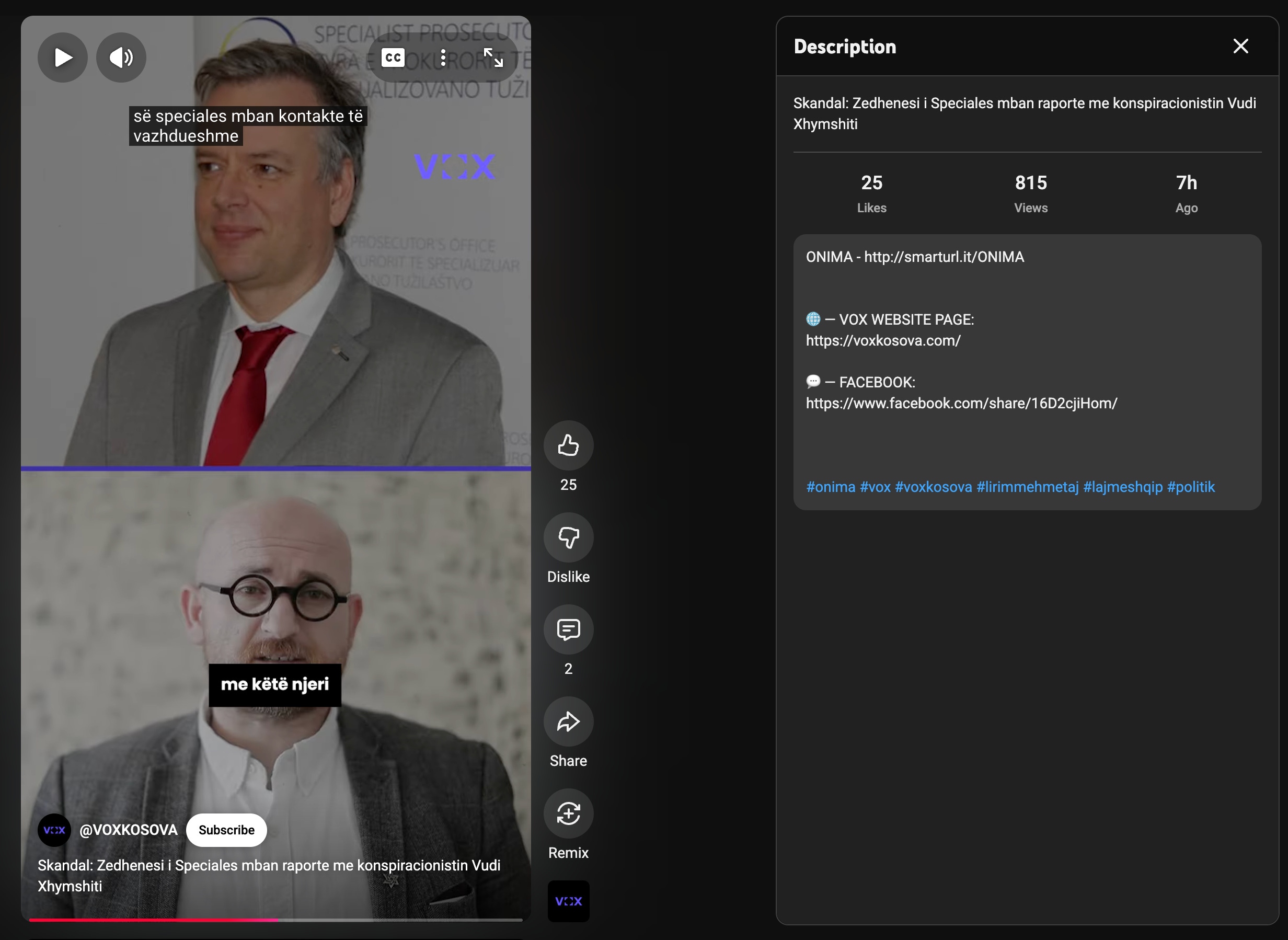
Now, on 22 February, VOX Kosova aired5 what I can only describe as a hit piece packaged as news, two minutes and forty seconds of insinuation designed to shift the question away from what I reported and onto whether I am allowed to exist in the public sphere at all.
The title alone is a verdict, “Scandal: The Specialist Prosecutor’s Spokesman Maintains Relations with Conspiracist Vudi Xhymshit”.
In one line, it tries to do three things. It labels me a conspiracist. It frames contact with me as a scandal. And it drags the Specialist Chambers into the contamination, implying that communication itself is wrongdoing.
The piece leans on anonymity as authority. It claims that “at least two international diplomats” were alarmed. They remain unnamed. Their alarm remains untestable. Their existence functions as a narrative device. This is not how journalism behaves when it has evidence. This is how an operation behaves when it wants the appearance of credibility without the burden of verification.
Then it escalates through one of the oldest coercive techniques in post conflict politics, equating scrutiny with alignment to the enemy. The narration suggests that what I wrote is a “mechanical reproduction of schemes and lies” encountered in Serbia about former KLA leaders. It implies that my work is not merely wrong, but foreign in origin and alien in loyalty. It is a boundary making move. It tells the audience, this person does not belong.
It continues by attempting to turn a routine public communications relationship into a stain. It claims that Christopher Bennett “does not deny communication with him nor the distribution of these dangerous materials”. The phrase “dangerous materials” is doing the work. It is not describing documents in an evidential sense. It is describing them as a hazard, as if the act of reading them is exposure. That framing is not about facts. It is about making engagement feel unsafe. It is about making distance appear prudent.
Then comes the most revealing manoeuvre, because it attempts to conscript a powerful external label as social permission. The narration asserts that I have been declared a liar by an American authority, stating that I was “publicly denounced by the United States State Department for producing fake news”. Even if a government disputes a specific claim, that is not a criminal conviction. It is not a judicial finding. But the VOX piece does not treat it as a dispute. It treats it as a moral sentence, a reason to place me beyond the protections of civic life.
This is how intimidation operates when it wears a suit. It does not say, harm him. It says, he is a contaminant. He is a threat. He is disgrace. He is disinformation. He is outside the moral community. It does not need to instruct anyone to act. It needs only to create a climate in which action, silence, or ostracism feels reasonable.
VOX Kosova also attempts to chill the court environment itself, under the pretence of defending international standards. It states that in international practice prosecutorial bodies are obliged to avoid any action that could be interpreted as amplifying one sided narratives. This is a rhetorical sleight of hand. A serious outlet would apply standards to itself first, by presenting verifiable sources, contextual detail, and the evidence it claims exists. VOX does the opposite. It relies on unnamed diplomats, undefined alarm, and insinuation heavy framing, then wraps itself in the language of international practice to appear responsible while behaving irresponsibly.
If I strip this down to its essentials, VOX Kosova is not debating my reporting. It is regulating behaviour around my reporting. It is telling the audience that the problem is not unresolved murders, disinformation patterns, coercive networks, or a documented history of intimidation. The problem is that someone is speaking about them, and that a spokesman spoke with the speaker. That is not journalism’s reflex. That is an enforcement reflex.
The quality question is the simplest to answer. Journalism rests on evidence, provenance, proportion, and the discipline of uncertainty. It distinguishes allegation from fact. It names sources where possible, and when anonymity is necessary, it provides enough context for the audience to evaluate credibility. It publishes documents with identifiable markers, or explains precisely why it cannot. It does not construct a case from labels, insinuations, and anonymous authority theatre.
An entity operating as a pressure instrument under the cover of journalism behaves differently. It leads with identity degradation. It uses labels that compress thought. It recruits anonymous voices that cannot be examined. It collapses complex disputes into loyalty tests. It targets the person so that the content need not be answered. And it repeats until the smear becomes ambient, until doubt becomes background noise, until silence feels safer than engagement.
That is what I have watched unfold over these past weeks, in sequence.
First, delegitimisation, I am framed as morally offensive to the war.
Second, contamination, I am linked to Serbia and Russia, and marked with phrases such as “Made in Serbia”.
Third, consequence signalling, fugitive talk, criminal insinuations, and the kind of language that suggests exclusion is justified.
Fourth, laundering, portals and programmes repeat the material so that it feels established even when it remains unproven.
VOX Kosova is not an anomaly in that chain. It is the point where the script seeks entry into institutions, where it attempts to make court communication itself appear suspect.
I am not asking to be shielded from criticism. I am asking for the minimum that a democratic society owes itself, that criticism be tethered to evidence, and that media cease functioning as a weapon against those who investigate power.
I am also asking authorities to recognise what this represents, a documented pattern of intimidation and reputational sabotage that increases foreseeable risk. It chills witnesses. It chills readers. It chills officials who might otherwise engage responsibly with reporting. It narrows the public sphere around the Specialist Chambers by making contact itself look tainted. And it tells the public, implicitly, that scrutiny is disloyal.
If the Specialist Chambers prosecution reads this, I want them to recognise the operational logic directed at their perimeter. When an outlet seeks to shame a spokesman for communicating widely, it is not defending neutrality. It is attempting to control the informational environment around a court. It is trying to decide who is legitimate to speak and who is legitimate to be heard. That is not a defence of due process. It is an attempt to constrain the ecosystem of accountability.
I also urge local institutions, and international missions that still claim commitment to the rule of law, to stop dismissing this as noise. Noise is part of the method. The objective is saturation. The objective is to create a social climate in which isolating a critic becomes routine, in which punishing a reader becomes entertainment, and in which the public gradually accepts that some people deserve whatever happens to them.
No society wakes one morning to discover that fear has become common sense. It is trained into that condition, post by post, programme by programme, label by label.
I will continue to do what I have done throughout this series, separating allegation from documentation, demanding provenance, and refusing to allow coercion to masquerade as civic debate. But responsibility here is not mine alone. Platforms have obligations. Regulators have obligations. Media unions have obligations. Law enforcement has obligations when campaigns slide into harassment and incitement.
The difference between journalism and a pressure operation is not tone. It is method. If you cannot show your work, you are not reporting. If your primary act is to make a person socially untouchable rather than to test the truth, you are not informing the public. You are disciplining it.
And when disciplining the public becomes a business model, the line between information and coercion collapses. In that collapse, people who would never consider harm can be nudged towards accepting exclusion, hostility, or worse as reasonable. That is why this is alarming. Not because I am fragile. But because the atmosphere being manufactured threatens any society that still wishes to call itself democratic.
The broadcast by VOX Kosova is not an exercise in journalism, it is a clinical demonstration of the “Assassination Manual” in live motion. By transitioning from the abstract smear of social media to the high-production values of a televised “hit piece,” the outlet has positioned itself as the institutional arm of a predatory machine. This is the “narrative placement” I previously warned of—the moment where character assassination is laundered through a studio microphone to provide social permission for physical or legal erasure. VOX Kosova is effectively pre-processing a target, painting a bullseye on the back of a journalist to signal to the underlying criminal structure that the “contaminant” has been sufficiently dehumanised. To trigger such an operation is to incite a climate of hate where the line between character assassination and the literal variety becomes dangerously porous.
It is particularly galling to witness Anduena Bajçinofci use the aesthetics of the press to shield the very structures that historically silenced our colleagues in cold blood. To claim the mantle of a journalist while functioning as a stenographer for a coercive shadow state is a betrayal of the dead. There is no “neutrality” in framing a professional communication as a “scandal,” nor is there “objectivity” in hiding behind the skirt of unnamed diplomats to justify a campaign of social exclusion. This is a perversion of the craft, a weaponisation of the airwaves designed to ensure that the truth remains a lethal pursuit. The Independent Media Commission and relevant law enforcement must stop treating this as a mere “editorial dispute” and recognise it for what it is, a coordinated psychological operation. If those who masquerade as reporters are allowed to serve as the vanguard for criminal intimidation without consequence, then the public sphere in Kosovo is not being informed, it is being policed.
A Nation Forced to Look at the Blood on Its Hands

On 17 February 2026, Kosovo marked eighteen years since independence with flags, speeches, and the familiar choreography of a young state insisting on its own permanence. Then, in the same capital, a second kind of procession gathered momentum. By early afternoon in Prishtina, a mass march moved under the slogan used by organisers, “Drejtësi, jo politikë”, Justice, not politics, in support of four detained former senior figures of the Kosovo Liberation Army,
Thaçi’s Assassination Manual
Thaçi’s strategy transformed Kosovo into a coercive state, where “assassination atmospheres” were manufactured to justify neutralising opponents and trapping loyalists in a cycle of debt. — The GPC I Unit.
How an Investigation Triggered a Campaign, Not a Debate
When scrutiny becomes danger and journalism invites sanction, the response does not weaken an investigation; it completes it, revealing the coercive logic it set out to document. — The GPC I Unit.
The Response That Confirmed the Reporting
By triggering punishment instead of debate, the War Veterans Organisation validated our reporting, behaving not as critics but as participants in the Hashim Thaçi’s assassination manual we documented. — The GPC I Unit.
Vehbi Kajtazi and the Politics of a Fabricated Espionage List
Vehbi Kajtazi’s tactic was familiar to Thaçi’s assassination manual, isolate the critic, attach a stigmatising label, and flood the space until doubt becomes ambient, and silence appears reasonable. — The GPC I Unit.
Skandal: Zedhenesi i Speciales mban raporte me konspiracionistin Vudi Xhymshiti — VOX Kosova YouTube and Facebook and author Anduena Bajçinofci.