

What Happened After Vehbi Kajtazi Turned a Fabricated List into an Espionage Story
Vehbi Kajtazi's Fabricated Espionage list was followed by 479 accounts targeting our reporting, a wave of repetition that exposed the scale of digital amplification.

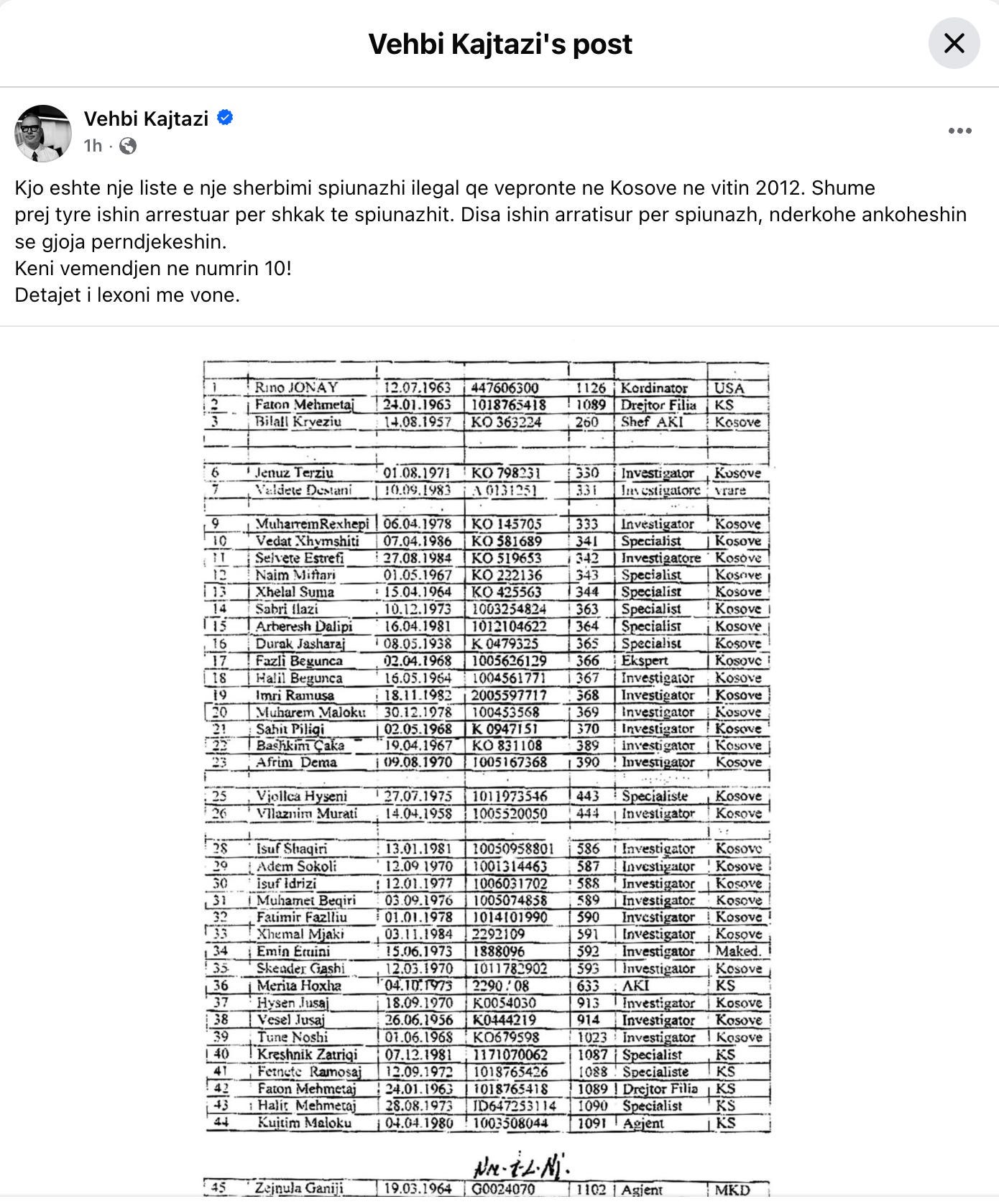
On February 10 we published an investigation1 that examined and debunked the document circulated by Vehbi Kajtazi and presented as evidence of an illegal espionage structure operating in Kosovo in 2012. The document2 named me among its alleged members.
Our investigation did not approach the matter rhetorically. It treated the list as a document and asked the questions any newsroom would ask of material claiming institutional authority.
Who produced it?
When was it issued?
Under what legal mandate?
What case number accompanies it?
What issuing body stands behind it?
Where is the traceable provenance?
The image circulated publicly contained no verifiable institutional markers. No case reference. No issuing unit. No official header. No signature. No stamp. No chain of custody. We reported those absences. We documented formatting inconsistencies and duplication visible within the table itself. We stated plainly that no publicly verifiable confirmation had been produced to authenticate the document as state output.
That reporting preceded what followed.
Within hours of the February 9 publication3, and intensifying after a February 10 video amplification4 on Paparaci, a surge of Facebook accounts began posting the same list repeatedly across multiple posts on my page. The pattern was not diffuse. It was concentrated around posts related to our reporting5 on Hashim Thaçi’s political methodology and what we had described as a systematic reputational neutralisation strategy.
The observable behaviour was repetitive and uniform. The same image. The same allegation. The same label.
From Accusation to Dataset
Faced with the volume of repetitive posting and direct accusations, I made a decision that was at once defensive and documentary. Every account that repeatedly posted the list while calling me a spy or repeating the allegation was blocked. The blocking was not arbitrary. It followed visible engagement behaviour.
A student monitoring the activity suggested that the block list itself would serve as a consolidated ledger of engagement. Every blocked account would be archived in one accessible place. The list would become measurable.
With technical assistance from colleagues at Everyday AI, we captured 17 full screenshots6 of the complete block list. The objective was straightforward. Count. Categorise. Analyse.
The findings were specific and verifiable.
A total of 479 Facebook accounts had been blocked following the February 9 circulation of the list and the February 10 video.
This number is not an estimate. It is a count derived from documented screenshots.
Within those 479 accounts, 11 names appeared more than once, each duplicated at least twice. The duplication of names does not by itself prove inauthenticity. It does, however, raise the possibility of replicated identity presentation within a confined narrative moment.
We then categorised accounts based on visible presentation markers.
At least 61 accounts displayed the default grey avatar and no personalised profile photograph.
A further group used non identifiable naming patterns such as “BZ BZ”, “pilot”, “Oboh Oko” and “Qeli MeFlok”.
In total, 82 accounts fell into what may be described as low credibility presentation markers. That represents approximately 17 to 18 percent of the total blocked list.
More than 350 of the blocked accounts showed little to no visible content on their own public timelines.
These characteristics do not prove coordination. They do indicate that a significant minority of accounts participating in the amplification exhibited minimal personalisation and limited public footprint.
The proportion is analytically relevant.
Engagement Disparities

We then examined the platform context.
Paparaci’s Facebook page displays over 106 thousand followers.
A publicly available engagement calculator snapshot7 shows an engagement rate of 0.11 percent over the past 30 days. Average reactions per post were approximately 95.74. Average comments approximately 15.53.
In isolation, a low engagement rate does not establish artificial inflation of followers. Many pages experience passive followership. However, 0.11 percent engagement for a page of over 100 thousand followers places it at the lower end of organic interaction benchmarks.
We then analysed the video8 specifically targeting the espionage allegation.
That video recorded 49 thousand views. It generated 510 reactions, 89 comments and 86 shares.
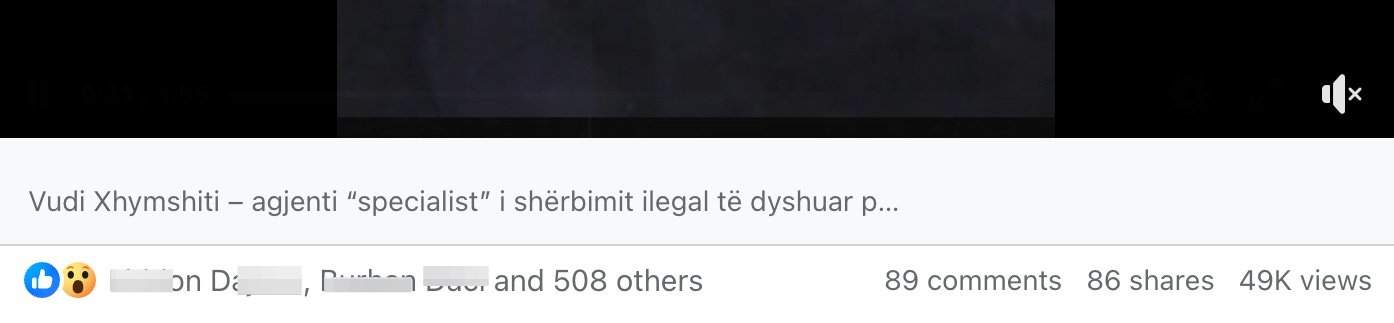
The view count is substantially higher than the average interaction metrics reflected in routine posts. The reaction and comment volume remains proportionally modest relative to the follower base.
This divergence is not proof of manipulation. It does demonstrate that the espionage allegation achieved significantly higher visibility than ordinary content on the page.
Commentary Breakdown
We reviewed the visible comments captured in the screenshots9. The commentary was categorised by position and tone.
Approximately 60 to 65 percent of visible commenters appeared to accept or repeat the espionage allegation. Many reiterated the label “shpiun10”. Several urged prosecution or institutional intervention.
Approximately 15 to 20 percent rejected the allegation or defended the credibility of our reporting.
Between 10 and 15 percent directly criticised Vehbi Kajtazi, sometimes referring to him as V.B and questioning his motivations.
The remainder were tangential, neutral or unrelated. The tone of the commentary is analytically significant. Several comments escalated into explicit incitement.
Mustaf Abazi wrote, “Ket duhet me vra”, translated as “He should be killed”

Driton Bytyqi wrote, “Qka po pret prokuroria nburg ket mut shpiuni menjeher”, calling for immediate imprisonment.
Other comments included dehumanising language and aggressive insults.
Among the accounts escalating the rhetoric was Azem Mjekiqi11, whose publicly accessible Facebook profile indicates past employment with the Kosovo Police and visible proximity to senior political figures in Kosovo.
In response to the espionage allegation fabricated and propagated by Vehbi Kajtazi, Mjekiqi posted: “I’d kill him with hammer between his bones.”

The statement was not metaphorical. It described a specific act of violence directed at a named individual within an active political dispute. When such language comes from a person publicly associated with law enforcement structures, it carries heightened weight. It signals that the discourse has moved beyond reputational disagreement into expressed physical hostility. The comment itself does not establish coordination or instruction. It does, however, illustrate how the circulation of a fabricated espionage list rapidly produced a climate in which explicit calls for violence were normalised within the comment stream.
The presence of violent rhetoric demonstrates that the allegation did not remain at the level of reputational dispute. It triggered hostility.
What cannot be inferred from comment content alone is whether the hostility was spontaneous or encouraged.
Scale and Concentration
The timeline is precise.
February 9. The list is circulated.
February 9. Our Dispute challenges its verifiable attributes.
February 10. A video amplifies the allegation and singles out my name.
February 10. Our investigation systematically dismantles the fabricated claim.
Following those events, 479 accounts engage in repeated posting behaviour on my Facebook Profile.
Nearly one fifth of those accounts exhibit low credibility presentation markers. More than 350 display minimal timeline activity. The concentration of engagement around a specific narrative event is measurable. The clustering is visible in the block ledger. The duplication of names is documented.
None of these observations independently prove orchestration. They do, however, demonstrate amplification at scale.
The Data Question
In digital environments, scale alone can distort perception. Repetition can simulate consensus. Uniform messaging can create the appearance of ambient belief. The dataset created by blocking 479 accounts offers a rare view of engagement concentrated around a single reputational allegation.
The list that was circulated claimed institutional authority without publicly verifiable confirmation. The response to our debunking was not documentary rebuttal. It was repetition.
The engagement discrepancy between follower count and routine interaction on Paparaci’s page is observable. The surge in targeted engagement following the February 9 and 10 posts is measurable. The presence of duplicated names, default avatars and low content profiles among participating accounts is quantifiable. What remains beyond the available data is intent.
Investigative reporting distinguishes between evidence and inference. The evidence here is numerical and documented. The inference of coordination would require platform level data that is not publicly accessible.
We debunked and exposed a document presented as an espionage list.
In the immediate aftermath, nearly 500 accounts engaged in concentrated repetition of that document and its accusation across multiple posts, particularly those connected to our reporting on Hashim Thaçi’s political methodology.
Seventeen screenshots document the scale. The dataset reveals clustering, duplication and a significant minority of accounts with low credibility presentation markers. It does not establish orchestration. It does establish amplification. In digital conflicts, amplification can be as consequential as proof.
Vehbi Kajtazi and the Politics of a Fabricated Espionage List

The smear arrived as a list, because a list is faster than proof.
Vehbi Kajtazi and the Politics of a Fabricated Espionage List
Vehbi Kajtazi’s tactic was familiar to Thaçi’s assassination manual, isolate the critic, attach a stigmatising label, and flood the space until doubt becomes ambient, and silence appears reasonable. — The GPC I Unit.
Kur Gazetaria Zëvendësohet me Linçim Digjital
Pas publikimit të videos së tij, Vehbi Kajtazi reagoi jo me fakte, por me një listë të rreme “spiunazhi”, duke synuar diskreditim personal, dhe duke treguar se nuk është i aftë për debat. — Kronika B Vëzhgimi Mbi Median.
Paparaci’s Facebook Page Video Post, Feb 10, 2026.
Thaçi’s Assassination Manual
Thaçi’s strategy transformed Kosovo into a coercive state, where “assassination atmospheres” were manufactured to justify neutralising opponents and trapping loyalists in a cycle of debt. — The GPC I Unit.


Paparaci-Vehbi Kajtazi Facebook Video Post, Feb 10, 2026.


“SPY”.
Azem Mjekiqi’s Facebook Account.


