

A Republic Built on the Silence of Thaçi’s Dead
Beyond the bullets, a year-long investigation reveals Hashim Thaçi’s chilling method of selective violence and narrative engineering used to consolidate power in post-war Kosovo.

For an Albanian reader who lived through post war Kosovo1, the names arrive already heavy. You feel them before you explain them. For an international reader, the same names can sound like a forest where only shadows move. When journalism works with shadows, its job is not to make them scarier. It is to make them legible. To separate what is public fact from what is testimony, what is claim from what is interpretation. To put events in time, to show what we know, and to mark, plainly, what we do not.
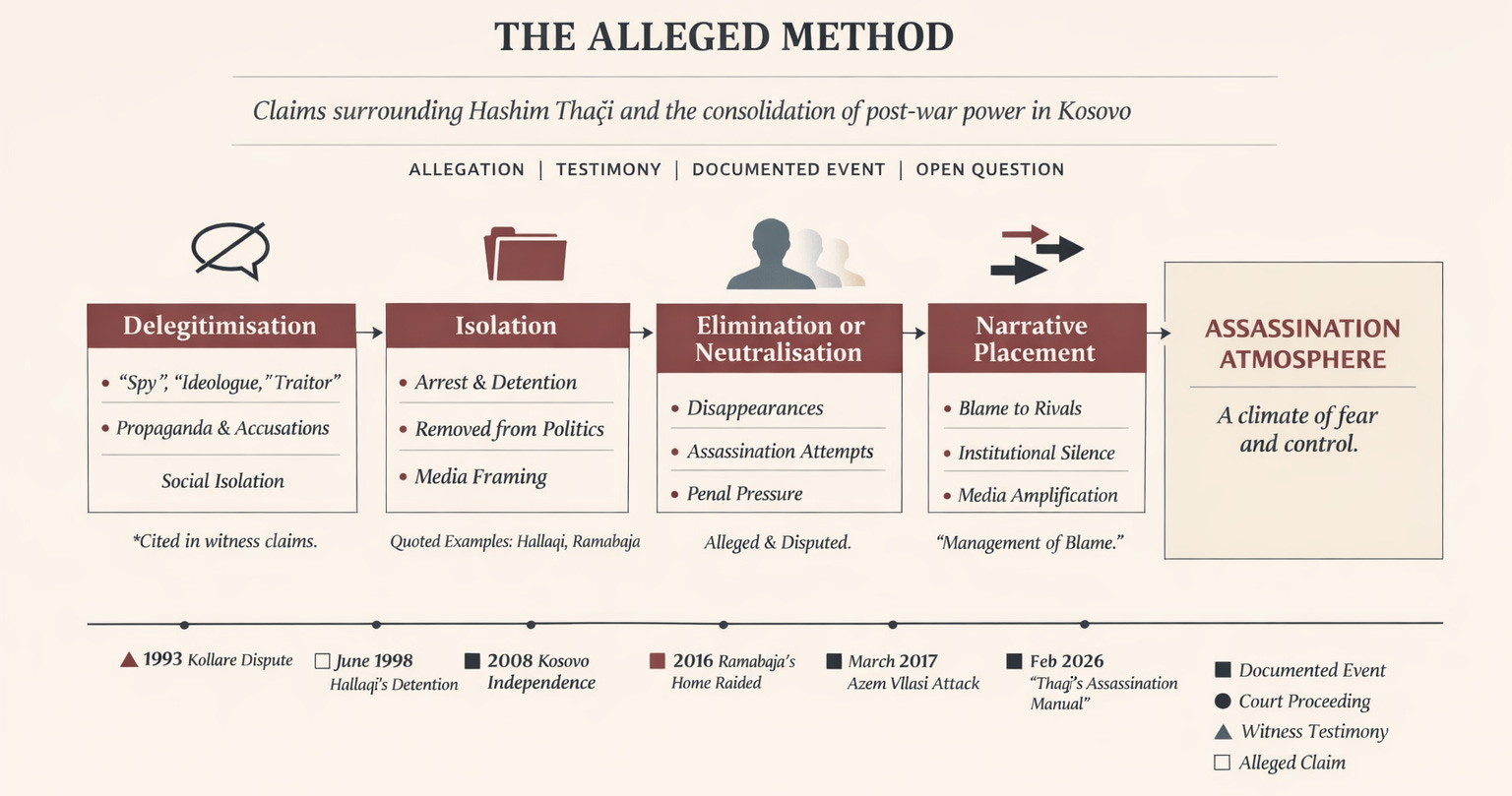
On 4 February 2026, our newsroom published2 the result of a year long investigation, which we titled “Thaçi’s Assassination Manual”. We did not publish it as a verdict. We published it as a method, reconstructed from multiple sources, documents, broadcast material, institutional records, and interviews conducted with care. Our central argument was narrow in what it claimed, and broad in what it implied. In post war Kosovo, we wrote, power could be consolidated through a repeatable sequence, selective violence, intimidation, narrative engineering, and pressure on investigations, merging into what I called an “assassination atmosphere”. The point was not spectacle. The point was the system.
Since that publication, a question has followed me into every conversation, public and private. Why do so many different voices, from different periods, describe the same machinery? The names change. The instruments change. The underlying rhythm, in their telling, stays recognisably the same.
That question is why I sat down with Sadri Ramabaja.
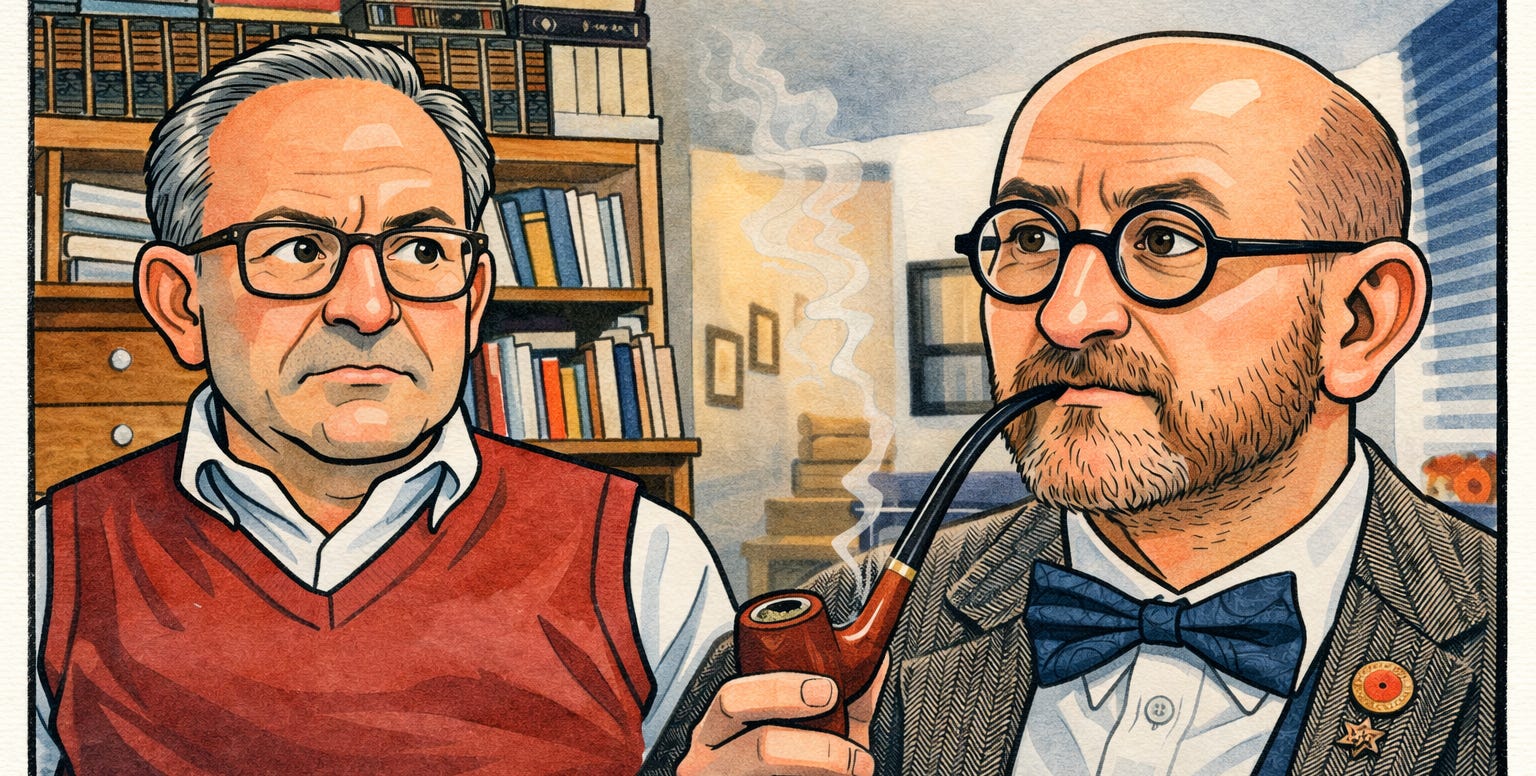
To understand why his testimony matters, you need a little context. Ramabaja is not a neutral bystander. He is a veteran of Kosovo’s older clandestine politics, a former activist linked to the Popular Movement for Kosovo in the eighties and nineties, someone shaped by an era when the line between loyalty and betrayal could decide whether you lived. After the war he moved into academic and public life as a political scientist and commentator, at times a candidate associated with Vetëvendosje, at times a sharp critic of state building. But for the purpose of this piece, his profile takes on a different weight, because he has seen the system from more than one angle, as someone who says he helped imagine liberation, and as someone prosecuted in the post war era in a case known locally as “Syri i Popullit”.
For years, he has argued that his prosecution was political, an attempt to silence him through what he calls institutional fabrication. That does not make him automatically right. It does make him a particular kind of witness, informed, motivated, and shaped by direct confrontation with the state. He arrived in our conversation not as a detached observer, but as someone who insists he felt the pressure of the very atmosphere we described.
As he spoke, I recognised something familiar, the way a reader sounds when they have not merely skimmed a text, but chewed it like evidence.
“While I was reading your investigative finidngs”, he told me, “this is exactly what I had in mind, it matches the later liquidation of Hallaqi, the case of Astrit Dehari, my imprisonment, and other imprisonments later.”
Even if you accept nothing without proof, that sentence forces a harder thought. Why does one man’s personal story, and one newsroom’s research, keep converging on the same outline?
Early in the interview I asked him about SHIK, the intelligence structure long rumoured, debated, and denied in Kosovo’s post war politics. He did not claim membership. He did what a careful witness should do, he marked the limit of his certainty.
“Since I was not part of it, I cannot speak with full certainty”, he said.
But he did describe an impression formed through contact with senior officers, a rigid structure, centralised command. Then he added something darker, the possibility of sub structures that did not answer to the official leader at all, but to “someone else”. That phrase, “someone else”, is the kind of phrase that opens every door and closes none. In countries where power moves through networks, a title is not always command, and command does not always leave a title.
When I asked who, in his view, made final decisions on political eliminations, and how such decisions could be transmitted without formal traces, he did not stay abstract. He linked it to himself.
“I am one of the victims of this structure, or rather of the former head of the Republic, Hashim Thaçi”, he said.
Then came his sharpest claim, one that, if ever proven, would matter enormously. He argued that after his release from prison he received information suggesting that Kadri Veseli, often linked in public discourse to SHIK’s leadership, may not have had full knowledge of the preparations in his case, which Ramabaja says were “exclusively under Hashim Thaçi’s direction”. He described it as a double game, designed to blur responsibility. Orders are not written, he implied. Orders are distributed. They pass through people. People become dependent, or disposable.
From there, the conversation returned again and again to Behadin Hallaqi. For Ramabaja, Hallaqi is not just a name in a file, he is a moral axis, a friend, a figure he describes as intellectually prepared and politically serious within the old movement structures. He located Hallaqi’s stature in the organisational life of the Popular Movement and in internal meetings from the early nineties. He then described a dispute in 1993, during a consultation in the village of Kollare in the Kërçovë area, where he says Hallaqi was attacked harshly by Thaçi. The cause, he argued, was procedural, Hallaqi had not allowed Thaçi to participate in an earlier meeting because he was not delegated. Ramabaja reads that as the start of a vendetta.
Then he went further, and said that Thaçi accused Hallaqi of being a Serbian spy.
In a culture forged in war and clandestinity, “spy” is not merely an insult. It is a targeting device. It marks a person for isolation before anything else happens. Ramabaja claimed that in June 1998, during the war, Hallaqi was arrested under an order he believes came directly from Thaçi, presented under the cover of a “General Staff” that he argues did not exist in the way it was being invoked at that time. He said Hallaqi was taken to the detention site in Kleçkë and held for about three weeks. He also referenced a diary attributed to Murat Jashari, describing a phone conversation involving Ismet Jashari, known as Commander Kumanova, where two men brought to Kleçkë were described as spies, and named as Behadin Hallaqi and Shaban Rexhep Shala.
He described efforts to intervene through calls to Xhavit Haliti and Ali Ahmeti. He said Ahmeti responded briefly, that he had not known, thanked him for the information, and urged him not to spread it further. Ramabaja then tied Hallaqi’s fate to 11 June 1998, and to the claim that a political leadership structure was formalised on 10 June.
“It appears to me that the first work carried out by the political leadership of that staff was the liquidation of Behadin Hallaqi”, he said.
At this point, I need to be clear, especially for international readers. These are claims made by an interviewed witness. They are not court judgments. They are not proof published here. But they do present a narrative that exposes a method, which is exactly what our 4 February reporting focused on.
First delegitimisation in the language of treason.
Then isolation.
Then elimination, or attempted elimination.
Then the management of blame.
Ramabaja went further still. He claimed there were efforts to attach responsibility for Hallaqi’s disappearance to Rexhep Selimi. He described a story, told in narrow circles, in which Thaçi, Veseli, and Selimi went to Kleçkë after three weeks to retrieve Hallaqi, and removed him from detention. According to this account, Selimi then departed on another task toward Prizren, leaving Hallaqi in the hands of Thaçi and Veseli.
“In the end, responsibility for Behadin Hallaqi’s disappearance should be explained by those two people, Thaçi and Veseli”, Ramabaja told Gunpowder Chronicles.
That claim echoes something we described in our February investigation as “narrative placement”, the deliberate positioning of guilt. In our reporting, a source who says they were close to Thaçi’s inner circle described an episode in which a Haki Imeri’s body was moved in a way intended to attribute blame to Selimi. In this alleged logic, rivals are not fought only with weapons. They are fought with files, insinuations, and decontextualised fragments fed into institutions until they return stamped with external authority. In an accountability vacuum, guilt becomes mobile, and truth becomes hostage to whoever controls the insinuation, because whoever controls insinuation controls fear.
I also raised a question that in Kosovo tends to trigger immediate debate, the role of foreign services. I mentioned our work tracing French diplomatic cables from the era of Jacques Chirac3. Ramabaja did not accept a conclusion. He accepted a possibility.
“Everything is possible”, he said, “but it must be deep and treated with competence.”
Then he shifted the emphasis to a different hinge in the story, Thaçi’s ascent to the head of the political directorate of the KLA staff. In his view, that political directorate was not merely a functional wartime structure, but a vehicle used to exclude the older Popular Movement leadership from political direction of the KLA.
“With this act, the political head of the KLA was cut off”, he said.
There is a risk, in conversations like this, of sliding into rhetoric. But beneath the rhetoric is a thesis worth examining. If a liberation movement emerges from war without a legitimate political leadership, or if that leadership is displaced internally, then post war power can fall not to the most prepared, but to the best networked, the most coercive, or the most skilled at converting war into political credit. And when war becomes credit, credit demands interest, in silence, in obedience, in fear.
Ramabaja returned again to Hallaqi’s role inside the old movement structure. He described councils organised by district, and said Prizren’s council was among the strongest, with Hallaqi at its head. He claimed Hallaqi had political support for reforms, and that this made him dangerous. He also argued, pointedly, that eliminating such figures would align with Serbian intelligence interests.
“The liquidation of these figures is entirely the first interest of Serbian services”, he told Gunpowder Chronicles this week, linking the thought to the disappearance of Ukshin Hoti, another figure he described as someone who stirred dormant waters.
When I asked whether there was evidence that Hallaqi’s case was manipulated immediately through disinformation or organised institutional silence, Ramabaja offered an episode he considered telling. During questioning by prosecutor Sylë Hoxha, he said he was explicitly told that Hallaqi had been a Serbian collaborator.
“The first killing was done through propaganda”, he said, “by presenting him as a collaborator of Serbia.”
That idea, delegitimisation before elimination, sits at the heart of many of the accounts we have collected over the years. A bullet can kill a person. The word “traitor” can kill a person twice, once socially, then physically, because it grants permission.
This is where Ramabaja’s story intersects with our reporting beyond the war era. He described his own prosecution as part of a method that does not always require a gunman. He has laid out this argument in his defence speech4 and in his book “Liria pa heronj”. In our conversation he condensed it into three pillars, the name of Behadin Hallaqi, because Ramabaja says he edited testimonies about Kleçkë, the portrayal of him as an “ideologue” of Vetëvendosje, and the publication of his dissertation, read by some as a political platform.
Then he delivered his most serious accusation, describing as public fact the presence of an adviser registered, he claimed, as an agent of Serbia’s BIA in Thaçi’s office, and arguing that this channel shaped orders in his case.
“Hashim Thaçi imprisoned me with Belgrade’s push”, he said.
That was an allegation of the highest order, and it demanded rigorous verification. We examined the contemporaneous reporting and confirmed that the appointment did in fact take place. As reported at the time by Reporteri5, Thaçi appointed Branislav Nikolic as a political adviser. Subsequent media monitoring summaries carried by UN sources reported6 that the President later dismissed Nikolic following claims of his alleged involvement in activities directed against the constitutional order and sovereignty of Kosovo.
The record therefore shows not merely an accusation in political rhetoric, but an appointment formally made and later rescinded. Even so, the episode illuminates how coercion can move through institutions. Labels such as “enemy” and “ideologue” do not remain confined to speech. They migrate into structures of authority. Pre-trial detention becomes punishment. Delay becomes discipline. Guilt does not need to be proven in order to operate as exclusion. In that environment, violence does not disappear; it is relocated into procedure, into dossiers, into the slow pressure of confinement.
After our 4 February publication, the model we described did not remain confined to the past. It moved into the present. The response to our reporting was not primarily a rebuttal of facts. It was a sequence many Kosovars will recognise, moral framing, personal delegitimisation, and contamination with accusations designed less to be verified than to exclude. That reaction matters because it suggests the infrastructure of intimidation is not historical residue. It is a living reflex7.
Integrity requires another separation. In a serious reporting piece, you do not merge claims and facts without naming them. What can be stated publicly is that Ramabaja’s case became a subject of media debate8, and that Kosovo reporting has discussed issues such as alleged surveillance and questions around detention. He cited local investigative journalism, named lawyers, and referenced international attention he says his case attracted, including statements and advocacy by foreign figures and institutions. I am not, in this piece, independently documenting each of those elements. Where documentation exists, it belongs in the evidentiary record, not in the heat of a single narrative. The point here is more modest, his case was not small, it carried enough weight to travel beyond Kosovo’s borders, and that alone says something about the seriousness of the allegations and the level of distrust many citizens hold toward domestic justice.
When I asked him when he first understood he had become a target, he pointed to 2016. He described his home and library being ransacked ahead of elections when he was a parliamentary candidate, and said a police investigator told him it did not look like ordinary theft, but like a search for something else. He read it as a signal of permanent pursuit.
Sadri Ramabaja’s home after it was ransacked in 2016.


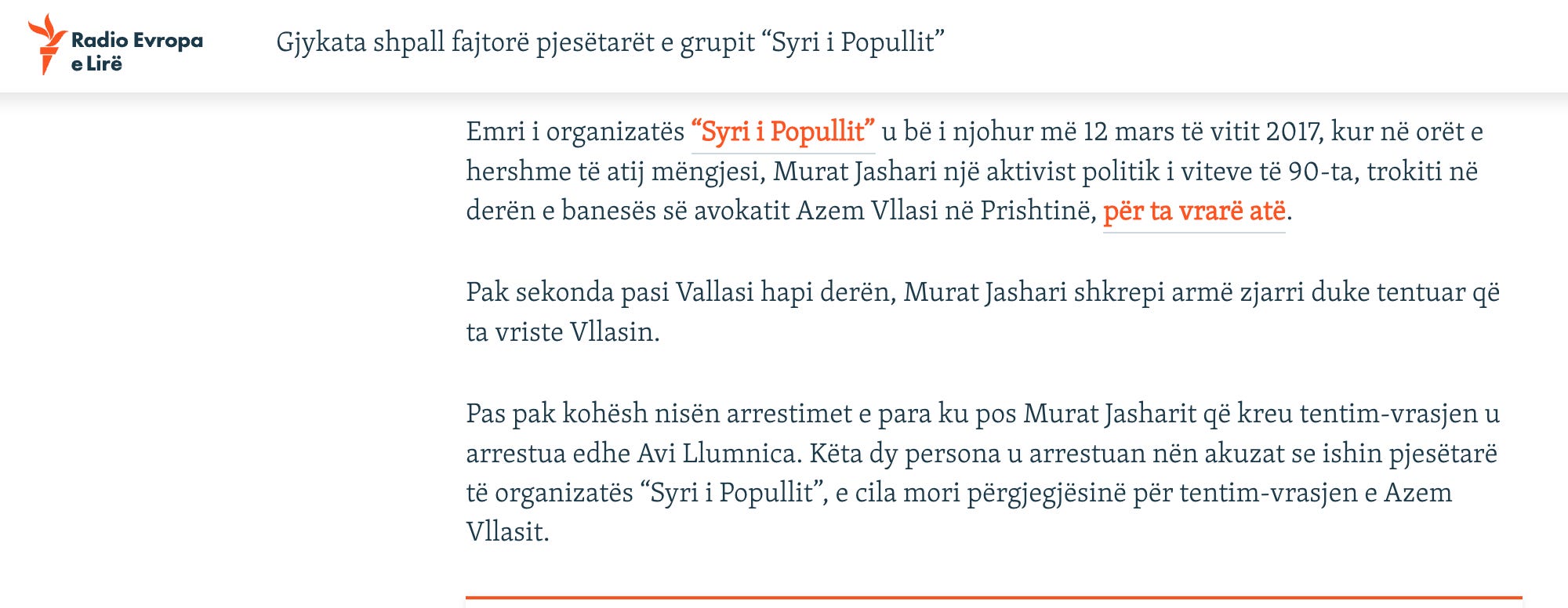
He then spoke of 2017, when the assassination attempt by Murat Jashari against Azem Vllasi occurred on 12 March, and claimed that his own name surfaced in portals he described as close to SHIK, along with his photograph. He alleged surveillance by intelligence officers using false identities, and claimed that professional reporting was then falsified at the top to keep him in detention. Those are grave claims. They demand grave investigation.
He also described prison conditions in ways that suggest intimidation can be psychological as well as physical. I will not reproduce the most distressing details. It is enough to say that he described episodes he believes were designed to degrade and frighten him, and he argued that accountability inside the system was treated as an inconvenience.
Why, I asked him, did Kosovo’s society stay quiet for so long?
He did not reduce it to one reason. He spoke about fear, kompromat, buying silence, economic looting, capture of justice, from investigative units to the state’s summit. He spoke of deep mistrust, including toward the Constitutional Court, which he portrayed as guarding entrenched interests. That is a political thesis, contested, but it is also a measure of something real, the depth of civic doubt. In a state where people do not believe courts can clarify political violence, truth itself becomes foreign. And the foreign is greeted either with hope, or with rage.
From there he moved to a myth Kosovo still lives with, the commander myth. He argued that the KLA’s full history has not been written, partly because of the ongoing process in The Hague. Then he gave a paradox that captures the country’s unease.
“We have left it to The Hague to bring us the foundation of the KLA’s history”, he said.
He also criticised the defence strategy around Thaçi, arguing it has sometimes protected the client at the expense of the KLA’s broader image. Here, precision matters. War crimes are not erased by speeches. They are investigated, prosecuted, proven, or refuted under legal standards. What Ramabaja appeared to be demanding was a separation between the KLA as a collective historical value, and individuals who, in his view, exploited its emblem for power and criminality.
Near the end, he placed his argument in a moral horizon. Truth, he said, is necessary to save what can still be saved of the KLA’s image. Responsibility should be individual, not tribal. The request sounds simple. In Kosovo it is heavy, because for two decades many people learned that the question itself could be dangerous. In an atmosphere where asking is treated as betrayal, silence becomes a survival skill.
In our 4 February investigation, I wrote that when a system rests on fear and narrative control, it will defend itself by making accountability look dangerous. After publication, we watched a portion of the reaction focus less on factual counter argument and more on delegitimising our team, on identity accusations, on demands for state consequences for speech. Ramabaja saw that as continuity. In Kosovo, he said, debates are not won with evidence. They are won by making the opponent socially unacceptable.
When I asked whether the truth about political killings can emerge without an international process, he was blunt about the current moment. He argued that Kosovo’s justice system, as presently structured, would obstruct such a process at any cost. But he also suggested that reforms could shift the terrain, pointing toward vetting as a future hinge. He framed Kosovo’s elections, especially 14 February 2021 and 28 December 2025, as democratic turning points. That is political interpretation, but it reveals something important, he does not believe history is closed. He believes it is still on trial.
Then he made the most direct appeal of our entire conversation, aimed at those he believes know what happened to Behadin Hallaqi.
“They should speak openly, clearly”, he said. “They have no reason to stay silent anymore.”
He added that testimony in The Hague, partial and sealed away from public view, is not enough.
“The case of Behadin Hallaqi kills the conscience of everyone who had him as a comrade and as a political leader”, he said, and especially of the old Popular Movement leadership, which he insisted still stays silent.
A small state born from war carries a recurring temptation. To confuse pride with immunity. To confuse heroism with untouchability. To confuse questioning with betrayal. In that confusion, if crimes occurred, they find shelter not only in perpetrators, but in collective fear. Honest journalism does not play judge. It plays light. It separates what is documented from what is alleged. It searches for proof. It protects sources when risk is real. It writes carefully, because a careless sentence can be weaponised by those who prefer fog.
Ramabaja’s testimony does not establish anyone’s criminal guilt. But it adds another piece to what we called, on 4 February 2026, a method. It offers an internal account from a man who says he experienced pursuit, fabrication, isolation, and risk. It describes how the label “spy” can open the road to disappearance. It describes how a penal process can function as a political instrument. It describes how fear can be sold and bought, and how silence can become currency. And above all, it returns us to the same question that has haunted Kosovo’s post war years, and now haunts our reporting.
If there are so many independent accounts, arriving from different angles, describing the same machinery, what does that mean for a society that learned, for two decades, to lower its voice whenever responsibility was mentioned?
Kosovo risks more than justice if political crimes remain unnamed and unaccounted for. It risks its moral language. If a society teaches itself that truth is a luxury, it turns itself into a hostage. And hostages, as people in this country know too well, are not always killed with weapons. Sometimes they are killed by endless waiting, by files that never open, by testimonies that remain partial, by fear passed down like an old house, with keys handed from one generation to the next.
In this long dusk of our history, where truth can feel like a relic buried under layers of institutional silence, testimony like Ramabaja’s is a shout rising from the bottom of a deep well. It does not ask merely to be heard. It asks for moral release, the kind only clean justice can provide. Kosovo cannot walk indefinitely on ground mined with nameless graves and suffocated files. A freedom fed by forgetting internal crimes eventually sickens with cynicism. Journalism has done its part, it has opened a window in the fog. Now the burden moves to conscience, and to the courage of magistrates who must prove that law is not a cloth used to wipe away the traces of power, but a blade that separates an era of intimidation from the dawn of a dignified Republic. History, that merciless judge with no statute of limitations, is waiting at the door. No media siege, and no narrative engineering, will keep it outside forever.
Thaçi’s Assassination Manual

In April 2025 our newsroom began pulling at a thread that kept resurfacing in different forms and different places. It was a claim that a Russian Serbian Kosovan entangled network had been tasked, by Hashim Thaçi and associates, with undermining the Kosovo court process in The Hague. That work started as a national security story and it stayed one. But as we mapped names, timelines and incentives, we kept returning to an older question that Kosovo never fully answered after the war. How did power consolidate so quickly, and what did it cost.
From the Ashes of Yugoslavia to the Independence of Kosovo
From Milosevic’s rise to the 2008 declaration, Kosovo’s path to statehood was forged through systemic repression, NATO intervention, and a desperate struggle to escape genocide. — The GPC Reportage.
Thaçi’s Assassination Manual
Thaçi’s strategy transformed Kosovo into a coercive state, where “assassination atmospheres” were manufactured to justify neutralising opponents and trapping loyalists in a cycle of debt. — The GPC I Unit.
Whispers of Blood and Borders: How France Backed Thaçi’s Rise
Behind Kosovo’s fragile independence lies a web of secret deals, assassinations, and foreign meddling. The Gunpowder Chronicles digs where no one else dares. — The GPC I Unit.
Nocioni esencial i shtetit-qytetari aktiv në përballje me drejtësinë e kapur
Më 4 tetor 2017, në Aeroportin Ndërkombëtar të Prishtinës “Adem Jashari”, jam përballur me një situatë tepër specifike: segmente me ndërgjegje profesionale e kombëtare brenda AKI-së më paralajmëronin për planin që kishte hartuar Policia për të më arrestuar dhe njëkohësisht më sugjeronin të largohem për disa muaj. — Sadri Ramabaja.
Hoti demands accountability from Thaçi: Who asked him to appoint the Serbian spy as advisor? — Reporteri.
Kosovo president Hashim Thaci dismisses Serb advisor (Serbian media) — UN Media Monitoring Unit.
The Violent Reflexes of Hashim Thaçi’s Dying Political Order
By unmasking the “assassination manual,” we triggered a dormant predator. The PDK’s subsequent campaign of dehumanisation is the sound of Hashim Thaçi’s coercive system attempting to survive. — The GPC I Unit.