

Elmi Reçica and the Senior Political Activation of the Assassination Manual
Our reporting raised a question about who ultimately activates political pressure. On 10 June, Elmi Reçica appeared to answer it.


The most significant development of 10 June was not that Elmi Reçica filed a lawsuit and criminal complaint against investigative journalist Vudi Xhymshiti. It was that, for the first time since Gunpowder Chronicles published its February investigation into what it described as Hashim Thaçi’s assassination manual, a senior political figure appeared to step forward and publicly assume a central role in the pattern we documented.
Every political targeting campaign reaches a point where hostility is converted into legitimacy. Veterans’ organisations had spoken. Political loyalists had spoken. Commentators, anonymous accounts and friendly media portals had spoken.
Then Elmi Reçica spoke.
That sequence matters. It suggests not spontaneity, but hierarchy. Reçica’s intervention did not begin the campaign against Xhymshiti. It appeared to elevate it.
For months, the question raised by our reporting was simple: who ultimately activates the machinery when powerful interests feel threatened? Reçica’s intervention may have provided the clearest answer yet. A senior political figure publicly cast a journalist as a threat. Within hours, sections of his audience responded with the language of spies, traitors, enemies and punishment.
Assassination manuals do not begin with bullets. They begin with permission. They begin by creating an atmosphere in which hostility becomes acceptable and punishment appears justified.
On 10 June, Elmi Reçica did more than announce legal action. He appeared to provide precisely the kind of political permission that our investigation warned about four months earlier. For the first time since publication, the alleged architecture of neutralisation we described seemed to acquire a public face.
On 10 June 2026, Elmi Reçica took the matter into his own hands.
The senior PDK figure announced publicly1 that he had filed a civil lawsuit and a criminal complaint against Vudi Xhymshiti, the founder and chief editor of Gunpowder Chronicles. Reçica alleged that Xhymshiti had threatened him and his family, and that he had engaged in repeated public defamation.
His post was short, but politically loaded.
“Dear citizens, today I have filed a lawsuit and criminal complaint against Vedat Xhymshiti, ‘Vudi’, because of threats against me and my family, as well as because of continuous public defamation”, he wrote. “I have full confidence that justice will say its word and that these defamers and threat makers will receive the punishment they deserve.”
On its face, this was a legal announcement. In context, it was something else.
It was the highest level activation yet of the very mechanism our investigations desk exposed on 4 February 2026, when we published the findings of a 14 month investigation into what we called the assassination manual2 of Hashim Thaçi. That investigation argued that political violence in post war Kosovo was not simply a matter of isolated killings. It described a method. First, delegitimise the target. Then isolate the target. Then manufacture an atmosphere in which punishment becomes thinkable. Then use loyal media, veterans networks, institutional language and legal pressure to make the campaign appear natural, patriotic and lawful.
On 10 June, that manual moved into a new phase.

Reçica’s post drew roughly 1.5 thousand likes, 9 shares and more than 100 comments. The volume was not extraordinary by itself. The content was.
Our newsroom reviewed the visible comments beneath his Facebook post3. What we found was not a debate about evidence. It was not a discussion of whether Xhymshiti had actually threatened Reçica or his family. It was not a public demand for facts, documents, dates or context. It was a chorus of punishment, degradation and political excommunication.
Several users treated Reçica not simply as a complainant, but as a commander who had finally acted.
Bekim Mani addressed him with revealing familiarity. “Boss, these people do not understand with criminal complaints, a good man should be sent to deal with them because only then will they understand” (”o bos nuk marrin vesh kta me kallxim penal po duhet me jav qu nje njeri tmir mi lan invalid tani marrin vesh”). The word “boss” matters. It implies proximity, hierarchy and loyalty. The comment also shows how the legal complaint was being interpreted by part of Reçica’s base, not as a sober legal process, but as the first step in discipline.
Xhevdet Sokoli went further. “He should be punished by hanging in the middle of Prishtina” (”Ata duhet me denu me denim me varje ne mes te prishtines”). That is not criticism. It is a public fantasy of punishment attached to a journalist after a politician’s accusation.
Rexhep Sadiku wrote, “Elmi Reçica, I followed this son of a dog Vudi the UDB man” (”Elmi Reçica.Ekam përcjell kët Bir Qeni VUDI UDBASHIN”). Labinot Baraliu wrote, “Mr Reçica, Vudi Xhymshiti is a remnant of the Serbian UDB. Do not waste time with leftovers” (”Zotri Reçica Vudi Xhymshiti eshte mbeturine e UDBs serbe. Mos humbë kohë me mbeturina”). Granit Grana Pasjaqa wrote simply, “Vudi is a dog” (”vudi asht zagar”).
Others used the older vocabulary of wartime betrayal. Vexhi Halili wrote that Reçica had done well to file a criminal complaint against “this Serbian spy” (”keni bere shume mire per padine penale ndaj ketij Bp te Serbise”). Fadil Banthiri wrote that Xhymshiti should be sent to the prosecutor and described him as someone producing “filth” (”E sa duhet me i dergue te prokurori vallahin nuk i nzen salla e gjygjit ksi shpifulina”). Ferki Oshlani wrote that Xhymshiti “should have been arrested long ago for Serbian writings” (”Vudi ky zog shkine duhet te ishte ne burg per shume shkrime pro serbe”). Petrit Gashi wrote, “That Serbian dog threatened you, the UDB man” (”Ai zagari i serbis me kercenu udbashi haj medet”).
The most important fact is not merely that such comments appeared. It is that they appeared in response to Reçica’s framing. The politician alleged victimhood. The crowd answered with enemy designation. The alleged threat against Reçica became, within the comment field, a licence to describe the journalist as Serbian, UDB, criminal, dog, traitor and a person deserving punishment.
This is the manual in motion.
It begins with reversal. The subject of investigation presents himself as the victim. The journalist becomes the danger. The investigation becomes the threat. The allegations against power are replaced by allegations against the reporter. Then the audience is invited, implicitly or explicitly, to complete the emotional logic.
This is why Reçica’s 10 June post cannot be treated as an isolated legal gesture. It arrived after a documented chain of escalation that began almost immediately after our 4 February investigation.
On 4 February, our investigations desk published “Thaçi’s Assassination Manual”. We made clear that the article was not a court verdict. It was a description of an alleged methodology, supported by multiple sources, public records, institutional documents, media archives and testimony. The central finding was that political violence and coercion in Kosovo had operated through a repeatable system. Delegitimisation came first. Isolation followed. Then came pressure, institutional capture, disinformation and, in the most serious cases, physical elimination or attempted elimination.
We wrote then that the strategy attributed by our sources to Thaçi’s circle turned Kosovo into a state where “atmospheres of assassination” could be created to justify the neutralisation of opponents and bind loyalists into cycles of debt.
What followed publication was not a factual rebuttal. It was an enactment.
The first major reaction came from the Kosovo War Veterans Organisation. Its public statement did not identify factual errors in our investigation. It did not say which document was false, which chronology was wrong or which source had been misrepresented. Instead, it framed the investigation as an insult to the war. That distinction matters. Once journalism is framed as an attack on the liberation struggle, the journalist is no longer treated as a reporter. He becomes a contaminant.
We documented this on 8 February in “The Response That Confirmed the Reporting”4. Beneath the OVL post5, the same sequence appeared. First came the label. Then came the humiliation. Then came demands for punishment. Some users called for prosecution. Others called for imprisonment. Others used the language of traitor, spy and enemy. The organisation did not meaningfully stop the escalation. It allowed the atmosphere to form.
The second phase came through the media ecosystem. On 9 February, in “How an Investigation Triggered a Campaign, Not a Debate”6, we documented how the reaction travelled from veterans networks into portals, commentators, synthetic videos, fake accounts and political loyalists. The structure was again familiar. Xhymshiti was not challenged on evidence. He was contaminated by association. He was described as Serbian, Russian, anti UÇK, morally corrupt, foreign controlled and dangerous. The aim was not to answer the investigation. The aim was to make reading it socially costly.
This is how the manual works when it does not yet need physical force. It destroys the space around the target. It warns potential readers, sources and allies that even a like, a share or a public expression of interest may be punished. It turns attention into complicity. It turns curiosity into risk.
By June, the campaign had entered a third phase, the legal phase.
A lawsuit and a criminal complaint can be legitimate tools. No newsroom should pretend otherwise. Public figures have the right to seek legal remedy if they believe they have been defamed or threatened. But in this case, the surrounding facts require scrutiny.
First, Reçica’s post publicly asserted serious accusations without presenting evidence of a threat.
Second, the post placed Xhymshiti in the category of “defamers and threat makers”, language that carries moral condemnation before any court has assessed the claim.
Third, Reçica’s audience immediately translated the accusation into enemy language.
Fourth, that translation followed the same pattern our newsroom had already documented in February.
That is why we believe this is not simply litigation. We believe it is a pre emptive strike in the architecture of pressure.
The purpose of such a strike is not necessarily to win in court. It is to shift the public battlefield. It forces the journalist to defend his existence instead of continuing the investigation. It tells sources that the newsroom is under legal attack. It tells media partners that association may carry consequences. It tells the public that the subject of reporting is now the victim and the reporter is now the accused.
This is victimhood as counter intelligence.
It is also deeply familiar. In authoritarian and post authoritarian systems, powerful actors often respond to exposure not by disproving the story, but by reversing the direction of accusation. The reporter becomes the criminal. The witness becomes the liar. The investigation becomes a conspiracy. The public interest becomes an attack on the nation.
Kosovo has its own version of this technique. It is wrapped in the language of the war. It treats criticism of post war power networks as an attack on the liberation struggle itself. It collapses the distinction between UÇK, SHIK, PDK, wartime sacrifice, post war impunity and the private interests of powerful men. This collapse is politically useful because it turns accountability into blasphemy.
That is what Reçica’s supporters did beneath his post. Many did not say, “show us the evidence”. They said, in effect, “punish him”.
Naim Bislimi wrote, “Right decision, in every aspect we are proud of you” (”Vendim i duhur,,ne gjdo aspekt jeni krenar ne ju”). Albion Begisholli wrote, “A right and necessary action. All those who insult the Liberation War and the sacrifice of those who fought for the freedom of the country must learn the lesson” (”Veprim i duhur dhe i nevojshëm. Duhet ta marrin mësimin të gjithë ata që e fyejnë Luftën Çlirimtare dhe sakrificën e atyre që luftuan për lirinë e vendit”). Enver Oruqaj wrote, “This is how one should act against anyone who insults and threatens distinguished figures of the nation” (”Kështu duhet vepruar ndaj secilit që shpif dhe kërcenon figura të ndritura të kombit”).
These comments are important because they show the transformation of a private legal allegation into a collective patriotic mandate. The journalist is not being treated as someone accused of a specific legal wrong. He is being treated as someone who has offended the nation, the war, the martyrs and the moral order.
That is precisely how delegitimisation works.
Once the target is placed outside the community, harsher measures begin to sound reasonable. Once he is described as UDB, Serbian, traitor, dog or enemy, the public imagination is prepared for punishment. This is not merely online noise. It is the creation of a permissive environment.
Our February investigation described this as one of the core mechanics of the assassination manual. Before the body is attacked, the name is attacked. Before a person is neutralised, the public must be taught not to defend him. Before violence can be excused, the target must be made unworthy of sympathy.
This does not mean that every person commenting under Reçica’s post is part of an organised command structure. We do not claim that. It does not mean that every insult was instructed. We do not need to prove that. The manual does not require every participant to receive an order. It requires a shared script, a triggering signal and a political culture trained to understand who is to be protected and who is to be destroyed.
That is why the familiarity of the language matters.
“UDB”. “Serbian spy”. “Dog”. “Traitor”. “Pro Serbian writings”. “Punishment”. “Prison”. “Prosecution”. These are not random words. They are old tools. They have been used in Kosovo for decades to isolate inconvenient people. They do not answer arguments. They mark targets.
Reçica’s significance in this sequence is not accidental. He is not an anonymous party militant. He is a senior figure of the PDK and a man whose name has long circulated in Kosovo’s public memory in connection with the post war intelligence and party security universe associated with SHIK. We are careful here. Public memory is not a verdict. Political association is not criminal proof. But seniority matters. When a figure of this rank deploys the language of victimhood against an investigative journalist, and when his audience responds with the vocabulary of enemy designation, we are no longer observing a peripheral smear campaign. We are observing escalation at the centre.
That is the new element.
In February, the manual surfaced through veterans structures, media surrogates, fake or suspicious accounts, commentators and portals. By June, it had reached the level where a senior political figure publicly carried the torch himself.
This matters because it suggests pressure from the investigation has travelled upwards. The machinery no longer relies only on proxies. A principal actor, or at minimum a senior political beneficiary of the old order, has stepped forward to recast the journalist as a criminal threat.
We did not expect the manual we exposed to become so visible at this level. We expected denial. We expected hostile commentary. We expected portals to recycle claims. We expected loyalists to shout. We did not expect the pattern to become so disciplined, so chronological and so faithful to the model we had described.
Yet here it is.
First came the investigation.
Then came the veterans organisation.
Then came the comment mobs.
Then came the synthetic and social media smear phase.
Then came the portals.
Then came the policing of likes and public sympathy.
Then came the legal complaint.
Then came Reçica’s comment field, where the alleged victimhood of a powerful man was converted into public hatred against the journalist who had reported on the system.
This chronology is why we believe Reçica’s action is part of the same operation. Not because a lawsuit is inherently illegitimate. Not because legal complaints cannot be filed in good faith. But because this complaint fits, almost too neatly, into a documented sequence of pressure that began after our newsroom exposed the alleged machinery of post war political violence.
The key question is not whether Reçica has the right to go to court. He does. The key question is what political function his public announcement served.
Did it invite a sober legal process?
Or did it incite a hostile audience to complete a campaign of delegitimisation?
The comments provide the answer.
They did not discuss evidence. They demanded punishment. They did not examine the reporting. They attacked the reporter. They did not separate alleged defamation from alleged threats. They merged everything into the older accusation of treason. That merger is the heart of the method.
We should also be clear about what our newsroom is not saying. We are not saying that a physical attack is certain. We are not claiming knowledge of a future plan. We are not asserting that every hostile commenter is a conspirator. We are saying that the behaviour visible on 10 June is dangerous because it creates the atmosphere that our February investigation described, an atmosphere in which legal accusation, patriotic outrage and public hatred begin to reinforce one another. And people were killed.
In that atmosphere, anything can later be described as spontaneous.
That is the strategic value of incitement without an explicit order. A powerful figure does not need to say “attack”. He only needs to say “I am threatened by this man”. He only needs to frame the journalist as a liar, defamer and danger to the family. If the target has already been labelled Serbian, UDB, anti UÇK and enemy, the audience understands the rest.
This is how responsibility is blurred.
This is how plausible deniability is built.
This is how political violence prepares the ground before it moves.
The family context makes the matter even more serious. Xhymshiti’s family home in Kosovo was vandalised last year7. Windows were broken. Property was damaged. Nothing of value was taken. The message was fear. The British National Union of Journalists publicly condemned the attack and called for investigation and accountability8. In that context, comments that now describe Xhymshiti as a Serbian spy, a dog, a traitor or someone deserving punishment cannot be dismissed as harmless anger.
They belong to a continuum.
A newsroom that has already seen physical intimidation has a responsibility to document the language that precedes further escalation. Silence would be negligence.
The public must understand the operational sequence.
A powerful figure files a complaint.
The complaint is announced publicly.
The announcement frames the journalist as a threat.
The audience repeats old enemy labels.
The target is dehumanised.
The legal process becomes a stage for political discipline.
The crowd is warmed.
The media is given material.
The institutions are invited in.
The target is forced to defend himself.
That is not justice. That is pressure.
If Reçica has evidence of threats, he should place it before the competent authorities. If he claims defamation, he should identify the specific statements, confront the sources and test the public interest defence in a credible forum. But if the purpose is to transform scrutiny into persecution, then the public should recognise the manoeuvre for what it is.
Our newsroom will not accept the collapse of journalism into criminality merely because powerful men dislike being investigated.
The reporting at the centre of this dispute concerns matters of overwhelming public interest, unresolved political killings, alleged post war intelligence structures, intimidation of witnesses, manipulation of public narratives, pressure against the Kosovo Specialist Chambers and the long shadow of SHIK over Kosovo’s political life. These are not private insults. They are questions of democratic survival.
A society cannot be free if questions about power are treated as threats.
It cannot be democratic if the war is used as a shield for impunity.
It cannot protect the memory of liberation by silencing those who investigate what was done in liberation’s name.
This is why the 10 June episode matters beyond one journalist and one politician. It shows how quickly a senior figure can move from subject of scrutiny to self declared victim, and how quickly his public base can turn that claim into an atmosphere of hostility. It shows that the manual we exposed was not only historical. It remains available. It can still be activated. It can still organise emotion. It can still discipline speech.
The question now is whether Kosovo’s public sphere will recognise it.
We believe Elmi Reçica’s action represents the legal and senior political phase of the same pressure architecture we documented after 4 February. We believe his public framing helped activate a comment environment that delegitimised, degraded and marked Xhymshiti as an enemy. We believe this is consistent with the assassination manual our investigation exposed, not because a court filing equals violence, but because in this model legal pressure, media pressure and social hatred operate together.
The manual is not a single act.
It is a sequence.
And on 10 June, that sequence advanced.
Thaçi’s Assassination Manual

In April 2025 our newsroom began pulling at a thread that kept resurfacing in different forms and different places. It was a claim that a Russian Serbian Kosovan entangled network had been tasked, by Hashim Thaçi and associates, with undermining the Kosovo court process in The Hague. That work started as a national security story and it stayed one. But as we mapped names, timelines and incentives, we kept returning to an older question that Kosovo never fully answered after the war. How did power consolidate so quickly, and what did it cost.
Public Announcement of Elmi Reçica’s pursuit of Justice via Facebook Post, June 10, 2026.


Thaçi’s Assassination Manual
Thaçi’s strategy transformed Kosovo into a coercive state, where “assassination atmospheres” were manufactured to justify neutralising opponents and trapping loyalists in a cycle of debt. — Investigations Desk
Documented Comments on Elmi Reçica’s Facebook Post of June 10, 2026


The Response That Confirmed the Reporting
By triggering punishment instead of debate, the War Veterans Organisation validated our reporting, behaving not as critics but as participants in the Hashim Thaçi’s assassination manual we documented. — Information Warfare
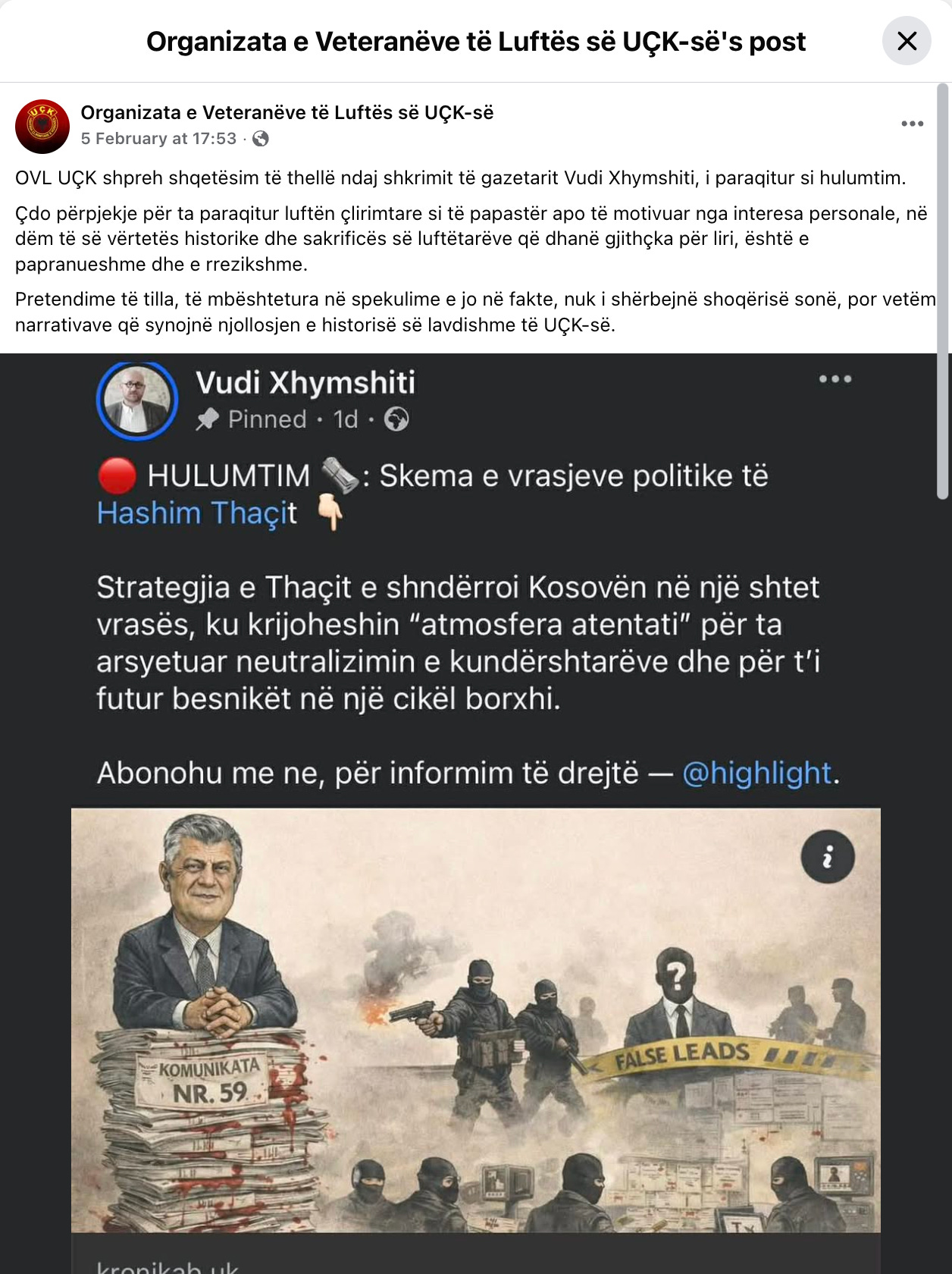
How an Investigation Triggered a Campaign, Not a Debate
When scrutiny becomes danger and journalism invites sanction, the response does not weaken an investigation; it completes it, revealing the coercive logic it set out to document. — Information Warfare
PRESS RELEASE: Journalist Vudi Xhymshiti Condemns Vandalism of Family Home in Kosovo
Investigative journalist Vudi Xhymshiti condemns the vandalism of his family home in Kosovo, calling it a criminal intimidation linked to his exposés on Serbian espionage networks. — Official Dispatches
NUJ condemns vandalism at Kosovo home of London-based journalist
Britain’s journalists’ union condemned vandalism at Vudi Xhymshiti’s family home in Kosovo, urging a inquiry into intimidation allegedly linked to his reporting on espionage networks. — Information Warfare