



Nasim Haradinaj spent Thursday doing something considerably more serious than defending Hashim Thaçi and his fellow defendants in The Hague. Across two television appearances and then on Facebook, he demonstrated a political instinct that Kosovo should have left behind with the violent disorder of its immediate postwar years. He warned that Kosovo and the wider Albanian world would burn if the Specialist Chambers delivered convictions. He said people who intended to celebrate such convictions would themselves burn. When challenged by Vullnet Krasniqi, an openly gay Kosovo journalist, he resorted to a degrading reference to haemorrhoids. When Gunpowder Chronicles Chief Editor Vudi Xhymshiti subsequently condemned his language, Haradinaj did not answer the substance of the criticism. He shared the article and declared that its author’s mission was against Kosovo’s freedom fighters, freedom, independence, sovereignty and final liberation. His supporters then supplied the next stage of the argument in the comments beneath him, insinuating Serbian ancestry, attaching the name “Drashkoviq” to the journalist and presenting criticism of Haradinaj as evidence of hostility towards the nation. Taken chronologically, the episode is not merely crude. It illustrates a political method in which criticism is converted into disloyalty, disloyalty into enemy status and enemy status into social permission for intimidation.
The starting point must be what Haradinaj actually said. On T7, discussing the forthcoming judgment in the case against Hashim Thaçi, Kadri Veseli, Rexhep Selimi and Jakup Krasniqi, Haradinaj declared1 that not only Kosovo but “all Albanian lands” would catch fire. When the journalist asked what he meant, he did not withdraw the remark or explain it as metaphor. He elaborated that individuals who were saying they would come to celebrate in the event of a conviction should understand that if they came while Kosovo was burning, “they will burn, they will not celebrate”. That distinction is crucial. Haradinaj was not describing an abstract risk of public disorder. He identified a category of people by a lawful political act they might undertake after a court judgment, celebration, and then associated that act with the prospect of those people burning. For an ordinary television guest this would already demand scrutiny. Coming from a man previously convicted of intimidation during criminal proceedings and obstruction by serious threat, it demands considerably more. The Kosovo Specialist Chambers records that Haradinaj was convicted in May 2022 of obstructing official persons, intimidation during criminal proceedings and violating the secrecy of proceedings. On appeal his convictions for intimidation, secrecy violations and obstruction by serious threat were affirmed, and his sentence was reduced to four years and three months.
That conviction is not a biographical footnote. It is the context through which Thursday’s words must be understood. Rehabilitation is not demonstrated by completing a sentence. It is demonstrated by subsequent conduct. A person convicted of intimidating participants in criminal justice should understand with exceptional clarity why language calculated to make people fear the consequences of their participation in or reaction to judicial proceedings is intolerable. Haradinaj instead placed himself again in the vicinity of precisely that conduct. He knows what intimidation means because a court has already explained it to him in the most consequential language available to a democratic state. He knows why the protection of witnesses and the integrity of criminal proceedings matter. Yet shortly before one of the most politically sensitive judgments in Kosovo’s recent history, he again introduced fear into the public atmosphere surrounding a judicial process. His present conduct therefore raises a legitimate and unavoidable question about whether the punishment he served produced any meaningful rejection of the behaviour for which he was convicted.
The prosecution’s final trial brief2 in the Thaçi case makes this atmosphere especially serious. It must be stated precisely that the brief represents the case advanced by the Specialist Prosecutor and not findings already made by the Trial Panel. Thaçi, Veseli, Selimi and Krasniqi remain entitled to the presumption of innocence until the judges pronounce their verdicts. But the prosecution’s allegations are directly relevant to understanding why threats, enemy labelling and public warnings cannot be casually dismissed in Kosovo. The brief alleges that public statements were used to promise punishment to perceived opponents, that rules and orders implemented a policy directed against them and that communiques presented deaths as warnings to others. It alleges that opponents were abducted, arbitrarily detained, tortured, killed and disappeared. It further alleges that the common purpose pursued by the accused involved gaining and exercising control in Kosovo by unlawfully intimidating, mistreating, committing violence against and removing people considered opponents, including people associated with the LDK and others regarded as insufficiently supportive of the KLA or the later provisional government.
The relevance to Haradinaj’s present rhetoric is not that his words prove those allegations. They do not. The relevance lies in the political technique. The prosecution describes a historical environment in which the category of “opponent” acquired consequences far beyond disagreement. Communiques did not merely criticise people. According to the prosecution, they issued explicit threats and warnings against them. The prosecution further argues that the effects of the alleged crimes extended beyond direct victims to families and communities because journalists, intellectuals and moderate political and community leaders were among those targeted, and because aggressive public statements amplified fear. It alleges that murder victims were placed in visible locations to “send a message”. The brief goes on to describe the collaborator label spreading through families, workplaces and friendships, families becoming ostracised and people becoming frightened that they might themselves be targeted. This is precisely why public figures in Kosovo carry a particular responsibility when they begin defining journalists or citizens as enemies of liberation.
Haradinaj then went to Klan Kosova and demonstrated another aspect of the same political temperament3. Vullnet Krasniqi challenged the contradiction in his argument. If Haradinaj believed the Specialist Chambers to be effectively Serbia’s court, Krasniqi asked, why was he speaking about Kosovo burning rather than Serbia. Haradinaj responded with the remark that Serbia could not be burned “with haemorrhoids”. Krasniqi is openly gay. We can responsibly assert that Haradinaj selected the word because of Krasniqi’s sexuality, although we probably should not pretend to know a speaker’s unspoken intention. But context is part of meaning. A public figure directing an anal bodily insult at an openly gay journalist during an aggressive confrontation cannot reasonably expect the audience to disregard the degrading sexual implication that the exchange carries. At minimum it was primitive and humiliating. If Haradinaj wishes to present himself as a defender of a Kosovo built upon Western democratic values, he should understand that the dignity of a gay journalist is not conditional upon whether that journalist asks agreeable questions. Britain and the democratic West do not recognise homosexuality as an invitation to ridicule. Nor should Kosovo.
The hypocrisy is difficult to miss. Political circles defending Thaçi have repeatedly sought validation and assistance from powerful Western figures irrespective of their sexuality. Richard Grenell is openly gay. Sexual orientation apparently ceases to matter when the Western political figure is considered useful4, yet a degrading insinuation suddenly becomes available when an openly gay Kosovo journalist5 challenges a nationalist argument on live television. Haradinaj should decide which civilisation he claims to represent. The Western political order whose support was indispensable to Kosovo’s liberation rests upon pluralism, individual dignity, equality before the law, protection of minorities, independent journalism and the proposition that political power can be challenged without retaliation. It does not rest upon commanders deciding which journalists are sufficiently patriotic, which citizens may celebrate a judgment or which families must remain silent because their grief conflicts with somebody else’s mythology.
What happened afterwards on Facebook6 is arguably more revealing than the television insult. Gunpowder Chronicles published an editorial7 stating that Haradinaj’s warning should not be softened as veteran rhetoric and arguing that telling citizens they would burn if they celebrated a conviction amounted to an attempt to terrorise them out of exercising lawful liberty.
Haradinaj shared the article and replied that his own mission protecting freedom fighters was sincere, while “according to me, your mission is against the freedom fighters, freedom, independence, sovereignty and the final liberation of Kosovo”.
That sentence deserves more attention than his theatrical spelling of Vudi Xhymshiti’s first name. Haradinaj did not demonstrate that the article contained a false quotation. He did not demonstrate that his previous conviction had been invented. He did not explain why saying that people “will burn” should be interpreted innocently. Instead he changed the identity of the journalist. The critic was no longer a journalist examining a public statement. He became a person allegedly acting against liberation, independence and sovereignty.
Then came the comments. One supporter insinuated that Xhymshiti’s name and supposed ancestry exposed who he really was. Another attached “Drashkoviq” to his identity. Others praised Haradinaj as a commander and liberator while treating criticism as hostility towards those categories. This demonstrate the foreseeable effect of his framing. Once a prominent political figure tells an audience that a journalist’s mission is against the freedom of his country, the argument is no longer confined to the merits of journalism. The journalist has been moved outside the community of legitimate disagreement. This is the intellectual architecture of intimidation. First comes delegitimisation. Then comes the suggestion of foreign allegiance. Then comes the social isolation of the target. Violence need not be explicitly ordered for the atmosphere around violence to become more permissive.
Our February investigation8 into allegations surrounding political killings after the war described precisely this kind of methodology. It did not present every allegation made by sources as judicially established fact, and neither should anybody reading it. Its central investigative proposition was that multiple sources described a system in which political opponents were first delegitimised, frequently through accusations of collaboration or betrayal, after which intimidation, violence, reputational destruction and the manipulation of narratives could become instruments for consolidating power. The investigation described what sources characterised as the creation of an “assassination atmosphere”. The significance of that phrase is not that every person participating in hostile rhetoric intends an assassination. It is that political violence becomes easier in a society where somebody has already performed the moral work of transforming the intended victim into an enemy.
This is not uniquely a Kosovo phenomenon. It is a doctrine recognisable from Serbian and Russian political operations as well. Authoritarian systems rarely begin by announcing that an intellectual, journalist or dissident must be destroyed. They begin by contesting his belonging. He is called a foreign agent, a traitor, an instrument of hostile powers or an enemy of the national interest. Serbia’s propaganda apparatus used such constructions throughout the wars of the 1990s and continues to employ variants of them against critics. Russia institutionalised the practice to the point that “foreign agent” became a legal and social category through which independent journalists, civil society organisations and dissidents could be isolated before being prosecuted, expelled or silenced. The method works because it replaces the question “Is what this journalist reported true” with the emotionally simpler question “Whose side is he on”. Once that substitution succeeds, evidence becomes secondary and hostility becomes patriotic duty.
That is why it is grotesque for Haradinaj to present this behaviour as defence of Kosovo’s liberation. Kosovo’s liberation was not accomplished so that Albanians could inherit the political methods of the governments that oppressed them. Serbia’s historical crime against Kosovo does not provide former Kosovo combatants with a moral licence to imitate Serbia’s treatment of critics. Russia’s assault upon independent journalism does not become less authoritarian when the vocabulary is translated into Albanian and wrapped in the flag of the KLA. A movement that fought against state repression cannot be honoured by reproducing intimidation in the state that emerged afterwards. If Kosovo is genuinely a Western republic, its moral test is not how loudly its politicians praise America or NATO. Its test is whether a powerless journalist can confront a powerful former commander without being transformed into an enemy of the nation.
Haradinaj’s rhetoric is particularly offensive to the families of Albanians murdered in Kosovo’s unresolved political killings. These families have lived for more than a quarter of a century with unanswered questions about fathers, husbands, brothers, political activists, intellectuals, journalists and former fighters who survived Serbia or helped resist Serbian rule and then died amid Kosovo’s postwar struggle for power. Their patriotism does not evaporate because their relatives belonged to the wrong political organisation. Their dead do not become less Albanian because somebody once called them collaborators. War veterans who opposed powerful postwar factions do not surrender their wartime service because they later demanded accountability. Journalists such as Xhemajl Mustafa, Bardhyl Ajeti and others, do not become enemies of liberation because their words inconvenienced men who claimed ownership over its legacy. The extraordinary obscenity of Haradinaj’s television warning is that some of the people he effectively tells may “burn” for celebrating a conviction could include precisely those families who believe a judgment might finally acknowledge the political violence that shaped their lives.
There is another distinction Haradinaj appears determined to erase. The KLA’s war and the conduct of individuals are not the same thing. Serbia conducted a campaign of repression, mass displacement and atrocities against Kosovo Albanians. NATO intervened. The KLA fought Serbian forces. None of those historical facts gives any individual permanent immunity from criminal law. If Thaçi is acquitted, the KLA’s historical role does not become more legitimate than it already was. If Thaçi is convicted, the KLA’s war does not retroactively become illegitimate. Courts judge defendants and charges. Nations that cannot distinguish themselves from individual defendants are not defending history. They are surrendering history to personalities.
The prosecution brief itself alleges a historical struggle over precisely this distinction between national legitimacy and political monopoly. It says that KLA and provisional government leadership sought to position themselves as the only legitimate voice of the Albanian people and alleges suppression and displacement of established Kosovo Albanian political leadership. It records public declarations asserting exclusive political authority and threats of punishment against people regarded as undermining that authority. Again, these are prosecution allegations rather than judicial findings. But Haradinaj’s present formulation should make every democrat uncomfortable because it reproduces the same conceptual error. He treats criticism of particular former commanders as criticism of liberation itself. He converts four defendants into the nation. Once that proposition is accepted, acquittal becomes patriotism and conviction becomes treason. No independent judiciary can operate safely under that doctrine.
British authorities should also be made aware of the material if threats or intimidating communications are directed towards journalists or organisations operating within Britain. It would be irresponsible for this newspaper to pronounce Haradinaj guilty of a British offence without a police investigation, prosecutorial decision and court judgment. It would be equally irresponsible to pretend British criminal law has nothing to say about threatening communications merely because the speaker is abroad. Section 181 of the Online Safety Act 2023 creates an offence concerning threatening communications where a message conveys a threat of death or serious harm and the required mental element is established. CPS guidance explains that the provision can apply where the recipient fears harm may be carried out by somebody other than the sender, and the legislation contains extraterritorial provisions. Whether Haradinaj’s particular communications satisfy every element is for investigators and prosecutors, not an editorial board, but the material should be preserved and assessed rather than dismissed as foreign political theatre.
The Kosovo Specialist Prosecutor should likewise examine Haradinaj’s statements to determine whether they have any legal relevance to the integrity of proceedings before the Specialist Chambers. The court cannot imprison somebody merely because his language is repellent, nor can his previous conviction become a permanent warrant for detention. But his previous conviction makes the present circumstances impossible to ignore. The Specialist Prosecutor should obtain the complete broadcasts, Haradinaj’s subsequent social media posts and relevant public responses, and assess whether the evidence establishes intimidation, obstruction or any other offence within the court’s jurisdiction. If investigators conclude that the statutory threshold for an offence is met, they should seek the measures available under law, including arrest where legally justified. Public safety cannot depend upon waiting for somebody to be physically attacked before institutions decide that a warning of violence deserved examination.
Kosovo’s domestic prosecution and police authorities carry an equally serious responsibility. They should establish exactly whom Haradinaj meant when he said people coming to celebrate “will burn”. They should ask whether he was predicting violence, threatening violence, encouraging violence or communicating knowledge of violence expected from others. They should ask whether he spoke for himself or for a wider criminal network prepared to destabilise Kosovo. They should identify whether any individuals have subsequently received direct threats. They should preserve the television recordings and online material. These are investigative questions, not declarations of guilt. That distinction is the difference between a democratic state and the political mentality Haradinaj appears to represent. Democracies investigate evidence. Political machines identify enemies.
Haradinaj may answer that he is merely defending the dignity of those who fought. That defence fails because nobody has challenged his right to defend them. He can spend every day until the judgment arguing that Thaçi and the other defendants are innocent. He can criticise the prosecution. He can attack the quality of evidence. He can call the Specialist Chambers institutionally flawed. He can organise demonstrations. He can celebrate an acquittal. He can sue Gunpowder Chronicles if he believes it has defamed him. Those rights are precisely what distinguish a republic from an authoritarian system. What he cannot reasonably demand is the unilateral right to decide that his political opponents are enemies of liberation and that citizens welcoming a verdict should contemplate being burned.
There is therefore no moral equivalence between Haradinaj and the journalists he attacks. One side is asking questions, publishing evidence and submitting its claims to public scrutiny. The other is a man with a final conviction for intimidation during criminal proceedings who has again chosen the language of menace around another criminal proceeding. One side can be sued, corrected, contradicted and investigated. The other has effectively told citizens that a lawful public reaction to a judicial verdict may end with them in flames. Haradinaj may wrap those words in the language of sacrifice, war and patriotism, but neither the KLA emblem nor the memory of Serbian oppression changes their meaning.
The more profound problem is that Haradinaj appears to believe the moral capital of wartime service remains transferable to every act committed afterwards. It does not. The war ended. The republic began. The moral standards changed because the object of liberation was supposed to be a society governed by law rather than loyalty. A man may have served his country honourably during one period of his life and behave disgracefully in another. A veteran may become a criminal. A liberator may intimidate. A former prisoner may fail to rehabilitate himself. History does not owe anyone a permanent certificate of virtue.
This newsroom will therefore make no concession to the idea that Nasim Haradinaj occupies some superior moral ground from which he may distribute certificates of patriotism. His criminal conviction is a matter of public record. His televised warning is a matter of public record. His Facebook accusation against our chief editor Vudi Xhymshiti is a matter of public record. The comments that followed it are visible. His conduct after imprisonment is available for the public to judge. On the evidence before us, he is not behaving as a moral guardian of Kosovo’s liberation. He is behaving like a political actor who still reaches instinctively for the old vocabulary of enemies, traitors, national betrayal and fear when confronted by scrutiny.
That vocabulary has already cost Kosovo too much. It was the language surrounding intellectuals who were murdered. It was the language surrounding political activists who were assassinated. It was the language that followed journalists who questioned powerful networks. It was the language applied to wartime figures who later found themselves on the wrong side of postwar power. The prosecution in The Hague now alleges that the labelling of opponents, aggressive public statements and warnings formed part of a wider environment in which violence was legitimised and fear spread through families and communities. Whether the Trial Panel ultimately accepts those allegations is for the judges. What Kosovo must decide independently of that verdict is whether it wishes to tolerate the political culture that made such allegations plausible in the first place.
Nasim Haradinaj’s remarks offer an answer of their own. Twenty seven years after liberation, a convicted intimidator can appear on national television, say that citizens celebrating a possible conviction will burn, insult an openly gay journalist who challenges him, then turn upon another journalist and declare his work hostile to Kosovo’s liberation, sovereignty and independence. Supporters can immediately begin supplying insinuations about Serbian identity and betrayal. And Haradinaj can still imagine that he occupies the position of patriot in this exchange.
He does not.
Patriotism is not the authority to frighten citizens. It is not ownership of the KLA. It is not immunity from investigation. It is not the power to transform a journalist into a traitor. It is not the right to tell the families of murdered Albanians when they may mourn or when they may celebrate. A patriot protects the republic even when the republic investigates his friends. A patriot accepts that Kosovo’s institutions belong equally to political enemies. A patriot understands that the victory over Serbia means nothing if Kosovo reproduces the Serbian doctrine that inconvenient journalists are enemies of the state.
The authorities in Kosovo should examine Haradinaj’s conduct now. The Specialist Prosecutor should examine whether his statements have consequences for proceedings under its jurisdiction. British authorities will be provided by our investigations desk and legal office with any material that may concern threats, intimidation or targeted hostility towards members of the press operating within Britain. Our newsroom will preserve what we have observed and will ensure that the relevant authorities can be made aware of it. That is not retaliation against Haradinaj. It is what responsible institutions and responsible journalism are supposed to do when a convicted intimidator begins speaking again in the language of fear.
Haradinaj said his mission is the defence of the freedom fighters. He is entitled to believe that. But freedom fighters do not own freedom after the war is over. Freedom belongs equally to the journalist questioning them, the widow accusing them, the witness testifying against them, the gay reporter challenging them, the political opponent denouncing them and the citizen who may decide to celebrate when a court delivers a judgment they consider just. The moment Haradinaj tells those people that their freedom ends where his political mythology begins, he ceases to defend liberation and begins to contradict its purpose.
Kosovo was not liberated so that its citizens could exchange fear of Belgrade for fear of their own former commanders. It was liberated so that nobody would again possess that power.
Nasim Haradinaj Tells Kosovo’s Victims They Will Burn

Nasim Haradinaj’s statement on Thursday should not be softened by euphemism, excused as veteran rhetoric or treated as another combustible performance from Kosovo’s political margins. A convicted criminal who has already served a prison sentence for intimidating people connected to criminal proceedings went on television and told citizens that if they celebrated a conviction in the
Nasim Haradinaj speaking on TV T7 on Thursday, Aug 20, 2026.
AUTHENTIC TRANSCRIPT in Albanian:
Nasim Haradinaj: Përndryshe, duhet me e dit që e jo Kosova, po tanë shqiptaria ka mu kall flakë. Se disa po mendojnë edhe me festu, po ata që do të festojnë ato ditë, besoj se do të kallen n’qatë zjarm.
Moderatorja: Për çfarë e keni fjalën zoti Haradinaj?
Haradinaj: E kom krejt fjalën për krejt çka thashë. Kemi individë që po thonë se do të vijnë me festuar nëse merret një vendim dënues, por edhe nëse merret ai vendim do të rrotullohet. Unë mendoj që ka me u eskalu çështja shumë keq, dhe do të digjet flakë ky vend. Do të digjet flakë Maqedonia, do të digjet flakë shqyptaria Nuk mundem me i marrë vendimet të cilat... Unë po them thjesht. Nuk mund me i marrë këta vendime të cilat e trazojnë një vend të cilin 26 shtete kanë bashkëluftuar me to dhe kanë pasur bashkëluftëtarë. Prandaj, ata nëse vijnë me festu n’Kosovë n’atë kohë që mendojnë kur Kosova digjet flakë, duhet me e ditë që kanë me u djeg ata, nuk kanë me festu.
The Evidence Against Hashim Thaçi
The prosecution argues Hashim Thaçi’s influence became criminal. The defence insists political leadership during war cannot substitute for proof beyond reasonable doubt of guilt.
The Evidence Against Hashim Thaçi

The prosecution’s case against Hashim Thaçi is built upon a proposition both simple in its formulation and extraordinarily demanding in the standard of proof required to sustain it.

Speaking on TV Klan Kosova on Thursday, Aug 20, 2026 posted on Facebook.
AUTHENTIC TRANSCRIPT in Albanian:
Vullnet Krasniqi: Pse mos me kall Serbinë përshembull, kur po thuni se ajo është gjykatë e Serbisë? Pse po thu me e kall Kosovën?
Nasim Haradinaj: Serbinë e kallin çiftat tu.
Vullnet Krasniqi: Qysh? A është Gjykata Speciale produkt i Serbisë, a po thuni?
Nasim Haradinaj: Dëgjo ti, I Kollan, nuk kallet Serbia me hemoroide.
Moderator: Haradinaj degjom, degjom, jo te lutem.
Nasim Haradinaj: Mos ma keqperdorni studion.
inaudible. …
Nasim Haradinaj: Unë e thashë që kallet Kosova, kallet Shqiptaria sepse, sepse i kallet e drejta dhe shpalljes shtet nga një ushtri çlirimtare në kombinim me NATO-n që ka pritur drejtën e shtetit.
Veterans for Sale: The OVL-UÇK Scandal
The OVL-UÇK disgraced Kosovo’s wartime legacy by appealing to Richard Grenell, an apologist for Serbian war crimes, pleading for intervention against international justice.
Veterans for Sale: The OVL-UÇK Scandal

A Letter of Dishonour: How the OVL-UÇK’s Appeal to Richard Grenell Betrays Kosovo’s Struggle for Justice
Vullnet’s Courage Sparks Kosovo’s Cultural Awakening
Kosovar journalist Vullnet Krasniqi’s public coming out challenges deep-seated norms, redefining courage and igniting dialogue in a nation still healing from its past.
Vullnet’s Courage Sparks Kosovo’s Cultural Awakening

In the late hours of December 27, 2024, Kosovar journalist Vullnet Krasniqi made a groundbreaking and deeply personal announcement: he came out publicly as gay. This moment, unprecedented in Kosovo’s public sphere, marks a watershed in the nation’s cultural and social landscape. It is an act of immense courage that speaks volumes about the resilience of an individual and the evolving identity of a young nation still grappling with the legacy of its tumultuous past.
Nasim Haradinaj’s Facebook Post, Aug 20, 2026.
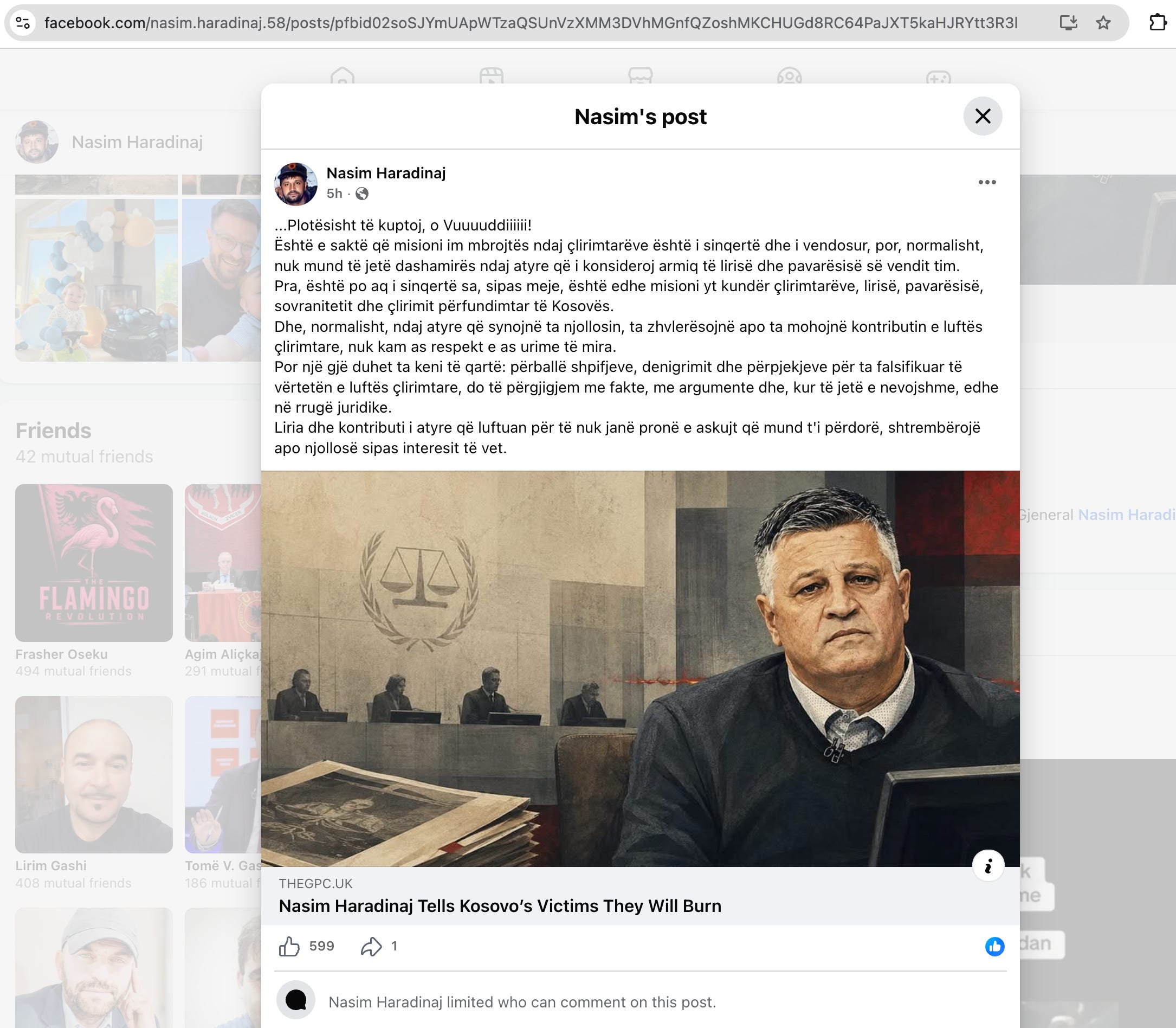


Nasim Haradinaj Tells Kosovo’s Victims They Will Burn
Nasim Haradinaj, previously convicted of witness intimidation, now warns that people celebrating possible convictions of Hashim Thaçi and others will burn. Kosovo must respond decisively.
Nasim Haradinaj Tells Kosovo’s Victims They Will Burn
Nasim Haradinaj’s statement on Thursday should not be softened by euphemism, excused as veteran rhetoric or treated as another combustible performance from Kosovo’s political margins. A convicted criminal who has already served a prison sentence for intimidating people connected to criminal proceedings went on television and told citizens that if they celebrated a conviction in the
Thaçi’s Assassination Manual
Thaçi’s strategy transformed Kosovo into a coercive state, where “assassination atmospheres” were manufactured to justify neutralising opponents and trapping loyalists in a cycle of debt.
Thaçi’s Assassination Manual

In April 2025 our newsroom began pulling at a thread that kept resurfacing in different forms and different places. It was a claim that a Russian Serbian Kosovan entangled network had been tasked, by Hashim Thaçi and associates, with undermining the Kosovo court process in The Hague. That work started as a national security story and it stayed one. But as we mapped names, timelines and incentives, we kept returning to an older question that Kosovo never fully answered after the war. How did power consolidate so quickly, and what did it cost.