

Inside Kosovo's Most Consequential Trial
Where investigative journalism meets international law, a grim picture emerges of Kosovo’s leadership using wartime structures to silence domestic opponents and consolidate absolute political control.
Can Liberation Survive the Truth?
Most readers will never reach page 690 of a 716-page prosecution brief. Few journalists do either. Court filings of this magnitude are rarely read cover to cover outside the courtroom itself. They are mined for headlines, searched for names, and reduced to isolated quotations that often reveal little about the architecture of the case they seek to explain. Yet the final pages of a prosecutor’s brief are where years of investigation, testimony and evidence converge. They are the place where the narrative stops expanding and begins to crystallise.
The document analysed here is the Public Redacted Version of the Corrected Prosecution Final Trial Brief submitted by the Specialist Prosecutor’s Office before the Kosovo Specialist Chambers in the case against Hashim Thaçi, Kadri Veseli, Rexhep Selimi and Jakup Krasniqi. Across 716 pages and almost 180,000 words, it represents the prosecution’s final legal account of what it says happened during and immediately after the Kosovo war, why it believes the evidence proves those allegations beyond reasonable doubt, and why, if the Trial Panel accepts its arguments, the accused should each receive a single sentence of 45 years’ imprisonment.
We begin where most analyses end.
From page 690 onwards, the prosecution no longer attempts to build its evidential case. It assumes that every witness has testified, every document has been admitted and every factual dispute has already been argued. What remains is something more revealing. These closing pages explain how the prosecution believes the evidence fits together. They dismantle the defence’s final arguments, address allegations of witness intimidation, define the legal significance of the accused’s alleged conduct, reject claims of mitigation, and ultimately present the prosecution’s complete theory of criminal responsibility. They are not merely the conclusion of a legal submission. They are its distilled meaning.
For us, those pages carry an additional significance. On 4 February 2026, The Gunpowder Chronicles published “Thaçi’s Assassination Manual”, an investigation built on multiple independent sources describing an alleged methodology through which violence, intimidation, disinformation and institutional influence were used to consolidate political power in post-war Kosovo. That reporting made no claim to replace a court of law, nor did it seek to pronounce guilt. It sought instead to understand method.
Reading the prosecution’s final pages through that earlier investigation presents an opportunity to examine whether two entirely different forms of inquiry, investigative journalism and international criminal prosecution, describe similar mechanisms. They do not speak with the same purpose, nor under the same standard of proof. One examines allegations through reporting, the other seeks convictions through law. Yet where their analyses intersect, they offer an unusually revealing perspective on one of the most consequential trials in Kosovo’s history.
Most people will never read page 690 of a 716-page prosecution brief.
We did.
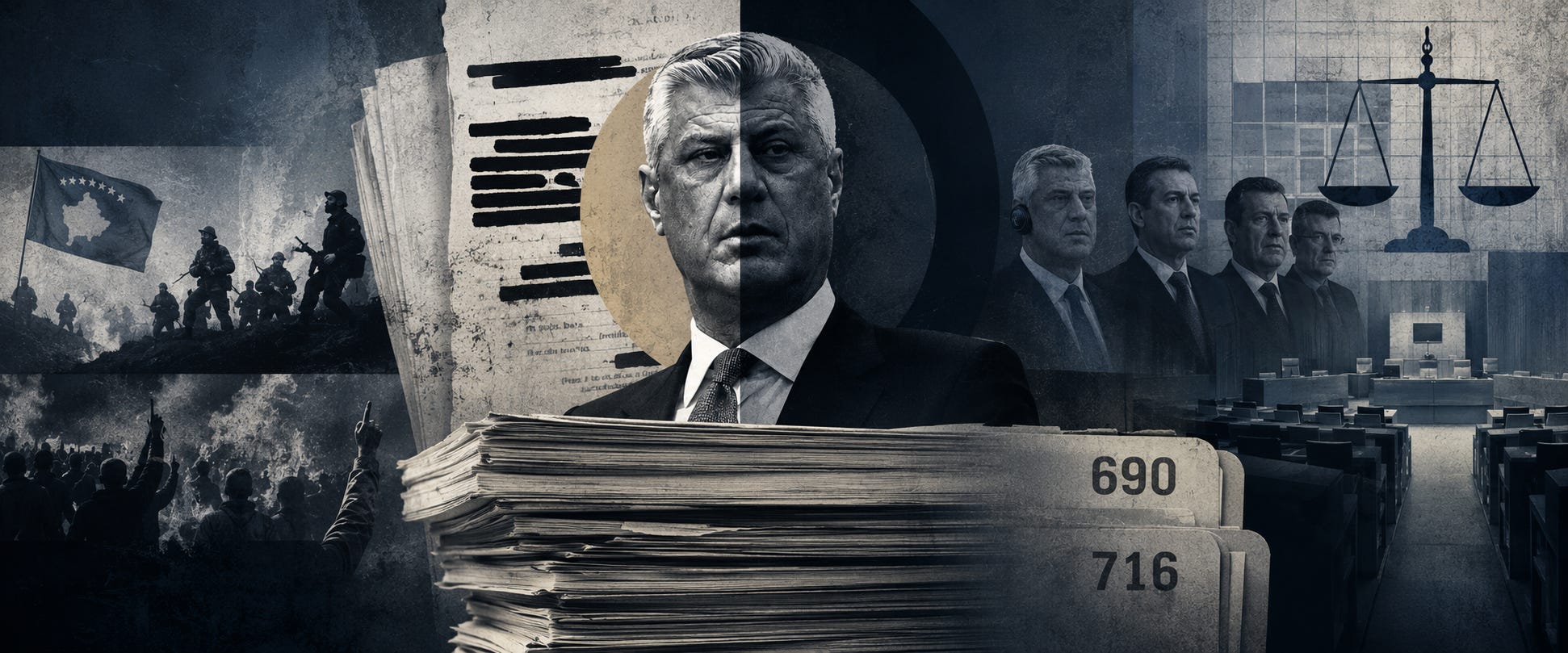
Our latest investigation examines where international criminal law and investigative journalism begin telling the same story, and why the final pages of the case against Hashim Thaçi may matter more than the first.
Subscribe to read the full report.
The Violent Reflexes of Hashim Thaçi's Dying Political Order

On 22 November 2025, months before I published our February investigation, the pattern was already visible in plain language. Hisen Berisha, a former PDK MP closely identified with the Thaçi era, wrote that it was time to strike, directly, strongly, and institutionally, against what he called propagandistic structures recycling Serbian narratives
Keep reading with a 7-day free trial
Subscribe to Gunpowder Chronicles to keep reading this post and get 7 days of free access to the full post archives.