

Buzhala Laughed When Asked About Abused Children
I asked Buzhala, as a father, whether he would distance himself from allegations involving abused children? He answered with emojis, laughter, and silence where responsibility should live.

It began, as these things often do, with a date that refuses to stay quiet.
On 11 December 2024, we published an investigation1 examining Berat Buzhala’s proximity to sanctioned figures, organised crime networks, and narratives that repeatedly aligned with interests hostile to Kosovo’s sovereignty. The piece was not written in the language of accusation but in the language of documentation. Names. Dates. Public statements. Sanctions already imposed by the United States. Editorial patterns visible to any reader willing to compare headlines over time. The question was not whether Berat Buzhala had opinions. It was whether a media figure with his reach had chosen, again and again, to place his power at the service of forces that corrode institutions rather than defend them.
Three days later, on 14 December 2024, Buzhala created a WhatsApp group.


The timing matters. It was not months later. It was not detached from the reporting. It was immediate. The group carried my name in its title. Not as a participant, but as a prop. I was added to it along with a small audience of commentators and associates. The group was not created to answer questions. It was created to stage ridicule.
From the first exchanges, the posture was clear. This was not a forum. It was a theatre. A place where mockery could be rehearsed collectively, where accountability could be turned into banter, and where the presence of others diluted responsibility. No single insult had to stand on its own. The group did the work.
I documented that group2. I published screenshots. I showed who was present and how the tone evolved. What mattered was not hurt feelings. What mattered was method. In fragile democracies, ridicule is not a joke. It is a tool. It teaches audiences which questions are forbidden by making the questioner look absurd.
The pattern repeated over the following year.
On 21 December 2025, Gunpowder Chronicles’ newsroom published another investigation3. This time the subject was Richard Grenell. The reporting was careful, restrained, and explicit about its limits. We reported that Patrick Byrne had made public allegations on InfoWars claiming that Grenell was compromised by Russian intelligence through illegal sexual conduct involving underaged boys in Serbia. We stated clearly that Byrne presented no documentary evidence. We stated clearly that no charges had been filed and no court had adjudicated the claims. We stated clearly that we sought comment from Grenell and received none, but threats4.
That was the story. Allegations made publicly. No proof presented. No denial offered. Silence where clarity would normally appear.
In journalism, that silence does not end inquiry. It begins it.
The obvious next step was to ask those who had publicly promoted Grenell as a political asset, a saviour figure, a lever of influence. Among them were Berat Buzhala and Artan Behrami. The questions I sent were direct and proportionate. Did Buzhala encourage Albanians in the United States to vote as if voting for Grenell. Did he meet Grenell in Tirana as he had previously written. Who was present. Did Grenell promise to intervene in international judicial processes. Does Buzhala consider such promises acceptable. In light of serious allegations now circulating publicly, does he distance himself.
These were not rhetorical traps. They were basic accountability questions.
The response was not an answer. It was laughter5.
Screenshots appeared on Buzhala’s social media. Cropped. Curated. Posted not to clarify but to invite amusement. Artan Behrami joined in. The message was unmistakable. The questions themselves were to be treated as comedy. The subject matter did not deserve adult language.
This week, that posture hardened into something darker.
After Buzhala blocked me on direct WhatsApp, I addressed him again, but this time in the group he had created. I wrote plainly that I was asking him as a parent. Not as a commentator. Not as a political actor. As a father. I asked whether he would distance himself publicly from a figure facing allegations of sexual abuse involving minors. I asked whether, if such harm had touched his own children or any child in Kosovo, he would still relativise it. I stated that these were legitimate public questions, and that silence was also an answer, but not an honest one.
His reply was not silence.
It was emoji laughter. Repeated. Public. Performed.


At that moment, the issue ceased to be about Grenell alone. It became about character. About ethical reflex. About the difference between not knowing and not caring to say.
I responded again, carefully. I wrote that an emoji response was not merely avoidance but a position. I asked again whether laughter would be his reaction if children had been abused. I named what should not need naming. Silence can be weakness. Irony can be cynicism. But laughter in the face of a subject involving abused children is a choice.
Instead of answering, the group escalated.
One participant, identified as Zymi, wrote a message that translated into a sexualised threat. Crude. Explicit. Directed at my media organisation. It was not metaphor. It was not satire. It was intimidation dressed as bravado. Buzhala’s reaction to that message was laughter.
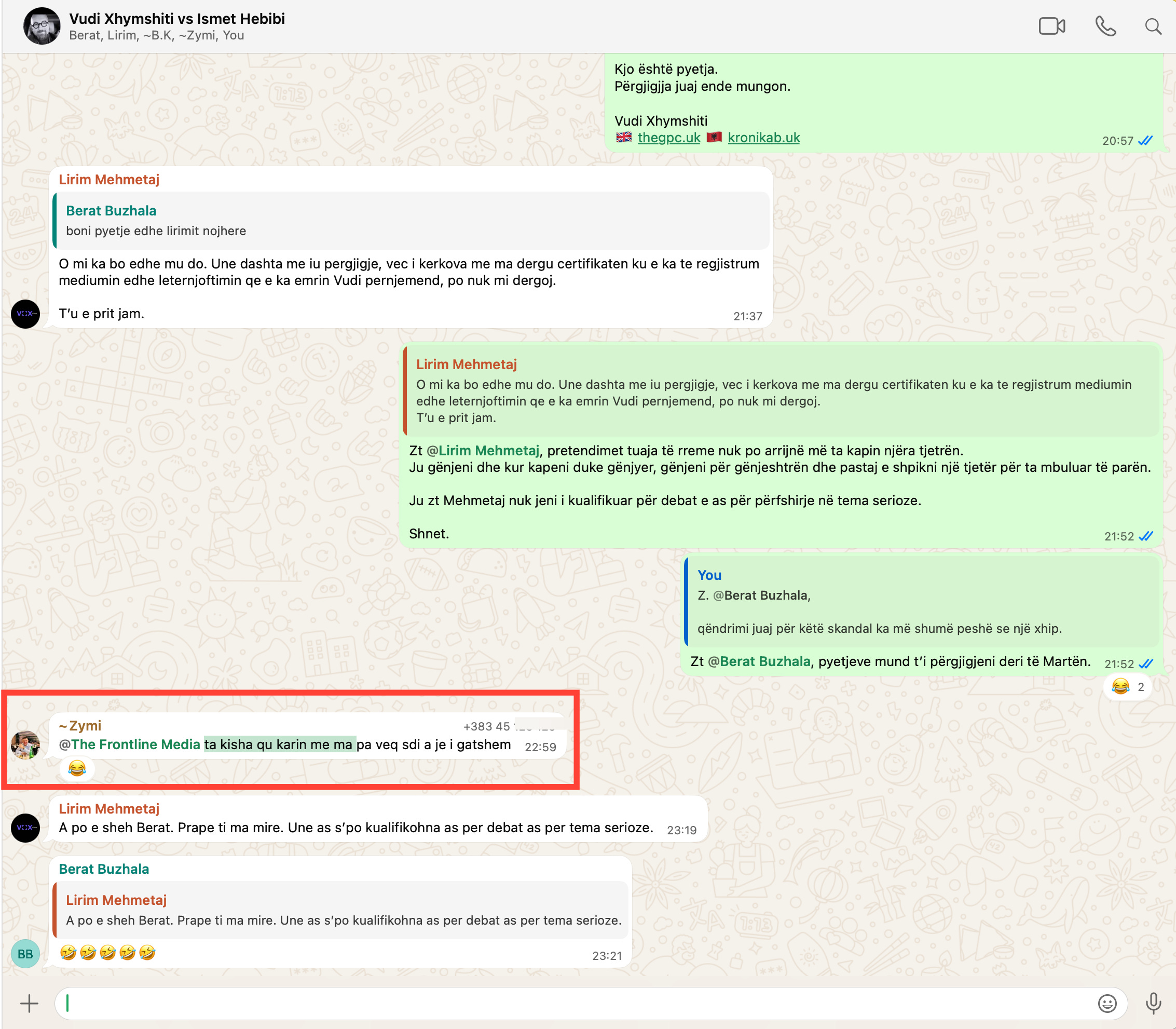
This is the point where analysis must be precise, because exaggeration is unnecessary. The record speaks for itself.
A media figure confronted with questions about his proximity to a man facing public allegations of child sexual abuse chose to laugh rather than answer. He allowed sexualised intimidation from an associate to stand without rebuke. He rewarded it with amusement. He did not say, this line is crossed. He did not say, children are not a joke. He did not say, answer or denial follows.
What does that tell us.
It does not prove that Berat Buzhala is a criminal. Courts exist for that. It does not prove that Richard Grenell committed the acts alleged. Evidence exists for that, or it does not. Journalism does not replace judges.
But it does tell us something unambiguous about responsibility.
A responsible public figure understands that when allegations involving minors enter the public sphere, tone matters as much as facts. A responsible parent understands that the first instinct should be distance, seriousness, and protection of children as a principle, even before evidence is weighed. A responsible journalist understands that ridicule is poison in such moments, because it trains audiences to treat harm as entertainment.
Buzhala failed that test in public.
His behaviour does not demonstrate caution. It demonstrates contempt. Not just contempt for me, but contempt for the idea that some subjects demand gravity regardless of personal alliances. He was not required to agree with the allegations. He was not required to accept them as true. He was required only to recognise their nature and respond accordingly.
He chose not to.
This is where the psycho sociological dimension becomes unavoidable. Power in Kosovo’s media ecosystem does not operate only through articles and broadcasts. It operates through posture. Through cues. Through the way influential figures model behaviour for their audiences. When a man with Buzhala’s reach laughs at questions involving potential abuse of children, he signals that proximity and loyalty matter more than moral clarity. He signals that the circle protects itself first.
That is why the trust question becomes untenable.
Trust in journalism is not built on claiming neutrality while performing cruelty. It is built on the willingness to pause when children enter the frame. It is built on the ability to say, this is not funny, even if it inconveniences me.
Buzhala could still answer the questions. He could still state his position plainly. He could still say whether he distances himself or not. He could still draw a line and say, whatever my politics, this subject demands seriousness.
He has chosen not to.
And that choice, repeated, documented, and performed in public, is not an accident. It is a window into how power behaves when it believes it is untouchable.
In societies under pressure, the most dangerous figures are not always those who shout. They are those who laugh at the wrong moment, and teach others to laugh with them.
Buzhala and Behrami Mocked Questions Over Allegations Linking Grenell to a Sex Scandal Involving a Minor

I am supposed to wait for the deadline.
Berat Buzhala, Sanctioned Figures, and the Threat to Kosovo’s National Security
Berat Buzhala’s troubling connections to U.S.-sanctioned figures like Grubi and Veselinovic expose a dangerous nexus of media manipulation, corruption, and threats to Kosovo’s national security. — The GPC I Unit.
Exposing Buzhala’s Playbook: Intimidation, Propaganda, and Misinformation in Kosovo
Berat Buzhala exploits media power in Kosovo, spreading Kremlin-aligned narratives, misinformation, and intimidation, undermining institutions, silencing dissent, and threatening stability. — The GPC Media Watch.
Patrick Byrne Goes Public, Richard Grenell Says Nothing
Patrick Byrne alleged on Infowars that Richard Grenell was compromised by Russian intelligence through sexual abuse of underaged boys in Serbia. Grenell has not responded. — The GPC I Unit.
Grenell Breaks Silence With Legal Threat After Investigative Report
Following our investigation into public allegations, Grenell offered no denial, no explanation, only a warning of legal action after publication. — The GPC I Unit.
Buzhala and Behrami Mocked Questions Over Allegations Linking Grenell to a Sex Scandal Involving a Minor
When allegations of a sex scandal involving a minor surfaced, Grenell stayed silent while Buzhala and Behrami mocked the questions instead of demanding accountability. — The GPC Media Watch.