



What follows is a media watch fact check by the Gunpowder Chronicles newsroom. We are not arguing tone. We are not trading opinions. We are doing the most basic job a newsroom can do when another outlet claims to be reporting from a transcript. We are placing the article next to the record1 and checking whether the story survives contact with what was actually said.
Nacionale published a piece2 suggesting that Jack Smith’s appearance before the House Judiciary Committee exposed something suspect about his work, his meetings with senior United States justice officials, and his past role at the Kosovo Specialist Chambers in The Hague. The article relies on insinuation rather than evidence, and it repeatedly nudges the reader toward conclusions that are not supported by the transcript. We are debunking it point by point, in plain language, by reading the deposition the way it is meant to be read.
This matters because in a small and politically saturated media ecosystem like Kosovo’s, insinuation does real damage. When a newsroom presents suggestion as fact and atmosphere as evidence, it does not merely misinform. It reshapes how institutions are perceived and how accountability is understood. Courts become suspect by association. Prosecutors are recast as political actors. Legal process is flattened into factional struggle. Over time, this corrodes public trust and makes it easier for powerful interests to argue that no judgment is legitimate unless it favours them. Debunking is not pedantry. It is a defensive act. It is how journalism prevents narrative manipulation from hardening into common sense, and how readers are protected from being led, quietly and without proof, toward conclusions that the record itself does not support.
First, the nature of the event itself.
Nacionale describes the 17 December 2025 session as an interview connected to investigations into Jack Smith over the Trump cases and election interference. That description omits the single most important fact in the opening minutes of the deposition. The committee staff states explicitly that the purpose of the proceeding is oversight of what they call the weaponisation of the Justice Department by the Biden Harris administration. This is not neutral language. It is a declared partisan premise. The transcript makes this clear immediately. Any reader deserves to know that the hearing is framed from the outset as a political attack, not as an evidentiary inquiry into misconduct. Nacionale does not foreground this. It allows the word investigation to do misleading work.
Second, the meetings with senior Justice Department officials.
Nacionale repeatedly emphasises that powerful figures in American justice showed interest in Smith’s work, with special weight given to Lisa Monaco. The article presents this as something that “stands out” and invites suspicion. The transcript does not support that framing.
Smith is asked directly who he met and what was discussed. His answer is unambiguous. He says that both meetings were about his work in The Hague. He repeats it. He narrows it. He adds that on the same trip he also spoke to the Human Rights Section about the work he was doing for the State Department. Then he delivers the line that collapses the insinuation entirely. He says they did not discuss the Trump investigations. That denial is clear, direct, and on the record.
Nacionale quotes parts of this exchange but treats the denial as disposable. Instead of reporting it as the central fact, the article continues to lean on the language of interest and power, as if repetition alone can outweigh a sworn answer. That is not reporting. That is steering.
Third, the description of Lisa Monaco as “the most powerful person in American justice” and the suggestion that her interest is itself suspect.
This characterisation does not appear in the transcript. It is an editorial flourish added by Nacionale. The transcript shows a deputy attorney general asking a senior prosecutor about his professional work. That is ordinary due diligence. There is no evidence in the record that Monaco sought to influence Smith, coordinate prosecutions, or discuss Trump matters. Nacionale converts a routine professional interaction into something ominous by layering its own language on top of neutral facts.
Fourth, the timing of the meetings.
Nacionale highlights that Smith travelled from The Hague to the United States during annual leave and met Justice Department officials in October 2022. This is accurate but irrelevant. The transcript does not suggest secrecy, urgency, or impropriety attached to the timing. Smith explains where he was and why he was there. Nacionale presents timing as if it adds suspicion, but offers no evidence that it does.
Fifth, the claim that Smith “left in the middle” the process against former KLA leaders.
This is one of the most misleading phrases in the article, particularly in a Kosovo context. The wording implies abandonment and betrayal. It is not Smith’s language. It is Nacionale’s.
What Smith actually says is straightforward. He says he liked his work in The Hague very much. He explains that for family reasons, if the right opportunity arose, he was willing to return to the United States. There is no claim of abandoning a case, no admission of leaving a process unfinished, and no suggestion of political pressure. Nacionale takes a personal explanation and reframes it as dereliction. That reframing is not supported by the transcript.
Sixth, the article’s handling of Smith’s denial regarding discussions of the Trump investigations.
Nacionale reports that Smith said the meetings were about The Hague and not about the investigations. Then it effectively ignores the significance of that statement. A newsroom acting in good faith would either accept the denial or challenge it with evidence. Nacionale does neither. It keeps the reader suspended in doubt without offering proof. That is not balance. It is insinuation.
Seventh, the broader context of the deposition.
The transcript shows a witness operating under legal constraints, with counsel repeatedly clarifying limits related to grand jury secrecy and a judicial order governing the special counsel report. This is not a freewheeling political actor. It is a former prosecutor navigating binding legal restrictions. Nacionale strips away that context and presents Smith as if he were casually revealing compromising details. The transcript shows the opposite.
Finally, the article’s underlying implication.
By repeatedly linking Smith, The Hague, powerful American officials, and the Trump prosecutions, Nacionale encourages the reader to see everything as one political scheme. The transcript does not support that conclusion. It shows a partisan committee pursuing a declared narrative, and a witness denying coordination and explaining routine professional conduct.
This is the central failure of the Nacionale piece. It does not misquote the transcript. It misuses it. It replaces evidence with atmosphere. It invites readers to feel suspicion without showing wrongdoing. It treats denial as an inconvenience rather than as a fact that must be addressed.
Our role as a media watch section is not to defend Jack Smith. It is to defend the reader’s right to accurate information. When an outlet takes a sworn record and bends it toward a predetermined story, the correction is not a matter of opinion. It is a matter of reading what is on the page.
The page is clear. Smith says the meetings were about his Hague work. He says the Trump investigations were not discussed. He explains his return to the United States in personal terms. The committee declares its partisan purpose at the outset. None of these facts support the conclusions Nacionale nudges its readers toward.
Anything beyond that is not fact. It is narrative.
Nacionale Versus the Record
A fact check on how Berat Buzhala’s outlet bends a sworn transcript into political insinuation, and why the manipulation matters for Kosovo’s justice and public trust.
Nacionale is not an abstract platform or an anonymous newsroom culture. It is a privately owned outlet controlled by one individual, Berat Buzhala. Any serious media watch must begin with that fact, because ownership in Kosovo’s media ecosystem is not incidental. It shapes editorial lines, determines which narratives are amplified, and defines which stories are framed as scandal and which are treated as background noise.
Berat Buzhala emerged in public life as a politician aligned with the Democratic Party of Kosovo during the post-war consolidation period3. When his formal political role ended, he did not retreat from influence. He changed instruments. Over the past decade he built a media network that includes Gazeta Express and later Nacionale, outlets that present themselves as irreverent, anti-establishment, and oppositional, while repeatedly aligning their editorial thrust with the interests of a very specific political and geopolitical bloc.
Our investigations since 2022 show a consistent pattern. Buzhala’s platforms minimise or mock Kosovo’s security concerns when Serbia escalates4. They delegitimise Kosovo’s institutions when those institutions confront organised crime, parallel Serbian structures, or war crimes accountability. They elevate figures sanctioned by the United States Treasury or under investigation for corruption5, often framing them as victims of Western hypocrisy rather than as subjects of scrutiny. When challenged, Buzhala does not respond with documentation or correction. He responds with ridicule, screenshots, and performative dismissal. This is not a stylistic quirk. It is a defensive tactic.
The pattern sharpened in 2023 and 2024, when our reporting documented Buzhala’s acknowledged business dealings with Zvonko Veselinovic, a Serbian organised crime figure sanctioned by the United States. Rather than offering transparency, Buzhala treated the matter as a joke. Around the same period, he publicly admitted that Kosovo’s intelligence services had taken an interest in him over alleged Russian links, again framing the issue as something humorous rather than serious. In any functional media culture, either admission would trigger sustained scrutiny. In Kosovo’s, they were normalised.
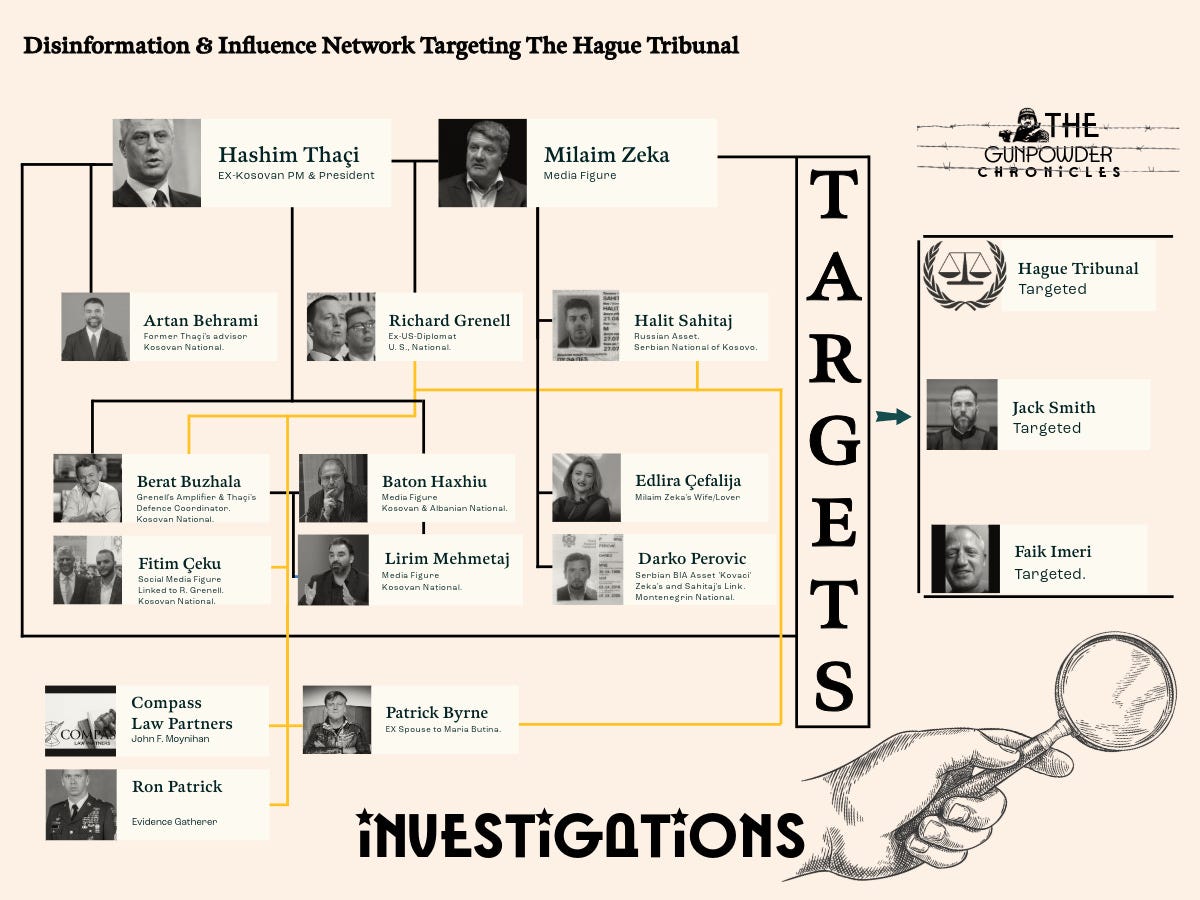
By late 2024, the line between media narrative and political operation became impossible to ignore. Buzhala openly championed Richard Grenell as a decisive external actor for Albanian interests, writing that if Albanians in the United States were voting for Trump6, they were in reality voting for Grenell. He further claimed that Grenell had privately pledged to secure the release of Hashim Thaçi and other detainees from The Hague. That assertion alone should have triggered alarm. A promise to interfere in an international judicial process is not commentary. It is either fantasy or an admission of intent to subvert the rule of law.
From that point onward, Nacionale’s editorial behaviour tracked closely with efforts to discredit the Kosovo Specialist Chambers and its prosecutors. Articles blurred legal process into political conspiracy. Prosecutors were recast as partisan operatives. The court was framed as an extension of American domestic politics rather than as a tribunal established by Kosovo’s own parliament under international agreement7. This framing did not arise organically. It mirrored talking points circulating in networks actively seeking to dismantle the court.
Our investigations into disinformation operations targeting The Hague tribunal have shown that Buzhala’s outlet does not operate in isolation. It functions within a broader ecosystem that includes political operatives, media figures, and criminal intermediaries working to erode confidence in the court. In that ecosystem, Jack Smith is not treated as a prosecutor bound by law, but as a symbolic obstacle to be personalised, politicised, and delegitimised.
That context matters when reading Nacionale’s article on Smith’s House Judiciary appearance. The piece is not an isolated lapse in judgment or a single instance of careless framing. It is consistent with a long-running editorial line that seeks to fuse three ideas into one narrative. That Smith is politically compromised. That the Hague tribunal is therefore illegitimate. And that Donald Trump’s personal war with Smith can be repackaged, falsely, as a pathway to freeing Kosovo detainees.
This is why the misrepresentation of the transcript is not a technical error. It is functional. It allows Nacionale to suggest conspiracy without asserting it, to plant suspicion without proving it, and to advance a political objective while maintaining plausible deniability. When denial appears in the transcript, it is treated as background noise. When routine professional conduct appears, it is described as ominous. When a partisan hearing declares its purpose at the outset, that declaration is quietly buried.
We do not claim that every reporter working under Buzhala shares the same intent. But ownership matters. Editorial incentives matter. And patterns, over time, matter more than any single article. Nacionale’s treatment of Jack Smith fits a trajectory we have documented for years, one in which journalism is used not to test claims against evidence, but to soften the ground for conclusions already chosen.
That is why this fact check exists. Not to litigate motives, but to put the record back in front of the reader. When a transcript is read plainly, without editorial fog, the insinuations collapse. And when the insinuations collapse, what remains is not scandal, but a clear view of how media power is being used in Kosovo today.
US House Judiciary — Transcript Record.
Transkripti i marrjes në pyetje të Jack Smith: Pse njerëzit e fuqishëm të drejtësisë amerikane interesoheshin për Gjykatën Speciale? — Nacionale.
Complex Interplay of Media Influence and Political Power in Kosovo — FRONTLINER.
Mercenary Journalism: Berat Buzhala’s Role in Destabilising Kosovo’s Democracy
Berat Buzhala’s mercenary tactics, hidden affiliations, and misuse of media to undermine Kosovo’s democracy demand urgent action to protect national sovereignty. — The GPC Media Watch.
Berat Buzhala, Sanctioned Figures, and the Threat to Kosovo’s National Security
Berat Buzhala’s troubling connections to U.S.-sanctioned figures like Grubi and Veselinovic expose a dangerous nexus of media manipulation, corruption, and threats to Kosovo’s national security. — The GPC I Unit.
Në mes të Chris Hillit dhe Richard Grenellit, unë do ta votoja Grenellin — Berat Buzhala, Nacionale.
Kosovo’s Veterans and Ministers Are Playing with Fire
Kosovo’s war crimes court, born of its own parliament, now faces political attacks as ministers and veterans risk trading liberation’s legacy for the brittle currency of impunity. — The GPC Balkan Watch.