
Edi Rama Is Not Kosovo’s Brother. He Is Its Liability.
Edi Rama congratulates Kosovo publicly while undermining it privately, a pattern that weakens our security, distorts justice, and serves Serbian strategic interests.
On Sunday 28 December 2025, Kosovo went back to the polls to break a year of deadlock. By the time the counting ran late into the night and early Monday, the direction of travel was clear, Albin Kurti and Lëvizja Vetëvendosje had emerged with enough strength to form the next government without begging reluctant partners for permission to govern. The paralysis that had frozen legislation, delayed financing, and fed the usual Balkan rumours of collapse was, at least on paper, over1.
I watched the reaction unfold the way it always does in this region, not first through institutions, but through posts. Edi Rama moved quickly. He did not speak in policy. He spoke in sentiment, seasonal symbols, and the oldest form of plausible deniability in Albanian politics, a blessing that sounds like solidarity while leaving him room to do the opposite tomorrow.
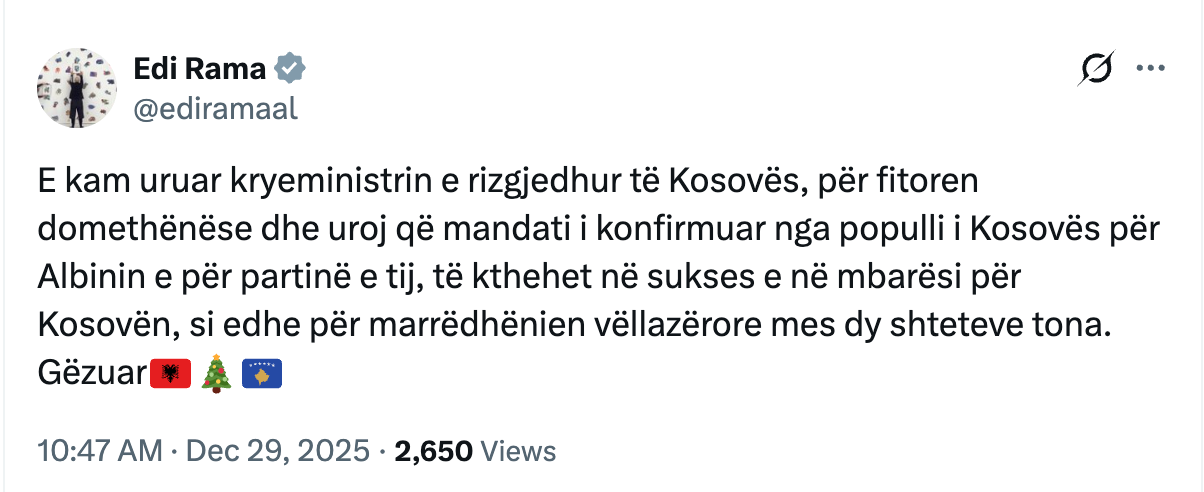
“I congratulated the re elected Prime Minister of Kosovo for the meaningful victory and I hope that the mandate confirmed by the people of Kosovo for Albin and his party turns into success and prosperity for Kosovo and also for the brotherly relationship between our two states. Cheers.”
He added the flags and the Christmas tree. Albania. Christmas. Kosovo. A neat little picture of kinship. A stage set built from emojis.
I have learned to treat Rama’s public tenderness as a warning sign, not a reassurance. I do not read his words as a window into intent. I read them as a method of control. Rama’s problem has never been that he dislikes Kosovo. His problem is that he treats Kosovo as material, a cause to be performed, a stage to be managed, a neighbour whose sovereignty is always one step behind his need to look like the region’s indispensable man.
In public, he wants to be seen as Kosovo’s brother. In practice, he has positioned himself as Kosovo’s handler.
That is why his congratulation matters. It is not the warmth that counts. It is the pattern that sits behind the warmth. Kosovo Albania relations are not stranded by accident, and they are not stranded because Kosovars suddenly stopped believing in the idea of unity. They are stranded because Rama has spent years replacing partnership with hierarchy, and he has done it so consistently that even his greetings now land like propaganda.
I say this as someone who has watched the relationship corrode in real time, through the choices Rama makes when the cameras turn off.
He has repeatedly inserted himself into Kosovo’s sovereign questions as if Prishtina were a department and Tirana the headquarters. He has floated initiatives in foreign capitals that touch the core of Kosovo’s constitutional red lines without Kosovo’s consent. He has sold regional projects that required Kosovo to sit at the table as a “status neutral” entity, a diplomatic euphemism that does exactly what Serbia needs, it smuggles non recognition into polite language and makes Kosovo’s statehood negotiable by administrative formatting.
When Kosovo refused to accept that, Rama did not treat Kosovo’s refusal as the act of a sovereign partner. He treated it as disobedience. The tone from Tirana was always the same, be practical, be flexible, do not make trouble. In the Balkans, that is not advice. That is a demand to shrink.
The consequences of that demand are not abstract. Serbia thrives on Albanian division. Every time Rama positions himself as the reasonable voice who can scold Kosovo into compliance, he creates room for Belgrade to apply pressure and then point at Tirana as proof that Kosovo is the problem. Rama does not need to sign a pact with Vucic to serve Vucic’s interests2. He merely needs to normalise the idea that Kosovo’s sovereignty is something to be managed, corrected, moderated.
He has normalised it.
The most dangerous arena where this normalisation shows is security. Intelligence is not poetry. It is trust, vetting, loyalty, and accountability. It is where small states either survive or become penetrated.
I documented3 what happened when Vlora Hyseni, dismissed from a senior role within Kosovo’s intelligence structures under classified provisions in 2021, resurfaced inside Rama’s orbit and later rose to lead Albania’s State Intelligence Service. The details matter less than the principle. A leader who claims brotherhood with Kosovo had an obligation to understand what such an appointment would signal in Prishtina and in every security service that watches the region. It signalled that Kosovo’s most sensitive concerns could be brushed aside if Rama found it useful. It signalled that the architecture of trust between the two states could be rearranged without explanation and without oversight.
Rama did not treat Kosovo as a partner entitled to reassurance. He treated Kosovo as a neighbour expected to swallow it.
Then there is the matter of accountability and justice, another domain where Rama’s behaviour has repeatedly weakened Kosovo’s position in the eyes of Western allies.
I have written about Rama’s role in pushing for the creation of the Kosovo Specialist Chambers4, and his later pivot into attacking it once its work threatened the political circle he preferred. This is not mere hypocrisy. It is a strategic act. When the prime minister of Albania undermines Kosovo’s most sensitive accountability mechanism, he does not only speak to Albanians. He speaks to Brussels, Washington, and every sceptical diplomat who already doubts Kosovo’s institutional maturity. He hands them a line, Kosovo cannot handle justice, Kosovo cannot handle the rule of law, Kosovo cannot handle itself.
That narrative is worth more to Serbia than a thousand speeches.
And when I asked questions that went directly to Kosovo’s safety, questions about suspected routes, seizures, and the possibility that Serbian linked weapons flows could exploit regional corridors, the Albanian government’s posture was not one of clarity. It was ridicule. Their spokesperson chose mockery rather than a substantive denial5. In security matters, ridicule is not a tone. It is a tactic. It is the attempt to make the question itself look unserious so the public stops asking it.
This is how relationships die in the Balkans. Not in a dramatic break. In a slow replacement of trust with performance.
So when Rama writes that he hopes Kurti’s renewed mandate will be a success for Kosovo and for “the brotherly relationship between our two states,” I do not take it as a blessing. I take it as an attempt to keep the brand alive while the substance rots. He wants the imagery of brotherhood because it buys him cover. It allows him to posture as Kosovo’s ally even as his decisions repeatedly place Kosovo at a disadvantage.
I am not interested in the emojis. I am interested in the effect.
And the effect of Rama’s foreign policy on Kosovo has been consistent, Kosovo is isolated when it asserts sovereignty, lectured when it defends itself, bypassed when its constitutional red lines become inconvenient, and softened into “reasonableness” whenever Serbia requires Kosovo to be portrayed as the stubborn party.
That is not brotherhood. That is leverage.
I have no need to romanticise the relationship between Kosovo and Albania. I am not arguing for sentiment. I am arguing for sovereignty and security. In a region where Serbia has repeatedly shown it will use violence, intimidation, and infiltration to weaken Kosovo’s institutions, Kosovo cannot afford a neighbour who performs solidarity while treating Kosovo’s agency as optional.
Rama is not a misunderstanding. He is a pattern. And the pattern is a threat.
He is a threat not because he shouts against Kosovo, but because he smiles while he narrows Kosovo’s room to move. He is a threat because he has made himself the intermediary, the editor, the moderator of Kosovo’s fate in rooms where Kosovo should speak for itself. He is a threat because he has repeatedly shown that his personal regional project matters more to him than Kosovo’s national security needs.
I can accept a rival. I cannot accept a brother who keeps stepping between me and the door, calling it love, and deciding whether I am allowed to leave.
The Prime Minister and the Spy Suspect
Two hours after posting a rallying call on Facebook »LIRIA KA EMËR… mijëra zemra do të bashkohen këtë të premte… për të kërkuar njëzëri DREJTËSI PËR ÇLIRIMTARËT« Edi Rama had, intentionally or not, distilled a decade of his Balkan statecraft into a single performance, the prime minister as impresario of grievance, the red theatre-curtain of patriotism drawn tight over a stage where law is the unwanted extra. The message is familiar by now. Albania’s strongman casts himself as steward of a wounded memory, even as his policies
Landslide Vote Restores Political Stability in Kosovo
With over half the vote, Vetëvendosje ended a year long deadlock, empowering Kurti to govern alone and confront corruption, organised crime and Serbian pressure directly. — The GPC Balkan Watch.
Is Albania Looking Away from Serbia’s Arms Trail to Kosovo?
Sources, seizures and silence raise a disturbing question, could Albania’s pro-Belgrade posture be creating space for Serbia-linked arms flows aimed at undermining Kosovo’s security architecture. — The GPC I Unit.
The Spy Who Wasn’t Vetted
A fired Kosovar spy now leads Albania’s intelligence, sparking fears over loyalty and foreign sway as Edi Rama enters a fourth term, has the shadow state overtaken the real one? — The GPC I Unit.
Edi Rama’s Cynical War on Truth and Justice
Rama, architect of Kosovo’s war crimes court, now torches it to shield allies and rewrite history, betraying justice, Kosovo’s sovereignty, and the victims his politics trample. — The GPC Europe Watch.
Is Albania Looking Away from Serbia’s Arms Trail to Kosovo?
Sources, seizures and silence raise a disturbing question, could Albania’s pro-Belgrade posture be creating space for Serbia-linked arms flows aimed at undermining Kosovo’s security architecture. — The GPC I Unit.


