

The Dark Side of Facebook
Mark Zuckerberg's Meta silences journalists, protecting powerful interests while stifling free speech. In doing so, they perpetuate violence and erode the foundations of democracy.

I’ve been a journalist for nearly two decades, covering conflicts, displacement, and human suffering in some of the most dangerous corners of the world. I’ve seen entire cities turned to dust, families torn apart, and children buried beneath the rubble of wars they never chose. It’s my job to bear witness, to document the atrocities that governments and military regimes would rather keep hidden. But in the age of social media, a time when we’re supposed to be more connected and informed than ever, something far more insidious is happening: the gatekeepers of the digital world are silencing those of us who dare to speak the truth.
On October 7, 2024, I posted an article on Facebook reflecting on the year that had passed since the October 7, 2023, Hamas attack and the subsequent Israeli military bombardment of Gaza. The piece, titled "One Year of Unrelenting Grief," was an attempt to make sense of the devastating cycle of violence that has claimed over 41,800 lives on both sides of the conflict. I drew on statements from world leaders—British Prime Minister Keir Starmer, French President Emmanuel Macron, German Chancellor Olaf Scholz, who expressed their sorrow for the Israeli victims, while often glossing over the unimaginable suffering of the Palestinians. I also included a critical analysis from human rights organisations like Amnesty International, which pointed to the decades of displacement and violence against Palestinians as the root cause of this ongoing tragedy.
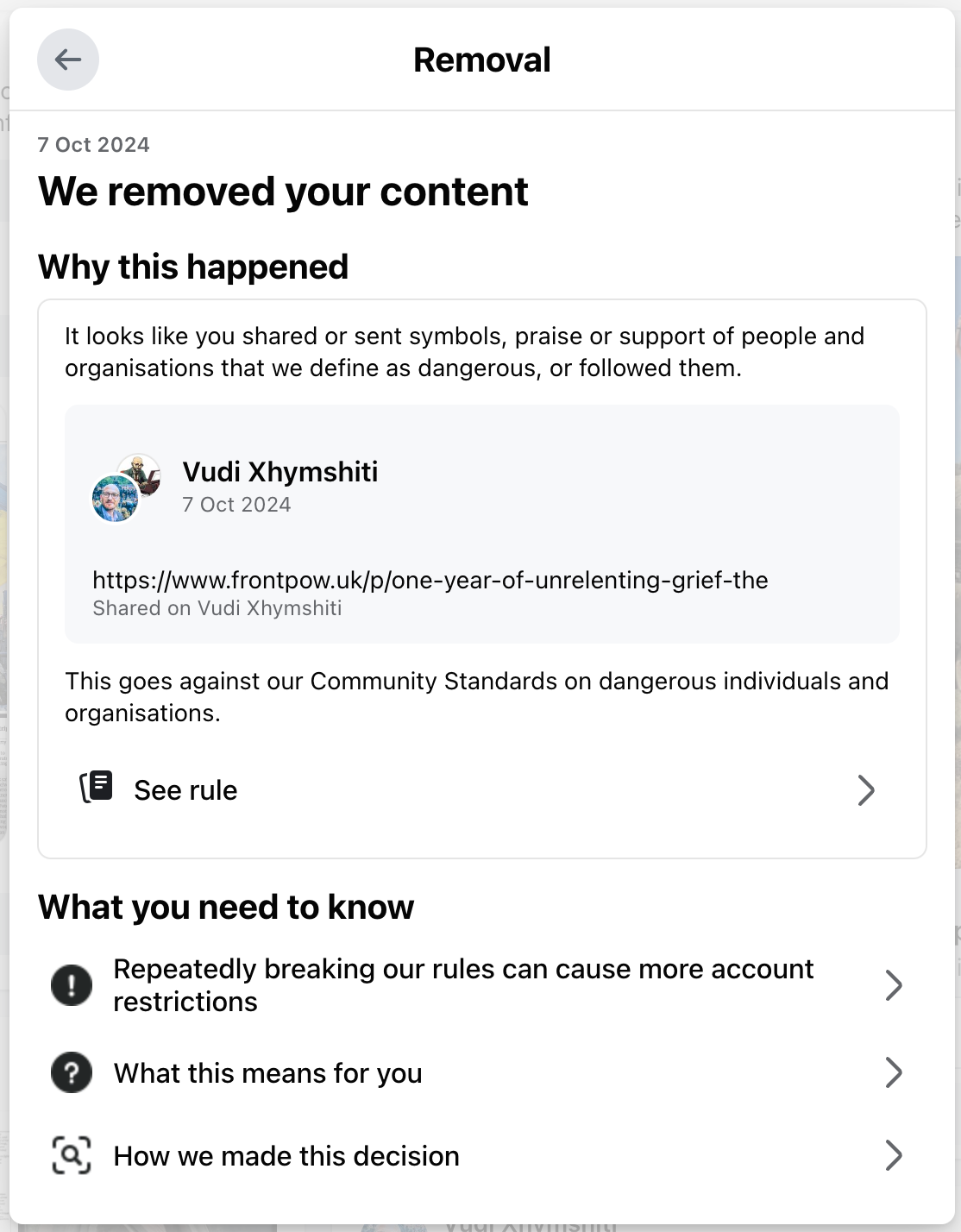
The article was factual, critical, and necessary. But within minutes of posting it, Facebook took it down, citing their “Community Standards on Dangerous Individuals and Organisations.” The notification I received claimed I had violated their policies by sharing content that glorified or supported terrorism. I was stunned. This was not a piece of propaganda, nor was it an endorsement of violence. It was journalism, plain and simple. Yet Facebook had deemed it too dangerous for public consumption.
Let me be clear: I’ve faced censorship before. I’ve been detained, threatened, and had my work blacklisted by authoritarian governments. But this was different. This wasn’t happening in a war zone or under a dictatorship. This was happening on a social media platform that claims to champion free speech and open dialogue, a platform owned by a man who built his empire on the premise of connecting people and fostering global conversation. Mark Zuckerberg’s Facebook, however, has become a dystopian nightmare where algorithms, not human editors, decide what we’re allowed to read, see, and discuss.
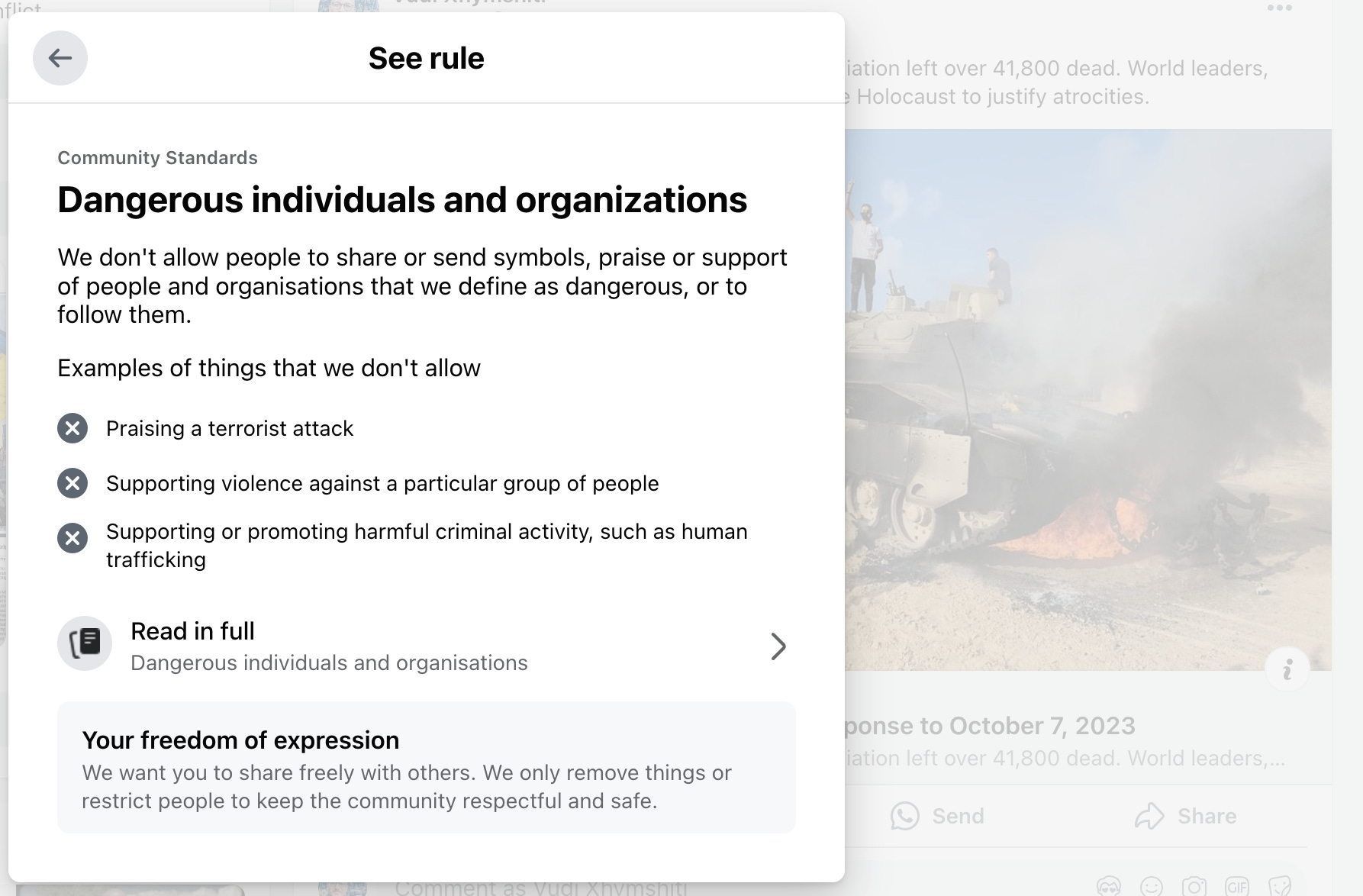
When I clicked on the link to “See why” my content had been removed, Facebook’s justification was riddled with hypocrisy.
Their policy, it said, aims “to prevent and disrupt real-world harm,” and forbids content that supports or glorifies dangerous organisations.
But here’s the catch: my article didn’t glorify or support anyone. It was a balanced, critical examination of both Hamas’s attack and Israel’s brutal retaliation. If anything, it condemned the violence on all sides. But Facebook’s algorithm didn’t care. To them, any criticism of Israel, or any discussion that complicates the binary narrative of “good vs. evil” — is apparently tantamount to supporting terrorism.
This isn’t just an isolated incident. Facebook’s selective enforcement of its so-called community standards has been well-documented. The platform regularly removes content that challenges mainstream narratives, particularly when it comes to sensitive geopolitical issues like Israel and Palestine. And while Facebook claims to make exceptions for news reporting, neutral discussion, or condemnation of dangerous organizations, the reality is far more troubling. If your article doesn’t fit neatly into the sanitized version of events preferred by governments and corporate advertisers, it gets flagged, removed, and buried in the digital abyss.
“Facebook’s Unpredictable Algorithm Removes Content on Srebrenica Genocide” — Balkan Insight.
Facebook and Meta, under the stewardship of Mark Zuckerberg, have effectively become tools of censorship, more interested in protecting their corporate interests than in upholding the values of free speech they so proudly claim to champion. And let’s not be naive: Zuckerberg’s allegiance isn’t to the truth. It’s to the shareholders, the lobbyists, and the powerful political figures who have a vested interest in controlling the narrative.
Systemic Censorship of Palestine Content on Instagram and Facebook — Human Rights Watch.
I can’t help but wonder what Zuckerberg himself would have done had he been in charge of communications during the darkest chapters of our recent history. If he had been in 1940s Germany, would he have censored stories about the atrocities being committed in Nazi concentration camps, all under the guise of “preventing real-world harm”? Would he have silenced journalists who tried to expose the horrors of the Holocaust, fearing that such stories might disrupt the fragile social order or provoke backlash from the regime?
In today’s world, the atrocities continue, albeit under different circumstances. Israel’s military bombardment of Gaza, which Amnesty International and others have called a form of collective punishment, has left thousands of civilians dead, many of them children. And yet, we’re told that to speak out against this is to support terrorism. We’re told that to call for an end to arms sales to Israel is to be anti-Semitic. This is the chilling reality of the digital age: the very platforms that were supposed to empower us to speak truth to power are now being used to silence us.
And I ask Zuckerberg directly: what scared you? What about my article, about the unvarnished truth it contained, frightened you and the paymasters to whom you’ve sold your soul? Was it the criticism of Western governments for their complicity in Israel’s actions? Was it the reminder that the violence didn’t start on October 7, 2023, but rather decades earlier, with the Nakba of 1948, when over 700,000 Palestinians were forcibly displaced from their homes? Or was it the mere fact that I dared to acknowledge the Palestinian dead with the same humanity afforded to Israeli victims?
In removing my article, Zuckerberg and Meta have made their position clear: they are not neutral platforms. They are active participants in the suppression of dissenting voices, the erasure of uncomfortable truths, and the silencing of journalists who refuse to toe the line. And by doing so, they are complicit in the very violence they claim to prevent.
The removal of my article is not just an attack on me as a journalist. It’s an attack on all of us who believe in the power of the free press. It’s an attack on the very foundations of democracy, which rely on the ability of the press to hold the powerful to account. By censoring stories like mine, Zuckerberg is doing the bidding of those who would rather the public remain ignorant, complacent, and complicit.
So here’s my challenge to Zuckerberg and to the executives at Meta: if you truly believe in free speech, if you genuinely care about preventing real-world harm, then let journalists like me do our jobs. Let us tell the stories that need to be told, without fear of censorship or retribution. Because as long as you continue to silence us, you are not just suppressing speech and information, you are helping to perpetuate the very violence you claim to oppose.
In the end, history will remember who stood on the side of truth and who stood on the side of power. And right now, Zuckerberg, you are firmly on the wrong side.
That last image speaks volumes. Bravo for fearlessly continuing to speak truth to power.