

The CIA Phantom of Gllogjan
THE REALITY CHECK: How does a Tennessee private security contractor become the "CIA’s Balkan Chief" overnight? In Gllogjan, Ron Patrick stood by Ramush Haradinaj, fuelling a baseless spy-thriller.

On March 24, 2026, a claim began circulating across Kosovo’s media and social platforms that a figure described as the “chief of the CIA for the Balkans” had attended a commemorative gathering hosted by Ramush Haradinaj in the village of Gllogjan.
The reports appeared almost simultaneously and in near identical language. Among the outlets that published or amplified the claim were INA - Iliria News Agency, Veriu.info, Llapi.info, Gazeta Journal, KosovaPost.net1, Kosova ime and Realiteti, alongside a number of widely shared Facebook pages including DPT te Fidani2. Each version of the story asserted that a senior American intelligence official had been present at the 28th anniversary of the Epopeja e Dukagjinit, a historically significant commemoration marking clashes between the Kosovo Liberation Army and Serbian forces in the late 1990s.


The framing was consistent. The presence of this alleged official was described as lending symbolic weight to the ceremony. Several reports cited a video3 said to show the individual being received by Haradinaj. Others referenced secondary sources, most notably a report attributed to Periskopi, which itself appeared to rely on footage initially published by Indeksonline. In each iteration, the claim was presented as fact, without attribution to any verifiable official source.

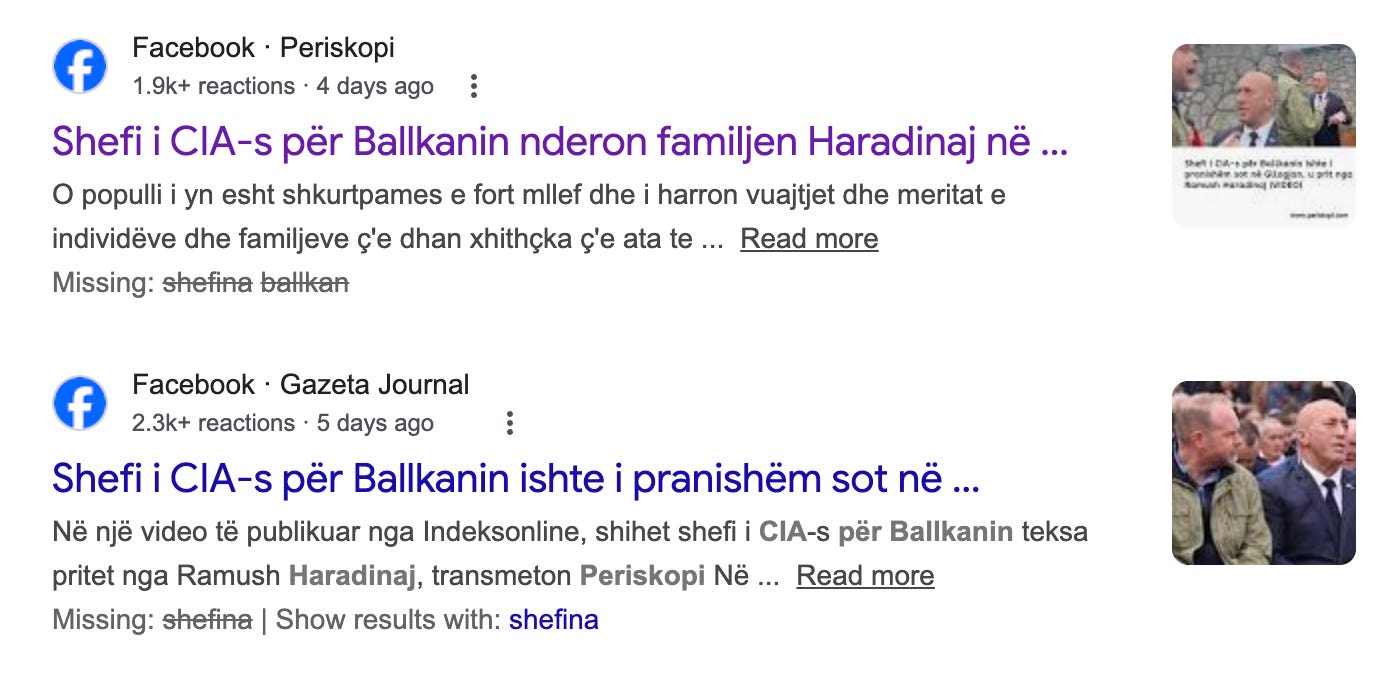
We began examining the origin of the claim by tracing its earliest identifiable publication. The trail led to a report published by Zhurnal.mk at 21.35 on March 24. The article stated4 that “chief of the CIA for the Balkans” had been present in Gllogjan and had been received by Haradinaj. It cited video material and referenced other outlets but did not provide any independent confirmation, official statement or identifiable source supporting the assertion that the individual was affiliated with the Central Intelligence Agency.
From there, the claim propagated rapidly. Multiple Kosovo based outlets reproduced the same narrative, often verbatim, without additional verification. In several cases, the wording, structure and sequence of facts remained unchanged, indicating a copy chain rather than independent reporting. Social media amplification followed, with captions and graphics reinforcing the claim in simplified, declarative terms.
We reviewed the visual material accompanying these reports. The footage and images show Haradinaj speaking with a man in casual attire, at times in conversation and at times standing alongside him during the gathering. At no point in the available material is the individual formally introduced by name, title or institutional affiliation. No insignia, credentials or contextual indicators support the claim that he represents any branch of the United States intelligence community.
The assertion itself raises immediate structural concerns. There is no publicly recognised position within the Central Intelligence Agency described as a “chief for the Balkans”. The CIA operates under a highly centralised leadership structure headed by a single Director, a position publicly known and appointed by the President of the United States. Operational roles within the agency, particularly those related to geographic regions, are not publicly disclosed. Officers do not identify themselves in open settings, nor do they participate in public political gatherings where their affiliation would be declared or visually documented.
To verify the claim, we contacted sources in Washington with direct familiarity with United States government structures and intelligence protocols. They were unequivocal.
“The man shown in the images is not CIA,” one source told Gunpowder Chronicles. “There is no record, no knowledge of this individual having worked within the agency or within the State Department. The claim is false.”
We sought further clarification on whether any CIA official could appear in the manner described by the reports. The response was categorical.
“There is no construct of the CIA outside the United States in the way it is being presented,” the source said. “There is no publicly designated CIA chief for any region, including the Balkans. CIA personnel do not identify themselves publicly, do not attend political events in that capacity and do not pose for media. If they are present anywhere operationally, it is covert. What is being claimed here contradicts the most basic protocols of the agency.”
A separate source in Europe, also familiar with transatlantic security structures, addressed a related claim repeated in several of the reports, that Haradinaj had cooperated with the CIA during the Kosovo war.
“The claim that Ramush Haradinaj cooperated with the CIA during the war is not grounded in verified evidence,” the source said. “What is being presented now builds on that narrative, but it does not hold. Bringing a person from the United States and presenting them as CIA in a public setting is not just inaccurate, it is misleading. No CIA officer would participate in such a display. It would be against protocol and against the legal framework governing their conduct.”
We then contacted the office of Ramush Haradinaj on March 275, addressing our inquiry to the Alliance for the Future of Kosovo. We asked directly whether the individual in question was accurately identified as a CIA representative, what his identity was and in what capacity he had attended the event. We also asked whether the political party or its representatives had been the original source of the information that spread across media platforms.
We received no response.
We subsequently contacted Besnik Tahiri, a member of parliament and a close associate of Haradinaj, providing the same questions and forwarding our original request. Again, there was no reply.
In parallel, we reached out to several of the media outlets that had published the claim, asking them to clarify the basis of their reporting, their sources and whether any independent verification had been conducted. Only one responded. INA - Iliria News Agency confirmed to us that it had removed its article6 after determining that the information was not credible.
“We deleted it after verifying that it was not a reliable report,” said Naser Pajaziti of INA. “The news had been taken from Zhurnal.mk and had been carried by other Kosovo media such as Insajder and Periskopi.”
Despite this, the original article on Zhurnal.mk remained accessible at the time of this publication, continuing to present the claim without correction or clarification.
We attempted to locate the purported original report from Periskopi, which had been cited as a source by several outlets. The post appears to have been removed, and no archived version of the article or social media post was available at the time of our review. This absence complicates the reconstruction of the claim’s initial transmission, but the pattern of replication suggests that Periskopi may have served as a key node in its early dissemination.
What emerges from this sequence is not an isolated error but a systemic failure of verification. A claim of significant geopolitical sensitivity, involving a major United States intelligence agency, was published and republished across multiple platforms without a single attributable, verifiable source. The repetition of identical language indicates that editorial judgement was subordinated to speed and amplification.
The claim itself collapses under minimal scrutiny.
There is no such publicly acknowledged position as “chief of the CIA for the Balkans”.
There is no precedent for CIA officials appearing openly in politically affiliated commemorations.
There is no evidence that the individual depicted has any affiliation with the agency or with the United States government.
What remains is a constructed narrative, one that moved rapidly through a fragmented media environment, gaining perceived legitimacy through repetition rather than verification. By the time corrections began to appear, the claim had already reached a wide audience, reinforced by imagery and declarative headlines.
In the absence of transparency from the political actors present at the event and in the absence of accountability from the majority of outlets that carried the claim, the burden of verification rests on independent scrutiny. Based on all available evidence, the assertion that a “CIA chief for the Balkans” attended the gathering in Gllogjan on March 24, 2026 is false.
The Man They Called a CIA Chief Was Not CIA
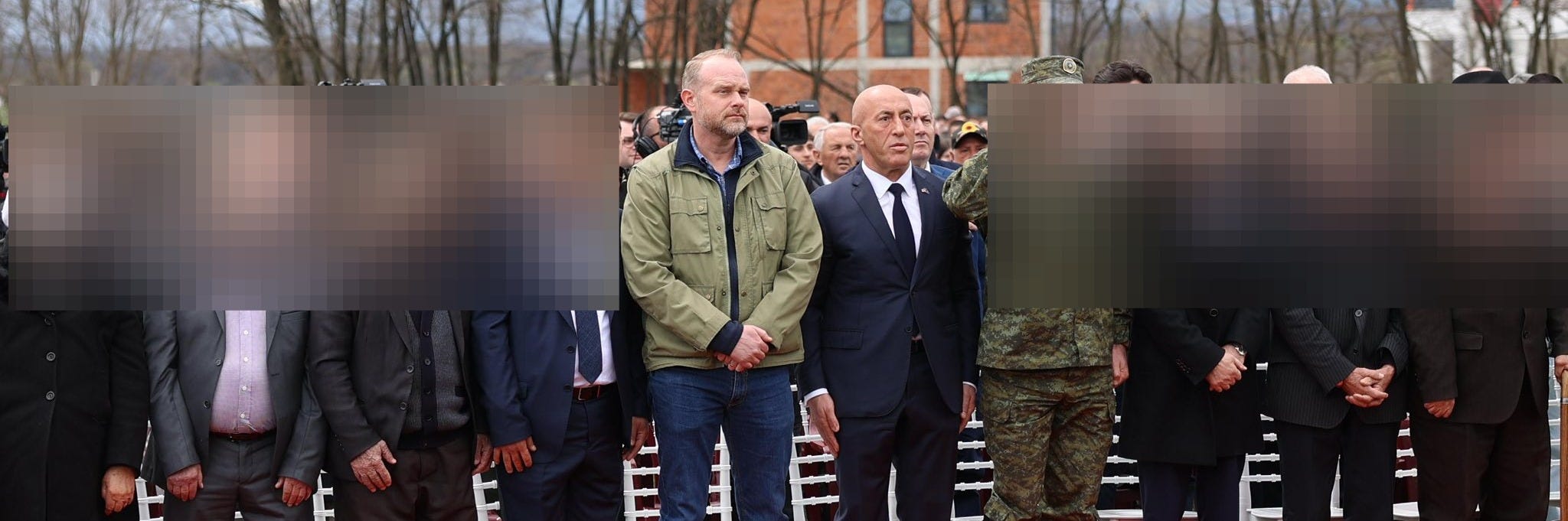
Following the circulation of claims that a “CIA chief for the Balkans” had appeared alongside Ramush Haradinaj in Gllogjan, we initiated a verification process to establish the identity of the individual in question.
Keep reading with a 7-day free trial
Subscribe to Gunpowder Chronicles to keep reading this post and get 7 days of free access to the full post archives.