


In the fragile democracy of Kosovo, where the law still fights to breathe above the suffocating weight of oligarchs, Flutura Kusari presents herself as a defender of justice and press freedom1. Yet her repeated actions expose not a guardian of rights but an operator willing to submit the very idea of rule of law to her own will, using networks of power and influence tied to one of the most entrenched oligarchies in the Balkans.
The case against citizen Mentor Llugaliu, dismissed first by the Basic Prosecution in Prishtina and again by the Appeal, ought to have been closed, a simple matter of law correctly applied. Both prosecutorial levels found no crime in his social media criticisms. The legal definition of harassment was not met. But for Kusari, the law itself became secondary. The decision was not a legal setback; it was an affront to her authority. In her public statement of 31 July2, she all but declared war on Kosovo’s judiciary, openly shaming the prosecutors by name: Kushtrim Zeka at the Basic Prosecution and Shkëlzen Brahimi at Appeal. NGOs sympathetic to her followed suit3, demanding the Kosovo Prosecutorial Council evaluate their performance, an unsubtle call for punishment.


This was not an act of transparency. It was intimidation in broad daylight. By naming prosecutors individually and framing their legal judgment as dereliction of duty, Kusari sent a message for the second time within a month to the prosecutorial body at large: side with her, or risk your career. In a small judiciary already burdened with political pressure, such tactics function as veiled threats. When the next prosecutor faces her file, they will do so under the shadow of professional ruin, aware that if they refuse her demands, they too may be paraded before the mob as enemies of justice.
Kusari’s manoeuvre cannot be separated from her connections. She has cultivated close ties with the Devolli network, the oligarchic power whose grip on Kosovo’s political and media landscape was laid bare in last week’s joint investigation by Osservatorio sui Balcani4 and EurActiv5. That report6 documented how the Devolli brothers, through Klan Kosova and other outlets, systematically censored journalism to protect their business empire while deploying media as a weapon against government institutions. Journalists described direct instructions not to report on scandals that touched Devolli’s interests. Entire programmes, like Jeta Xharra’s “Jeta ne Kosove,” were axed after crossing the wrong family7. This is the company Kusari keeps and protects.
Her silence following the investigation speaks louder than her endless rhetoric about harassment. At a moment when credible journalists exposed the suffocating stranglehold of business interests on Kosovo’s media and democracy, Kusari offered nothing. No condemnation, no solidarity, no outrage. Instead, she poured her energy into vilifying Llugaliu, a single citizen who dared criticise her online. She has never hesitated to weaponise her status to shield her allies in Klan Kosova or the Devolli empire, yet she shows fury only when her own name is on the line.
The hypocrisy is glaring. Kusari, a woman who sits on the anti-SLAPP steering committee in Europe, has adopted the very same playbook she claims to fight. She filed a criminal complaint against a critic, orchestrated international endorsements to pressure prosecutors, smeared her target as a partisan operative, and when the courts rejected her case, turned her ire against the judiciary itself. It is the anatomy of a SLAPP, only cloaked in feminist rhetoric and international credentials.
Her allies in civil society, including QIKA and the Rrjeti i Grave Gazetare, have amplified her narrative, reducing complex questions of law into slogans about violence against women. The vulgar and hateful comments cited in her complaint are indefensible as discourse, but the legal test is not about taste, it is about crime. By insisting that prosecutorial rejection of her claims constitutes negligence, these organisations position themselves not as advocates for justice but as enforcers of Kusari’s personal agenda. Their statements naming Zeka and Brahimi are chilling: they transform legal discretion into grounds for professional punishment, collapsing the independence of prosecution under the weight of political theatre.
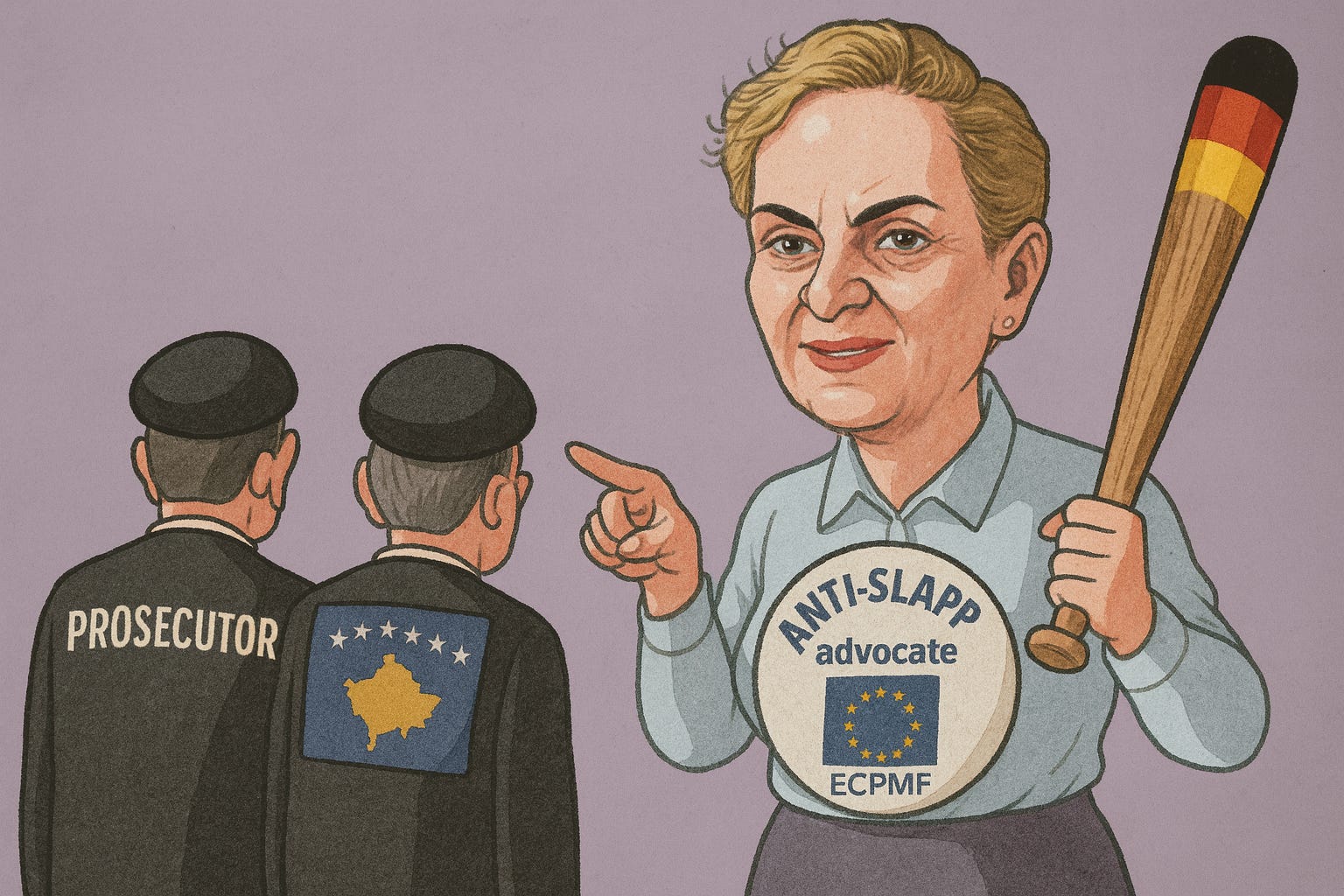
The danger here is systemic. If Kusari succeeds in bending prosecutors through public shaming, she will establish a precedent where international prestige and oligarchic ties override the legal framework. In Kosovo, where corruption has long hollowed out institutions, this is not a mere dispute between two citizens. It is an act of sabotage against the rule of law itself. Every prosecutor who observes Kusari’s ability to marshal NGOs, media, and international networks into a chorus of denunciation will think twice before crossing her or those she protects. Justice becomes no longer a matter of codes and statutes, but of who holds the loudest megaphone.
Kusari’s conduct reveals a pattern of selective outrage. When Devolli interests suffocate journalists, she is mute. When the reformist government resists the old guard, she sides with the past. And when a citizen calls her “Mickoja” online, she launches an international campaign, dragging prosecutors through the mud and demanding institutional heads roll. The proportionality is grotesque, the priorities distorted beyond recognition.
This is not advocacy. It is the appropriation of legal systems and civil society for personal vendetta and oligarchic protection. In the name of defending press freedom, Flutura Kusari is dismantling the very foundations that allow it to exist. In Kosovo, where democracy hangs by threads, such behaviour is not merely hypocrisy. It is corruption in motion, dressed in the respectable clothes of human rights.
How a Press Freedom Icon Became a Political Actor

In Kosovo’s turbulent post-independence political landscape, where trust in institutions is fragile and the line between advocacy and partisanship often blurs, one of the loudest voices claiming to defend press freedom is now accused of trying to silence it.
How a Press Freedom Icon Became a Political Actor
Flutura Kusari built a reputation defending press freedom. Now, she stands accused of using that same power to silence a citizen who challenged her. — The GPC Media Watch.
Flutura Kusari’s July 31, 2025 — Facebook Post Statement.
Rrjeti i Grave Gazetare të Kosovës — Facebook Post.
With media outlets in Kosovo and the region increasingly concentrated in the hands of major business moguls, journalists say censorship to protect the owners’ interests has become ‘the norm’. — OSB.
The bosses of Klan Kosova, one of Kosovo’s biggest media company, have a straight-forward approach to stories concerning their wealthy owners – they ignore them. — EURActiv.
Journalism Is Dead. Klan Kosova Pulled the Trigger.
Klan Kosova isn’t a media outlet. It’s a gilded bunker for oligarchs masquerading as journalists, waging war on truth while prostituting public trust. — The GPC.
BIRN Wins Landmark SLAPP Case Against Devolli Corporation — Prishtina Insight.