


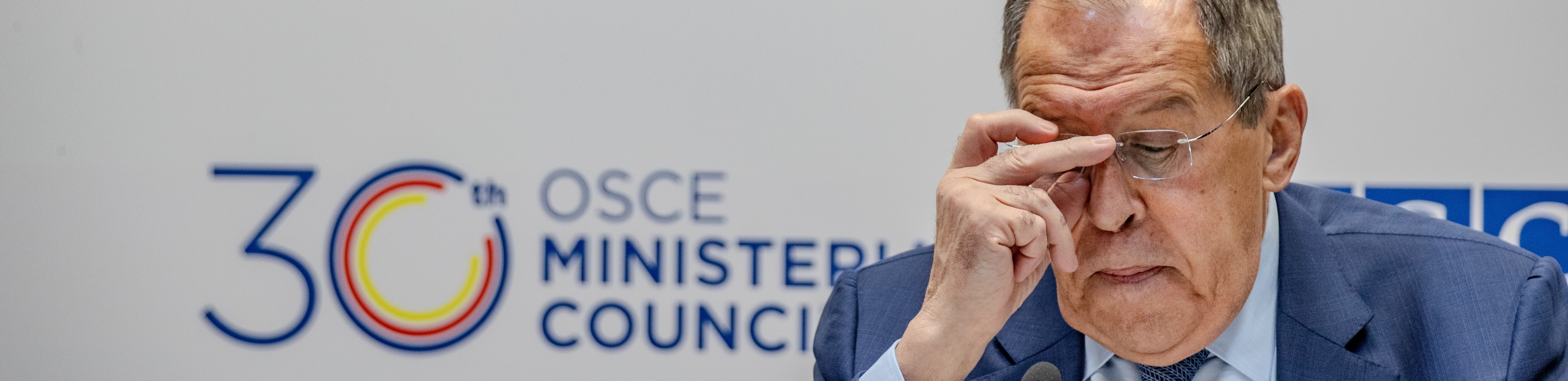
The microphone was taken away before Sergei Lavrov answered the question.
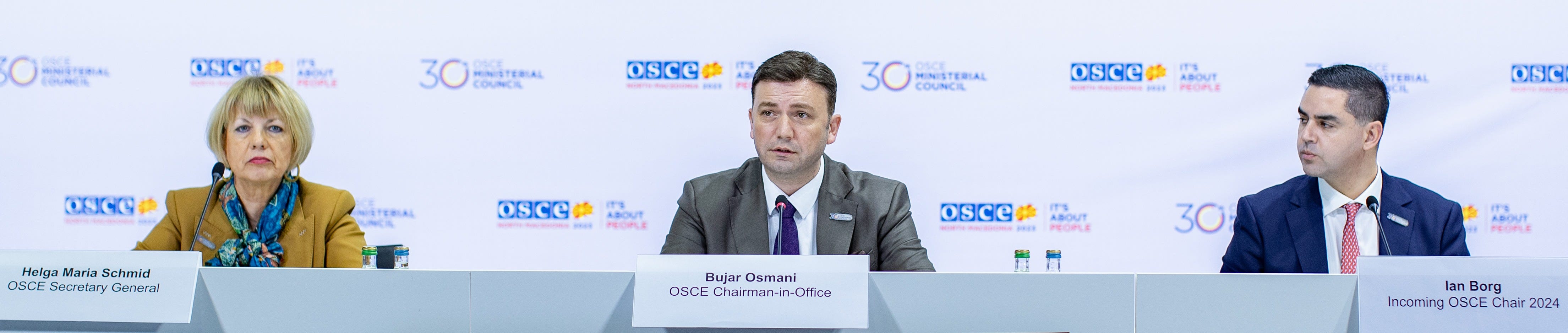
Moments earlier, at the conclusion of the Organisation for Security and Co operation in Europe Ministerial Council meeting in Skopje, I had asked Russia’s foreign minister whether Moscow’s vision of peace in Europe included its deepening political alignment with Serbia, a country whose actions had repeatedly raised tensions across the Western Balkans. Lavrov smiled, questioned my accent and shifted his attention elsewhere. The question remained unanswered.
The exchange lasted only minutes. Yet it captured a broader reality that hung over the OSCE gathering in North Macedonia from November 30 to December 1 2023. For all the declarations about European security, Ukraine, democratic resilience and regional stability, some of the most consequential questions facing the Balkans appeared to receive remarkably little scrutiny.
The annual meeting brought together senior diplomats from across Europe, North America and Central Asia. Among the most closely watched participants were Antony Blinken, the US secretary of state, and Lavrov, whose attendance marked a rare appearance at a major European diplomatic gathering since Russia’s full scale invasion of Ukraine.
Officially, the agenda focused on Ukraine, violence against women, climate change and the future of European security. Unofficially, another issue lingered beneath the surface. It concerned the increasingly visible alignment between Moscow and Belgrade and the implications of that relationship for a region that remains one of Europe’s most fragile security environments.
The contrast between the two foreign ministers was striking. Blinken arrived briefly in Skopje before departing. Lavrov arrived later and dominated much of the public attention surrounding the meeting. The Russian minister used his appearances to attack western governments and accuse them of undermining the OSCE’s founding principles. Western diplomats responded by reaffirming support for Ukraine and condemning Russia’s aggression.
What neither side addressed in meaningful detail was the question of Serbia.
That omission matters.
In September 2022, months after Russia launched its invasion of Ukraine, Serbia and Russia signed a framework for foreign policy consultations. The agreement attracted concern among several western officials and regional observers who viewed it as evidence of Belgrade’s continuing strategic relationship with Moscow despite Russia’s growing international isolation.
Since then, tensions across the Western Balkans have intensified. Kosovo and Serbia have experienced repeated confrontations. NATO peacekeepers have been injured in clashes in northern Kosovo. Kosovo police officers were detained by Serbian authorities in incidents that further deepened mistrust between the two sides. In September 2023, heavily armed Serbian gunmen attacked Kosovo police near the village of Banjska in northern Kosovo, triggering one of the most serious security crises in the region in years.
Western governments publicly condemned the violence. Yet many officials in Kosovo and elsewhere in the region argue that Washington and Brussels have remained reluctant to exert significant pressure on Belgrade.
That perception has become an increasingly important factor in regional politics.
At the OSCE meeting, senior western diplomats repeatedly stressed the importance of preserving stability in the Balkans. However, questions about whether current western policy has succeeded in deterring Serbian assertiveness largely went unanswered.
The issue extends beyond Kosovo.
In Bosnia and Herzegovina, Milorad Dodik, the leader of Republika Srpska, has repeatedly challenged the country’s constitutional order and maintained close relations with both Moscow and Belgrade. His rhetoric has frequently echoed themes promoted by the Kremlin regarding sovereignty, western influence and regional realignment. Russian officials, including Lavrov, have consistently supported positions advanced by Dodik.
For critics of current western policy, the concern is not simply Russia’s influence. It is the possibility that Moscow has found an effective vehicle for projecting that influence through regional actors whose ambitions and grievances predate the war in Ukraine but whose leverage has increased as geopolitical tensions have deepened.
Those concerns were largely absent from the public proceedings in Skopje.
Instead, the meeting often appeared to operate on two parallel tracks. On one track, diplomats delivered familiar warnings about Russian aggression in Ukraine and reaffirmed commitments to international law. On the other, some of the same governments continued pursuing engagement with Serbia despite growing concerns about Belgrade’s regional conduct.
The resulting contradiction has become increasingly difficult to ignore.
Western officials argue that engagement with Serbia remains necessary to preserve stability and prevent further regional fragmentation. They point to the risks of isolating Belgrade and the strategic importance of maintaining dialogue with a country that occupies a central position in the Balkans.
Critics counter that the policy has produced few measurable results. Serbia remains one of the only European countries not to align with sanctions against Russia. Its political leadership continues to maintain close ties with Moscow. Tensions with neighbouring states persist. Nationalist rhetoric remains a powerful force in domestic politics.
The question facing western policymakers is whether engagement has become an objective in itself rather than a means to achieve behavioural change.
Lavrov’s performance in Skopje offered little indication that Moscow views the Balkans as anything other than a strategic arena in which western influence can be challenged. When confronted with questions by the Gunpowder Chronicles regarding Russia’s relationship with Serbia and the wider implications for regional security, he chose deflection over explanation.
Yet the meeting also exposed a weakness within western diplomacy.
Blinken and other western officials arrived in Skopje with a clear message regarding Ukraine. Their position was unambiguous. Russia’s invasion represented a direct assault on the foundations of European security.
The difficulty arises when that principle is applied elsewhere.
If European security is indivisible, as western leaders frequently argue, then questions surrounding Serbia’s conduct, Russian influence in the Balkans and the long term stability of Kosovo cannot remain peripheral concerns. They are part of the same strategic landscape.
The unanswered question in Skopje was therefore not directed solely at Lavrov.
It was also directed at western governments.
Asked by the Gunpowder Chronicles, Russia’s foreign minister declined to explain why Moscow continues to support actors who challenge the stability of the Western Balkans. Western diplomats, meanwhile, offered little clarity on how their current approach towards Serbia will prevent future crises.
For a conference dedicated to European security, those omissions were difficult to overlook.
The microphone was taken away before an answer arrived. By the time the meeting ended, the silence surrounding those questions had become part of the story itself.
When Russia’s Peace Narrative Met an Uncomfortable Question
Lavrov’s claim that Russia remained a force for peace and stability in international affairs was among the central themes of his remarks in Skopje. The Russian foreign minister portrayed Moscow as a defender of international norms and a victim of western double standards. Yet the atmosphere inside the press conference suggested that some questions would be more welcome than others.
From my seat roughly six rows behind a large contingent of Russian journalists, I repeatedly raised my hand as Lavrov concluded his opening remarks and the floor was opened to questions. Several journalists seated closer to the front were called upon. Minutes passed. I continued to signal for the microphone.
Maria Zakharova, the foreign ministry spokeswoman and one of Lavrov’s closest aides, appeared to notice my attempts to participate. Yet the microphone never arrived. As more journalists were recognised, it became increasingly clear that gaining the floor would require persistence.
Eventually, I stood up.
The reaction was immediate. Cameramen positioned behind me began making audible complaints and gestures for me to sit down. I remained standing. The conference was nearing its conclusion and I had no intention of leaving without putting my question directly to Russia’s most senior diplomat.
After several moments, a microphone was finally passed in my direction.
I introduced myself, greeted the audience and addressed Lavrov as “Your Excellency”. Referring to his earlier remarks, I noted that he had described Russia as a contributor to peace, stability and international norms. I then contrasted those claims with Moscow’s record across the former Soviet space.
I referenced Russia’s wars in Chechnya, the occupation of territories in Georgia following the 2008 conflict, Moscow’s role in regional disputes across the Caucasus, the annexation of Crimea in 2014 and the full scale invasion of Ukraine in 2022.
I then turned to Serbia.
Just months after launching its invasion of Ukraine, Russia signed a foreign policy consultation agreement with Serbia in September 20221. Since then, tensions between Kosovo and Serbia had intensified dramatically. Serbian representatives withdrew from Kosovo’s institutions. Barricades appeared in northern Kosovo. Political tensions escalated into security crises. In September 2023, heavily armed Serbian gunmen attacked Kosovo police in Banjska in what Kosovo authorities described as an attempt to destabilise the country’s north.
Given the chronology of events, I asked Lavrov whether Russia had played any role in encouraging Serbia’s increasingly confrontational posture and how Moscow could reconcile its actions with his assertion that Russia was advancing peace and international stability.
The question was lengthy but direct.
Lavrov listened. He smiled. He appeared amused.
His first response was not to address the substance of the question.
Instead, he asked whether it was my first time travelling outside London.
The room laughed.
I replied that it might well be my first time, but that was not the issue. The issue was whether Russia could justify presenting itself as a guarantor of peace while pursuing policies that many European governments regarded as destabilising. If necessary, I said, I would gladly repeat the question.
Lavrov acknowledged that he had heard it.
What followed was a familiar diplomatic manoeuvre.
Rather than address Russia’s relationship with Serbia, he shifted his attention to the United States. He criticised Washington’s approach to Ukraine. He accused western governments of provoking Russia. He referred to sanctions. He criticised Secretary of State Antony Blinken and suggested that western leaders had avoided direct engagement with Moscow.
The answer continued for several minutes.
The question remained unanswered.
As Lavrov spoke, it became increasingly apparent that he had no intention of addressing the specific issue I had raised, namely whether Russia’s strategic relationship with Serbia had contributed to instability in the Western Balkans.
When he paused, I interrupted.
“Your Excellency, you are not answering my question.”
The room fell briefly silent.
I repeated that my question concerned Russia’s actions and Russia’s claims about peace and international norms. It was not about Washington. It was not about sanctions. It was about Moscow’s conduct and its relationship with Belgrade.
Lavrov smiled again.
He responded with further personal remarks, joking about my appearance and avoiding the substance of the question once more.
At that point, Zakharova intervened.
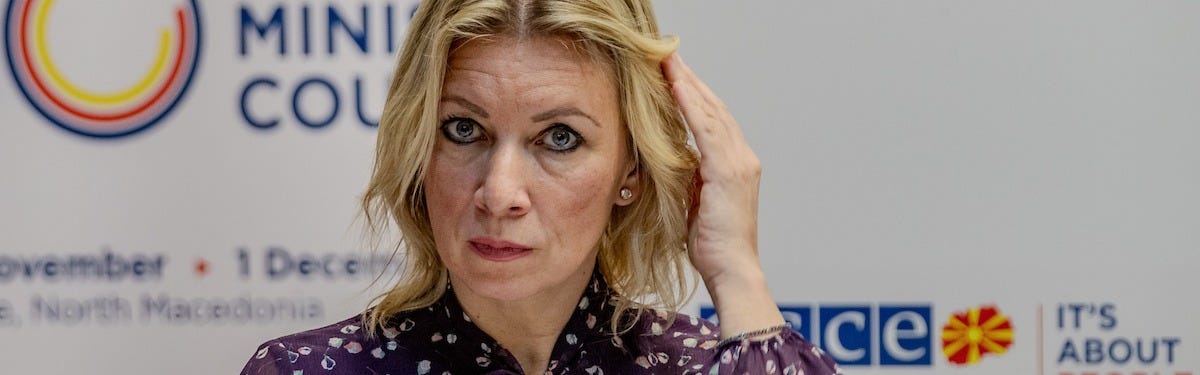
The spokeswoman accused me of behaving improperly and suggested my conduct was disrespectful. The criticism was notable because I had neither shouted nor used abusive language. I had simply insisted that the foreign minister answer the question he had been asked.
As the exchange continued, Lavrov remained largely silent, watching as his spokeswoman took control of the situation.
Then the microphone disappeared.
A member of a Russian media crew standing nearby reached forward and removed it from my hands before I could continue. Several journalists seated in front of me turned around and began photographing me. The focus of attention had shifted away from the unanswered question and onto the journalist asking it.
I objected.
“The story is not me,” I said. “The story is the question.”
The atmosphere in the room had become increasingly tense. Voices were raised. Zakharova signalled for another journalist to speak. A new question was asked. Mine was left unresolved.
Minutes later, the press conference ended.
The episode may appear minor in isolation. Diplomatic gatherings are often carefully managed affairs and politicians frequently avoid uncomfortable questions. Yet the exchange was revealing precisely because of what it demonstrated.
Lavrov had entered the room presenting Russia as a defender of peace, stability and international norms. When confronted with questions about Russia’s wars, its regional interventions and its relationship with Serbia following Moscow’s 2022 agreement with Belgrade, he did not offer a direct defence of Russian policy. Instead, he questioned the messenger, redirected attention towards the United States and ultimately left the question unanswered.
For a government that routinely accuses the West of suppressing debate and avoiding scrutiny, the scene offered an irony that was difficult to miss.
The unanswered question remained hanging in the room long after the microphones were switched off.
Serbia’s Hybrid War Against Kosovo

In the heart of the Balkans, a tumultuous saga unfolds, marking the struggle of Kosovo against relentless aggression. In September 2022, Serbia's alignment with Moscow catapulted the region into chaos. Kosovar Serbs faced coercion, barricades, and manipulated elections under the shadow of Belgrade's influence. Amidst escalating tensions, international diplomacy seemed feeble, allowing Serbian President Aleksandar Vucic to evade accountability. The conflict escalated further as paramilitary units and armed aggression gripped Kosovo's territory. This article meticulously unravels the complex web of political intrigue, diplomatic failures, and the resilience of Kosovo in the face of adversity. Explore the depths of this struggle, where justice, democracy, and sovereignty hang in the balance. — Vudi Xhymshiti, October 2023.