

Justice Under Siege: How KDI’s Voice Fuels Impunity
A KDI official undermines justice by spreading unverified claims, shielding alleged war criminals, and attacking journalists, raising grave concerns about civil society's role in Kosovo.

In an era where fragile democracies must uphold the rule of law to escape the shadows of violent pasts, the role of civil society is paramount. Nowhere is this more true than in Kosovo, a country still grappling with the consequences of war, trauma, and delayed justice. Yet, what happens when individuals within civil society, especially those entrusted with EU, US, UK, Swiss and German taxpayer funds use their platforms not to bolster the course of justice but to malign it?
This is the stark and deeply disturbing case of Eugen Cakolli, Programme Manager at the Kosovo Democratic Institute (KDI), a flagship NGO often presented as a beacon of civic responsibility and democratic values. Funded generously by the European Union, the German Cooperation, USAID, the Swiss Government, and British Foreign Aid, KDI positions itself as a promoter of transparency and institutional accountability.
But when one of its senior representatives embarks on a public crusade to delegitimise the very justice mechanisms that seek accountability for wartime atrocities, one must ask: Who is KDI truly serving, the people of Kosovo, or a selective history built on impunity?
A Post on Facebook, A Window Into Dangerous Narratives
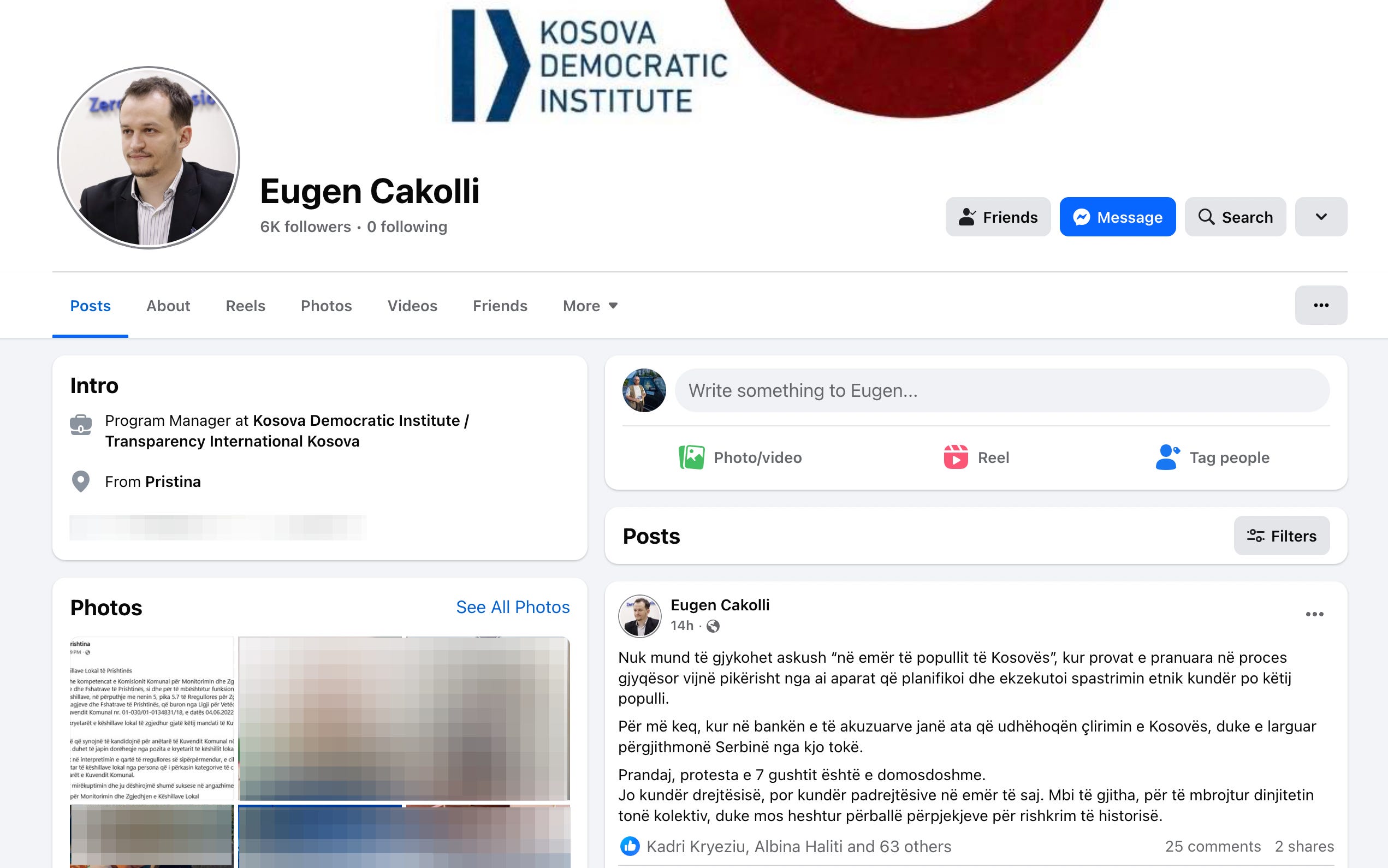
On 30 July 2025, Eugen Cakolli posted the following statement on his personal Facebook profile1 – a platform he regularly uses to engage with the public in his capacity as a civil society advocate:
“Nuk mund të gjykohet askush ‘në emër të popullit të Kosovës’, kur provat e pranuara në proces gjyqësor vijnë pikërisht nga ai aparat që planifikoi dhe ekzekutoi spastrimin etnik kundër po këtij populli... Prandaj, protesta e 7 gushtit është e domosdoshme. Jo kundër drejtësisë, por kundër padrejtësive në emër të saj.”
At first glance, such rhetoric may appear cloaked in patriotism or indignation at perceived injustice. But dig even slightly beneath the surface, and what emerges is a calculated attempt to delegitimise the Kosovo Specialist Chambers in The Hague – an internationally sanctioned tribunal tasked with investigating crimes committed during and after the 1998–1999 Kosovo War.
Cakolli’s post is not just a political opinion. It is a public accusation, disseminated by a representative of an NGO subsidised by foreign governments, alleging that the Court is using fabricated or tainted evidence from Serbia – without presenting a single piece of credible proof.
This is not civil society at work. This is the subversion of justice under the banner of civic resistance.
Raising Questions Met With Contempt
In my role as a journalist and as someone who has covered armed conflicts and war crimes in some of the most complex theatres of the world, I considered it my responsibility to seek clarification. I publicly addressed Cakolli with a series of pointed, respectful, and professional questions aimed at understanding the factual basis of his claims.
Among them:
Which specific documents allegedly sourced from Serbian institutions have been admitted as evidence?
Where exactly in the judicial records are these documents found?
Is he claiming that all evidence presented by the Prosecution is tainted simply by virtue of origin?
How does he reconcile his position with the fact that many Kosovar Albanians, too, have demanded justice for crimes committed by members of the Kosovo Liberation Army (KLA)?
Is he not concerned that such rhetoric may discourage witnesses and undermine fair trial guarantees?
From Accusation to Evasion: When a Transparency Advocate Ducks Transparency
None of these questions received direct, credible answers. Instead, Cakolli responded with ad hominem attacks, unfounded insinuations about my motives, and an astonishing refusal to engage with the content of the questions.
This gallery documents an extended public exchange between me and Eugen Cakolli, Program Manager at the Kosova Democratic Institute / Transparency International Kosova, over Cakolli’s controversial public claim that Kosovo’s Special Chambers accept as evidence documents originating from the Serbian wartime security apparatus.
Below is a gallery of screenshots showcasing the exchange.
![This gallery documents a telling public exchange between myself and Eugen Cakolli, Program Manager at the Kosova Democratic Institute / Transparency International Kosova, following his controversial claim that Kosovo’s Special Chambers are accepting as evidence documents originating from the Serbian wartime security apparatus. When pressed with clear, direct questions—such as: “Cilat janë këto padrejtësi që ju i përmendni? A bëhet fjalë për standardet ligjore, për kontekstin politik, për përbërjen e trupit gjykues, apo për diçka tjetër?” [“What are these injustices you refer to? Are we talking about legal standards, political context, judicial composition, or something else?”]— Cakolli offered no substantive answers. Instead of engaging on the facts, Cakolli resorted to deflection and personal insinuation. When asked to specify the alleged documents or sources, he responded: “Besoj, kaq pak, kupton edhe ti – përveç nëse dëshira për t’a pa dikë në burg, ta errëson arsyen edhe nuk zgjedh mjete.” [“I believe you understand this a little—unless your desire to see someone jailed clouds your reason and justifies any means.”] Rather than substantiating his assertions, Cakolli questioned my professional legitimacy: “Ti që pretendon që je gazetar, duhesh me i gjetë ato.” [“You, who claim to be a journalist, should go and find them yourself.”] And later added: “Pse po pretendoj me argumentu mbi premisa gazetarie, me dikë që esencialisht ka qasje që s’i takon një gazetari.” [“Why am I arguing on journalistic grounds with someone whose approach doesn’t belong in journalism?”] His central claim—that evidence from the “aparatit serb” [“Serbian apparatus”] is being admitted in court—was never supported with a single concrete document, verified source, or legal reference. Instead, Cakolli deferred to a single article from Nacionale, a portal with documented ties to sanctioned criminal networks, raising further questions about the integrity of his sources. When reminded that “Besueshmëria e një media lidhet domosdoshmërisht me pronësinë” [“The credibility of a media outlet is inextricably linked to its ownership”], he pivoted to vague relativism and rhetorical evasion. In the end, none of the questions were answered. As I concluded in the final exchange: “Ti nuk u përgjigje asnjëherë. Asnjë nga pyetjet nuk mori përgjigje.” [“You never answered. Not a single question received a reply.”] This exchange is more than a disagreement—it is a case study in how public figures sometimes leverage the rhetoric of justice while shirking the basic standards of evidence and accountability. At a time when post-war justice in Kosovo remains politically charged and morally urgent, such evasions not only insult public intelligence but corrode the credibility of those claiming to speak in the name of transparency.](https://substackcdn.com/image/fetch/$s_!FhXS!,w_474,c_limit,f_webp,q_auto:good,fl_progressive:steep/https%3A%2F%2Fsubstack-post-media.s3.amazonaws.com%2Fpublic%2Fimages%2F1ea5f01e-71fc-48bd-b994-9f09b4985a1a_1384x602.png)
![This gallery documents a telling public exchange between myself and Eugen Cakolli, Program Manager at the Kosova Democratic Institute / Transparency International Kosova, following his controversial claim that Kosovo’s Special Chambers are accepting as evidence documents originating from the Serbian wartime security apparatus. When pressed with clear, direct questions—such as: “Cilat janë këto padrejtësi që ju i përmendni? A bëhet fjalë për standardet ligjore, për kontekstin politik, për përbërjen e trupit gjykues, apo për diçka tjetër?” [“What are these injustices you refer to? Are we talking about legal standards, political context, judicial composition, or something else?”]— Cakolli offered no substantive answers. Instead of engaging on the facts, Cakolli resorted to deflection and personal insinuation. When asked to specify the alleged documents or sources, he responded: “Besoj, kaq pak, kupton edhe ti – përveç nëse dëshira për t’a pa dikë në burg, ta errëson arsyen edhe nuk zgjedh mjete.” [“I believe you understand this a little—unless your desire to see someone jailed clouds your reason and justifies any means.”] Rather than substantiating his assertions, Cakolli questioned my professional legitimacy: “Ti që pretendon që je gazetar, duhesh me i gjetë ato.” [“You, who claim to be a journalist, should go and find them yourself.”] And later added: “Pse po pretendoj me argumentu mbi premisa gazetarie, me dikë që esencialisht ka qasje që s’i takon një gazetari.” [“Why am I arguing on journalistic grounds with someone whose approach doesn’t belong in journalism?”] His central claim—that evidence from the “aparatit serb” [“Serbian apparatus”] is being admitted in court—was never supported with a single concrete document, verified source, or legal reference. Instead, Cakolli deferred to a single article from Nacionale, a portal with documented ties to sanctioned criminal networks, raising further questions about the integrity of his sources. When reminded that “Besueshmëria e një media lidhet domosdoshmërisht me pronësinë” [“The credibility of a media outlet is inextricably linked to its ownership”], he pivoted to vague relativism and rhetorical evasion. In the end, none of the questions were answered. As I concluded in the final exchange: “Ti nuk u përgjigje asnjëherë. Asnjë nga pyetjet nuk mori përgjigje.” [“You never answered. Not a single question received a reply.”] This exchange is more than a disagreement—it is a case study in how public figures sometimes leverage the rhetoric of justice while shirking the basic standards of evidence and accountability. At a time when post-war justice in Kosovo remains politically charged and morally urgent, such evasions not only insult public intelligence but corrode the credibility of those claiming to speak in the name of transparency.](https://substackcdn.com/image/fetch/$s_!FOfA!,w_474,c_limit,f_webp,q_auto:good,fl_progressive:steep/https%3A%2F%2Fsubstack-post-media.s3.amazonaws.com%2Fpublic%2Fimages%2Fbc1f3cf7-613b-4637-9448-3c35593e0cf6_1382x1776.png)
![This gallery documents a telling public exchange between myself and Eugen Cakolli, Program Manager at the Kosova Democratic Institute / Transparency International Kosova, following his controversial claim that Kosovo’s Special Chambers are accepting as evidence documents originating from the Serbian wartime security apparatus. When pressed with clear, direct questions—such as: “Cilat janë këto padrejtësi që ju i përmendni? A bëhet fjalë për standardet ligjore, për kontekstin politik, për përbërjen e trupit gjykues, apo për diçka tjetër?” [“What are these injustices you refer to? Are we talking about legal standards, political context, judicial composition, or something else?”]— Cakolli offered no substantive answers. Instead of engaging on the facts, Cakolli resorted to deflection and personal insinuation. When asked to specify the alleged documents or sources, he responded: “Besoj, kaq pak, kupton edhe ti – përveç nëse dëshira për t’a pa dikë në burg, ta errëson arsyen edhe nuk zgjedh mjete.” [“I believe you understand this a little—unless your desire to see someone jailed clouds your reason and justifies any means.”] Rather than substantiating his assertions, Cakolli questioned my professional legitimacy: “Ti që pretendon që je gazetar, duhesh me i gjetë ato.” [“You, who claim to be a journalist, should go and find them yourself.”] And later added: “Pse po pretendoj me argumentu mbi premisa gazetarie, me dikë që esencialisht ka qasje që s’i takon një gazetari.” [“Why am I arguing on journalistic grounds with someone whose approach doesn’t belong in journalism?”] His central claim—that evidence from the “aparatit serb” [“Serbian apparatus”] is being admitted in court—was never supported with a single concrete document, verified source, or legal reference. Instead, Cakolli deferred to a single article from Nacionale, a portal with documented ties to sanctioned criminal networks, raising further questions about the integrity of his sources. When reminded that “Besueshmëria e një media lidhet domosdoshmërisht me pronësinë” [“The credibility of a media outlet is inextricably linked to its ownership”], he pivoted to vague relativism and rhetorical evasion. In the end, none of the questions were answered. As I concluded in the final exchange: “Ti nuk u përgjigje asnjëherë. Asnjë nga pyetjet nuk mori përgjigje.” [“You never answered. Not a single question received a reply.”] This exchange is more than a disagreement—it is a case study in how public figures sometimes leverage the rhetoric of justice while shirking the basic standards of evidence and accountability. At a time when post-war justice in Kosovo remains politically charged and morally urgent, such evasions not only insult public intelligence but corrode the credibility of those claiming to speak in the name of transparency.](https://substackcdn.com/image/fetch/$s_!QLym!,w_474,c_limit,f_webp,q_auto:good,fl_progressive:steep/https%3A%2F%2Fsubstack-post-media.s3.amazonaws.com%2Fpublic%2Fimages%2Ff47446ea-d8f6-4b53-a40d-ded232839b72_1282x1824.png)
![This gallery documents a telling public exchange between myself and Eugen Cakolli, Program Manager at the Kosova Democratic Institute / Transparency International Kosova, following his controversial claim that Kosovo’s Special Chambers are accepting as evidence documents originating from the Serbian wartime security apparatus. When pressed with clear, direct questions—such as: “Cilat janë këto padrejtësi që ju i përmendni? A bëhet fjalë për standardet ligjore, për kontekstin politik, për përbërjen e trupit gjykues, apo për diçka tjetër?” [“What are these injustices you refer to? Are we talking about legal standards, political context, judicial composition, or something else?”]— Cakolli offered no substantive answers. Instead of engaging on the facts, Cakolli resorted to deflection and personal insinuation. When asked to specify the alleged documents or sources, he responded: “Besoj, kaq pak, kupton edhe ti – përveç nëse dëshira për t’a pa dikë në burg, ta errëson arsyen edhe nuk zgjedh mjete.” [“I believe you understand this a little—unless your desire to see someone jailed clouds your reason and justifies any means.”] Rather than substantiating his assertions, Cakolli questioned my professional legitimacy: “Ti që pretendon që je gazetar, duhesh me i gjetë ato.” [“You, who claim to be a journalist, should go and find them yourself.”] And later added: “Pse po pretendoj me argumentu mbi premisa gazetarie, me dikë që esencialisht ka qasje që s’i takon një gazetari.” [“Why am I arguing on journalistic grounds with someone whose approach doesn’t belong in journalism?”] His central claim—that evidence from the “aparatit serb” [“Serbian apparatus”] is being admitted in court—was never supported with a single concrete document, verified source, or legal reference. Instead, Cakolli deferred to a single article from Nacionale, a portal with documented ties to sanctioned criminal networks, raising further questions about the integrity of his sources. When reminded that “Besueshmëria e një media lidhet domosdoshmërisht me pronësinë” [“The credibility of a media outlet is inextricably linked to its ownership”], he pivoted to vague relativism and rhetorical evasion. In the end, none of the questions were answered. As I concluded in the final exchange: “Ti nuk u përgjigje asnjëherë. Asnjë nga pyetjet nuk mori përgjigje.” [“You never answered. Not a single question received a reply.”] This exchange is more than a disagreement—it is a case study in how public figures sometimes leverage the rhetoric of justice while shirking the basic standards of evidence and accountability. At a time when post-war justice in Kosovo remains politically charged and morally urgent, such evasions not only insult public intelligence but corrode the credibility of those claiming to speak in the name of transparency.](https://substackcdn.com/image/fetch/$s_!JIbc!,w_474,c_limit,f_webp,q_auto:good,fl_progressive:steep/https%3A%2F%2Fsubstack-post-media.s3.amazonaws.com%2Fpublic%2Fimages%2F0cfeaba6-db56-4fd9-b8f8-cae448294235_1076x1842.png)
![This gallery documents a telling public exchange between myself and Eugen Cakolli, Program Manager at the Kosova Democratic Institute / Transparency International Kosova, following his controversial claim that Kosovo’s Special Chambers are accepting as evidence documents originating from the Serbian wartime security apparatus. When pressed with clear, direct questions—such as: “Cilat janë këto padrejtësi që ju i përmendni? A bëhet fjalë për standardet ligjore, për kontekstin politik, për përbërjen e trupit gjykues, apo për diçka tjetër?” [“What are these injustices you refer to? Are we talking about legal standards, political context, judicial composition, or something else?”]— Cakolli offered no substantive answers. Instead of engaging on the facts, Cakolli resorted to deflection and personal insinuation. When asked to specify the alleged documents or sources, he responded: “Besoj, kaq pak, kupton edhe ti – përveç nëse dëshira për t’a pa dikë në burg, ta errëson arsyen edhe nuk zgjedh mjete.” [“I believe you understand this a little—unless your desire to see someone jailed clouds your reason and justifies any means.”] Rather than substantiating his assertions, Cakolli questioned my professional legitimacy: “Ti që pretendon që je gazetar, duhesh me i gjetë ato.” [“You, who claim to be a journalist, should go and find them yourself.”] And later added: “Pse po pretendoj me argumentu mbi premisa gazetarie, me dikë që esencialisht ka qasje që s’i takon një gazetari.” [“Why am I arguing on journalistic grounds with someone whose approach doesn’t belong in journalism?”] His central claim—that evidence from the “aparatit serb” [“Serbian apparatus”] is being admitted in court—was never supported with a single concrete document, verified source, or legal reference. Instead, Cakolli deferred to a single article from Nacionale, a portal with documented ties to sanctioned criminal networks, raising further questions about the integrity of his sources. When reminded that “Besueshmëria e një media lidhet domosdoshmërisht me pronësinë” [“The credibility of a media outlet is inextricably linked to its ownership”], he pivoted to vague relativism and rhetorical evasion. In the end, none of the questions were answered. As I concluded in the final exchange: “Ti nuk u përgjigje asnjëherë. Asnjë nga pyetjet nuk mori përgjigje.” [“You never answered. Not a single question received a reply.”] This exchange is more than a disagreement—it is a case study in how public figures sometimes leverage the rhetoric of justice while shirking the basic standards of evidence and accountability. At a time when post-war justice in Kosovo remains politically charged and morally urgent, such evasions not only insult public intelligence but corrode the credibility of those claiming to speak in the name of transparency.](https://substackcdn.com/image/fetch/$s_!AixS!,w_474,c_limit,f_webp,q_auto:good,fl_progressive:steep/https%3A%2F%2Fsubstack-post-media.s3.amazonaws.com%2Fpublic%2Fimages%2Fce1f6774-a593-4d38-80db-62dbbe7ca131_1074x1836.png)
![This gallery documents a telling public exchange between myself and Eugen Cakolli, Program Manager at the Kosova Democratic Institute / Transparency International Kosova, following his controversial claim that Kosovo’s Special Chambers are accepting as evidence documents originating from the Serbian wartime security apparatus. When pressed with clear, direct questions—such as: “Cilat janë këto padrejtësi që ju i përmendni? A bëhet fjalë për standardet ligjore, për kontekstin politik, për përbërjen e trupit gjykues, apo për diçka tjetër?” [“What are these injustices you refer to? Are we talking about legal standards, political context, judicial composition, or something else?”]— Cakolli offered no substantive answers. Instead of engaging on the facts, Cakolli resorted to deflection and personal insinuation. When asked to specify the alleged documents or sources, he responded: “Besoj, kaq pak, kupton edhe ti – përveç nëse dëshira për t’a pa dikë në burg, ta errëson arsyen edhe nuk zgjedh mjete.” [“I believe you understand this a little—unless your desire to see someone jailed clouds your reason and justifies any means.”] Rather than substantiating his assertions, Cakolli questioned my professional legitimacy: “Ti që pretendon që je gazetar, duhesh me i gjetë ato.” [“You, who claim to be a journalist, should go and find them yourself.”] And later added: “Pse po pretendoj me argumentu mbi premisa gazetarie, me dikë që esencialisht ka qasje që s’i takon një gazetari.” [“Why am I arguing on journalistic grounds with someone whose approach doesn’t belong in journalism?”] His central claim—that evidence from the “aparatit serb” [“Serbian apparatus”] is being admitted in court—was never supported with a single concrete document, verified source, or legal reference. Instead, Cakolli deferred to a single article from Nacionale, a portal with documented ties to sanctioned criminal networks, raising further questions about the integrity of his sources. When reminded that “Besueshmëria e një media lidhet domosdoshmërisht me pronësinë” [“The credibility of a media outlet is inextricably linked to its ownership”], he pivoted to vague relativism and rhetorical evasion. In the end, none of the questions were answered. As I concluded in the final exchange: “Ti nuk u përgjigje asnjëherë. Asnjë nga pyetjet nuk mori përgjigje.” [“You never answered. Not a single question received a reply.”] This exchange is more than a disagreement—it is a case study in how public figures sometimes leverage the rhetoric of justice while shirking the basic standards of evidence and accountability. At a time when post-war justice in Kosovo remains politically charged and morally urgent, such evasions not only insult public intelligence but corrode the credibility of those claiming to speak in the name of transparency.](https://substackcdn.com/image/fetch/$s_!lWlN!,w_474,c_limit,f_webp,q_auto:good,fl_progressive:steep/https%3A%2F%2Fsubstack-post-media.s3.amazonaws.com%2Fpublic%2Fimages%2F2cd50631-8ed0-4fdc-a2fe-6e69c821cc5c_1090x1624.png)
![This gallery documents a telling public exchange between myself and Eugen Cakolli, Program Manager at the Kosova Democratic Institute / Transparency International Kosova, following his controversial claim that Kosovo’s Special Chambers are accepting as evidence documents originating from the Serbian wartime security apparatus. When pressed with clear, direct questions—such as: “Cilat janë këto padrejtësi që ju i përmendni? A bëhet fjalë për standardet ligjore, për kontekstin politik, për përbërjen e trupit gjykues, apo për diçka tjetër?” [“What are these injustices you refer to? Are we talking about legal standards, political context, judicial composition, or something else?”]— Cakolli offered no substantive answers. Instead of engaging on the facts, Cakolli resorted to deflection and personal insinuation. When asked to specify the alleged documents or sources, he responded: “Besoj, kaq pak, kupton edhe ti – përveç nëse dëshira për t’a pa dikë në burg, ta errëson arsyen edhe nuk zgjedh mjete.” [“I believe you understand this a little—unless your desire to see someone jailed clouds your reason and justifies any means.”] Rather than substantiating his assertions, Cakolli questioned my professional legitimacy: “Ti që pretendon që je gazetar, duhesh me i gjetë ato.” [“You, who claim to be a journalist, should go and find them yourself.”] And later added: “Pse po pretendoj me argumentu mbi premisa gazetarie, me dikë që esencialisht ka qasje që s’i takon një gazetari.” [“Why am I arguing on journalistic grounds with someone whose approach doesn’t belong in journalism?”] His central claim—that evidence from the “aparatit serb” [“Serbian apparatus”] is being admitted in court—was never supported with a single concrete document, verified source, or legal reference. Instead, Cakolli deferred to a single article from Nacionale, a portal with documented ties to sanctioned criminal networks, raising further questions about the integrity of his sources. When reminded that “Besueshmëria e një media lidhet domosdoshmërisht me pronësinë” [“The credibility of a media outlet is inextricably linked to its ownership”], he pivoted to vague relativism and rhetorical evasion. In the end, none of the questions were answered. As I concluded in the final exchange: “Ti nuk u përgjigje asnjëherë. Asnjë nga pyetjet nuk mori përgjigje.” [“You never answered. Not a single question received a reply.”] This exchange is more than a disagreement—it is a case study in how public figures sometimes leverage the rhetoric of justice while shirking the basic standards of evidence and accountability. At a time when post-war justice in Kosovo remains politically charged and morally urgent, such evasions not only insult public intelligence but corrode the credibility of those claiming to speak in the name of transparency.](https://substackcdn.com/image/fetch/$s_!Snel!,w_720,c_limit,f_webp,q_auto:good,fl_progressive:steep/https%3A%2F%2Fsubstack-post-media.s3.amazonaws.com%2Fpublic%2Fimages%2Fe11bac65-5d47-467a-be90-8a771e4bad2f_1070x1848.png)
![This gallery documents a telling public exchange between myself and Eugen Cakolli, Program Manager at the Kosova Democratic Institute / Transparency International Kosova, following his controversial claim that Kosovo’s Special Chambers are accepting as evidence documents originating from the Serbian wartime security apparatus. When pressed with clear, direct questions—such as: “Cilat janë këto padrejtësi që ju i përmendni? A bëhet fjalë për standardet ligjore, për kontekstin politik, për përbërjen e trupit gjykues, apo për diçka tjetër?” [“What are these injustices you refer to? Are we talking about legal standards, political context, judicial composition, or something else?”]— Cakolli offered no substantive answers. Instead of engaging on the facts, Cakolli resorted to deflection and personal insinuation. When asked to specify the alleged documents or sources, he responded: “Besoj, kaq pak, kupton edhe ti – përveç nëse dëshira për t’a pa dikë në burg, ta errëson arsyen edhe nuk zgjedh mjete.” [“I believe you understand this a little—unless your desire to see someone jailed clouds your reason and justifies any means.”] Rather than substantiating his assertions, Cakolli questioned my professional legitimacy: “Ti që pretendon që je gazetar, duhesh me i gjetë ato.” [“You, who claim to be a journalist, should go and find them yourself.”] And later added: “Pse po pretendoj me argumentu mbi premisa gazetarie, me dikë që esencialisht ka qasje që s’i takon një gazetari.” [“Why am I arguing on journalistic grounds with someone whose approach doesn’t belong in journalism?”] His central claim—that evidence from the “aparatit serb” [“Serbian apparatus”] is being admitted in court—was never supported with a single concrete document, verified source, or legal reference. Instead, Cakolli deferred to a single article from Nacionale, a portal with documented ties to sanctioned criminal networks, raising further questions about the integrity of his sources. When reminded that “Besueshmëria e një media lidhet domosdoshmërisht me pronësinë” [“The credibility of a media outlet is inextricably linked to its ownership”], he pivoted to vague relativism and rhetorical evasion. In the end, none of the questions were answered. As I concluded in the final exchange: “Ti nuk u përgjigje asnjëherë. Asnjë nga pyetjet nuk mori përgjigje.” [“You never answered. Not a single question received a reply.”] This exchange is more than a disagreement—it is a case study in how public figures sometimes leverage the rhetoric of justice while shirking the basic standards of evidence and accountability. At a time when post-war justice in Kosovo remains politically charged and morally urgent, such evasions not only insult public intelligence but corrode the credibility of those claiming to speak in the name of transparency.](https://substackcdn.com/image/fetch/$s_!0fCT!,w_720,c_limit,f_webp,q_auto:good,fl_progressive:steep/https%3A%2F%2Fsubstack-post-media.s3.amazonaws.com%2Fpublic%2Fimages%2Fa2875a6e-bf62-4cbc-b4bb-6dcbce4943e0_1080x1846.png)
The Ad Hominem Playbook
Instead of engaging in good-faith debate, Cakolli pivoted to character assassination:
“Besoj, kaq pak, kupton edhe ti, përveç nëse dëshira për ta pa dikë në burg, ta errëson arsyen...”
When pressed further for sources, Cakolli redirected me to a single article on Nacionale.com, a portal widely criticised for its ownership ties to Berat Buzhala2, a businessman linked to Zvonko Veselinovic3, an individual sanctioned by the U.S. Treasury for organised crime and destabilisation activities in Kosovo.
When I raised legitimate concerns about the credibility of this source, Cakolli accused me of being “unserious” and of pursuing an agenda:
“Agjendë është, pa pikë dyshimi. Edhe tendencë.”
He then proceeded to dig through past Facebook posts to label me biased and discredit my professional integrity, a desperate pivot from fact to personal attack, emblematic of those unwilling to defend their claims under scrutiny.
“Gabimi yt, është që harroni se postimet janë publike, edhe ruhen. I tille është edhe ai i yti, i 5 janarit 2017...”
This behaviour is not only intellectually bankrupt, but deeply anti-democratic. It reveals a mindset in which anyone who asks questions becomes the enemy, an attitude chillingly familiar in societies where accountability is viewed as betrayal.
The False Martyrdom of a Civil Society Actor
Let us be unequivocal: the Kosovo Specialist Chambers is not prosecuting the KLA. It is prosecuting individuals suspected of serious crimes, some of whom happen to have been members of the KLA. This distinction matters.
Cakolli’s rhetoric, however, deliberately blurs this line, conflating individual accountability with collective condemnation. This serves no one, except those seeking to shield power behind the fog of nostalgia and nationalism.
His insistence that the Court is weaponising “Serbian documents” is a dangerous fabrication, one unsupported by judicial filings and unsubstantiated by any third-party analysis. And yet, he refuses to acknowledge this or to provide even the most basic citations.
Worse still, he claims that he does not speak on behalf of civil society, despite using his publicly verified platform as KDI’s Programme Manager to speak to thousands. This kind of duplicity, disavowing institutional accountability while leveraging institutional visibility, is profoundly unethical.
KDI Must Answer
This brings us to the inescapable question: What is Kosovo Democratic Institute’s position on all this?
How can an organisation purporting to advance democratic governance and rule of law continue to employ a senior figure who:
Publicly undermines international justice mechanisms;
Makes unsubstantiated accusations against a court of law;
Encourages public protest against legitimate judicial procedures;
Frames journalistic inquiry as an attack, and refuses to engage with facts;
References platforms linked to sanctioned individuals as credible sources?
If KDI’s silence is meant to be interpreted as neutrality, it is in fact complicity. Foreign funders including the EU, USAID, FCDO, and SDC, must now reckon with the fact that their development funds are subsidising a narrative hostile to justice, transparency, and the international rule of law.
The Greater Danger: Polluting the Public Sphere
What Cakolli is engaged in is not just a debate. It is a systematic attempt to pollute the public sphere, to transform judicial accountability into betrayal, to treat critical inquiry as sabotage, and to frame legitimate Kosovan and European institutions of justice as foreign conspiracies.
It is a strategy lifted from the populist playbook, one that weaponises emotion, denies nuance, vilifies dissent, and elevates mythology over fact.
This is not merely a civil disagreement between two voices in the public square.
This is an insidious effort to undermine the foundations of justice in Kosovo.
The questions posed to Eugen Cakolli remain unanswered. They will continue to linger, because they are not personal. They are public. They concern every Kosovar who believes in justice, accountability, and truth.
If civil society leaders cannot uphold these principles, they forfeit the moral right to speak in the name of the people.
And if institutions like KDI allow such figures to act unchecked, then they must be held to account, not just by donors, but by the very public they claim to serve.
This is not about Mr Cakolli.
This is not about me.
This is about Kosovo.
And about the solemn truth that justice does not thrive in the dark, it dies in silence.
Kosovo’s Justice System is Under Siege

For years, I was vaguely aware of the Special Prosecutor’s Office (SPO), but never did I allow myself to take a deeper interest. The American, European and British newsrooms I worked with had little focus on it, and when they did, the stories were assigned to journalists well-versed in its complexities. Knowing the intricacies of international war crimes investigations, I hesitated to immerse myself in a subject fraught with legal, political, and historical entanglements. But one thing remained clear to me: justice must prevail, regardless of who stands accused.
Eugen Cakolli’s Facebook Post.
Berat Buzhala, Sanctioned Figures, and the Threat to Kosovo’s National Security
Berat Buzhala’s troubling connections to U.S.-sanctioned figures like Grubi and Veselinovic expose a dangerous nexus of media manipulation, corruption, and threats to Kosovo’s national security. — The GPC I Unit.
Treasury Targets Corruption Networks Linked to Transnational Organised Crime — US State Department Treasury.