

Inside the Plot to Dismantle Kosovo’s War Crimes Tribunal
How a simple Facebook bribe unravelled into a scandal, unveiling a clandestine effort to sabotage Kosovo’s Special Chambers and destabilise a nation.

The Bribe That Unveiled a Conspiracy: In January, a deceptive outreach from a Facebook user named 'Laky Laky' quickly escalated beyond simple flattery about my investigative work. What began as praise for my reports on geopolitical manoeuvring soon revealed a sinister attempt to manipulate my reporting with fabricated intelligence.


But there was a catch: “Laky Laky” offered me €5,000 to publish the story immediately. It was unmistakable a bribe, masked as “support” for my independent journalism. I refused outright. Sensing resistance, they backtracked, insisting their offer was merely a donation, citing my platforms, Gunpowder Chronicles and Spotlight Magazine, where I had previously called for public contributions1. But by then, the damage was done. Their agenda was clear.
Unraveling the Network: Despite rejecting the money, I pursued the claim with due diligence. I contacted experts familiar with Russian influence operations, each tasked with scrutinising the authenticity of the document. Meanwhile, “Laky Laky” shifted tactics. They sent me a link, claiming the allegations about Grenell had already been published elsewhere2. The intent was clear: to create urgency, to make me feel I was losing an exclusive. But I wasn’t biting.


To cross-check further, I reached out to trusted Ukrainian sources, including colleague journalists Iryna Matviyishyn3 who has worked with Radio Free Europe and Vovo Yorchuk, who also works with the Associated Press. Both denied any knowledge of the web portal ‘Informators’4 and independently raised red flags. They suggested it was likely a Russian-backed outlet designed to spread disinformation. This suspicion was echoed by communication experts based in Brussels, who noted similar patterns of manipulation linked to pro-Kremlin influence campaigns.
By mid-February, after weeks of investigation, I reached a definitive conclusion: the document was fabricated. But that discovery raised a far more unsettling question, who was behind this effort to manipulate me, and why?


The deeper I dug, the clearer it became that this was not an isolated incident. It was part of a much broader operation, one that involved key political players in Kosovo and a network working to reshape public narratives for their own strategic gain.
At the center of it all is a power struggle with far-reaching implications. As our investigation deepened, the names began to connect: Milaim Zeka, Berat Buzhala, Artan Behrami, Baton Haxhiu, Richard Grenell, Fitim Çeku, Lirim Mehmetaj, and a few others.
Central figures like Milaim Zeka, Berat Buzhala, and Richard Grenell, along with others, have been identified as key players in a sustained disinformation campaign. This campaign is designed to destabilise Kosovo’s judicial process, particularly targeting the Special Prosecutor’s Office prosecuting former leaders for war crimes. Their tactics include undermining the tribunal, intimidating witnesses, swaying public opinion, and eroding judicial credibility.
The operation was larger than any one person. It involved intelligence-linked operatives, political figures with vested interests, and a media landscape being actively shaped to mislead the public. As our investigation continued, it became evident that what started as an unsolicited bribe to publish false information was, in reality, a symptom of a much larger scheme, one that sought to upend Kosovo’s democratic and judicial institutions in ways that had long-term consequences.
The question remained:
Who, exactly, was pulling the strings?
And how deep did this go?
For years, I had been aware of the swirling allegations against Special Prosecutor Jack Smith. But without the necessary resources to launch a full-scale investigation, my focus remained on matters of national security, warfare, and human rights—alongside my unflinching criticism5 of journalistic integrity. I left my initial curiosity behind as figures like Richard Grenell, Berat Buzhala, Artan Behrami, Baton Haxhiu and Milaim Zeka relentlessly attacked the prosecutor’s name.
That changed when “Laky Laky” targeted me: What began as an anonymous message, an innocuous outreach from a Facebook account praising my investigative work, quickly evolved into something more insidious. It was an orchestrated effort to manipulate my reporting, lure me into publishing a fabricated document, and coerce me into becoming an unwitting pawn in a broader disinformation campaign. The attempt failed. But it set me on a path to uncovering something far more dangerous than I had imagined.
This was no isolated act of journalistic deception, it was a test. International experts familiar with covert operations in the Balkans confirmed my suspicion: as a journalist with international credibility, I was a high-value target. If I could be compromised, coerced, or blackmailed, my reporting could be weaponised to serve a larger agenda, one that stretched well beyond Kosovo’s borders.
At the center of this network stood Hashim Thaçi. The former Warlord, Prime Minister, Foreign Minister, and President of Kosovo, now facing war crimes and crimes against humanity charges in The Hague, once championed the very tribunal that now seeks to convict him6. The Special Prosecutor’s Office (SPO), initially seen by Thaçi as a tool to neutralise his political rivals, turned against him. The man who once wielded unchecked power now sits among the accused.
Findings indicate that a sophisticated operation is underway to discredit the tribunal, erode its credibility, and, if the plan succeeds, dismantle it altogether. The strategy does not rely on legal arguments or due process. It leans on coercion, blackmail, and a sprawling disinformation campaign designed to undermine public trust. Findings suggest that even assassination plots targeting political figures7 were considered, with international non-state actors backing the effort.
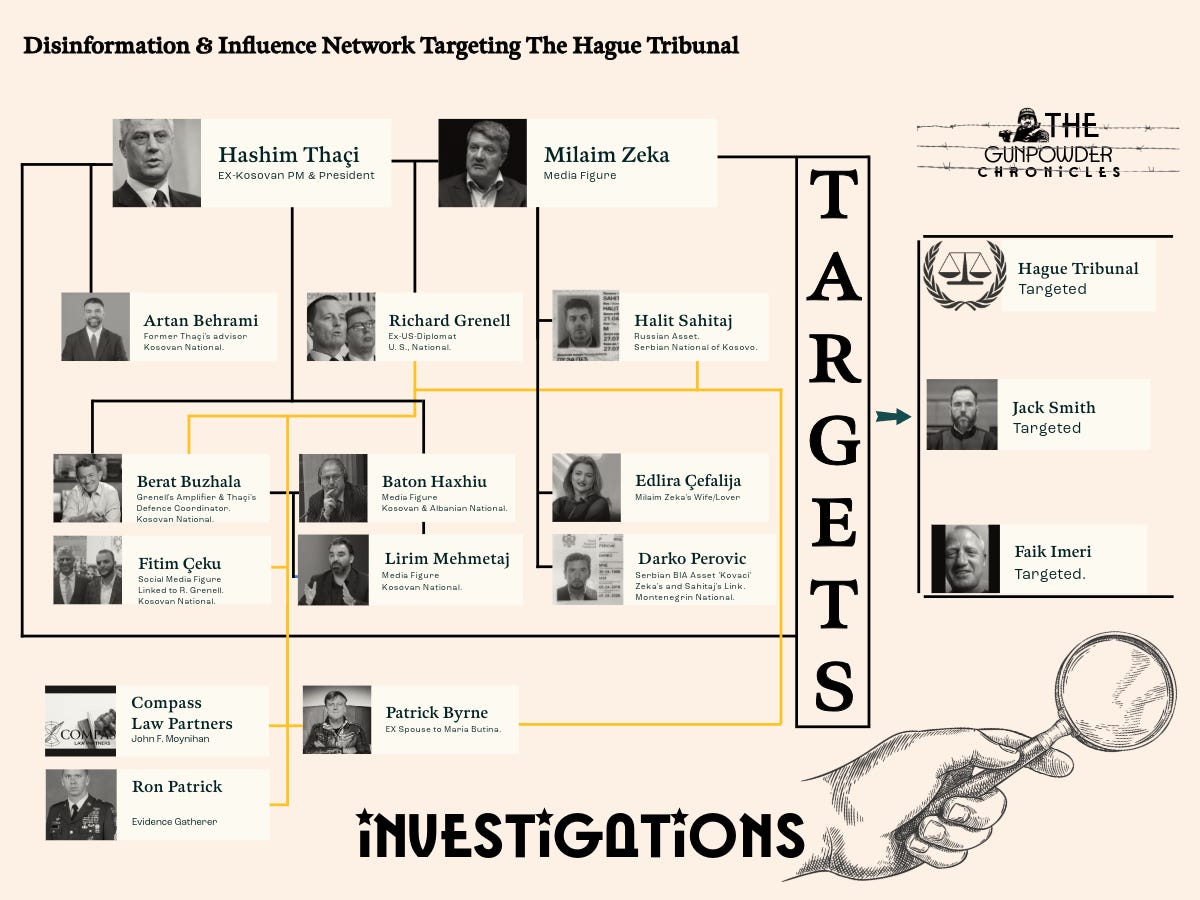
The network extends deep into Kosovo’s media and political landscape. Journalists, operatives, and political figures have played a role in legitimising this campaign.
Among them is Berat Buzhala, a Kosovo-based former MP of the previously ruling PDK party of Hashim Thaçi. Following his mandate, he became a media mogul. Well-informed international sources told Gunpowder Chronicles that money was funnelled from organised crime networks linked to Thaçi to support his media's propagation of Thaçi’s agenda. Buzhala, as a journalist with ties to organised crime has worked to delegitimise Kosovo’s [Kurti 2] government-led efforts against Serbian aggression the GPC can reveal. Our investigations8 exposed his links to individuals blacklisted by the U.S. Treasury Department9, including three with known organised crime connections. Two are found to be tied to Serbian intelligence, and one reportedly operates under the direct influence of Serbian President Aleksandar Vucic10, a claim corroborated by an Organised Crime and Corruption Reporting Project (OCCRP) investigation11.
As our investigation deepened, the names began to connect: Milaim Zeka, a well-known public and controversial media figure, portrays himself variously as a witness, a man with ties to high-end authorities, and when it suits him, a man with credible intelligence information. At times, he also portrays himself as a trusted journalist who may have been granted access to the UDB Serbia's secret service archives of Yugoslavia12. He often claims in various media presentations to have spent time with Richard Grenell. In a recorded conversation with Gunpowder Chronicles, he confirmed that Grenell did not spend more than five minutes with him. He then insists he is among dozens of Western journalists whose story, though never published, was submitted to the US Congress, the State Department, or similar entities. When pressed, he admitted that the 'journalists' he referred to as foreign were his wife, Edlira Çefalija, and himself. Additionally, the three other people identified in what is referred to as a »Whistleblower Complaint« report published by a private law firm are actually individuals whom, according to our findings13, he had convinced to make false claims targeting the SPO, Jack Smith, and Faik Imeri, a personality whom Gunpowder Chronicles continues to search for, albeit without any success to date.
Others have emerged as key enablers. Fitim Çeku14, who presents himself as an independent journalist, has been actively promoting Richard Grenell’s political narratives that closely align with efforts to destabilise Kosovo’s institutions. Grenell has consistently attacked Jack Smith based on unverified, and now demonstrably false, allegations fabricated by Milaim Zeka and his associates. Baton Haxhiu, a prominent media figure, is widely known for his deep-rooted ties to Serbian intelligence. His relationship with Vucic was dramatically highlighted when the Serbian president interrupted an international conference to embrace him, a gesture that raised significant speculation and concern.
In this video material transmitted by Serbia's National Broadcaster, known as RTS, it is seen that Serbia's President Vucic goes straight to give a warm hug to Baton Haxhiu after he leaves the stage of a panel discussion at an international conference.
Artan Behrami, a former journalist turned Thaçi advisor, was instrumental in persuading Thaçi to support the SPO’s creation-believing, wrongly, that it would spare him. That calculation collapsed in 2023 when the SPO raided Behrami’s residence in an obstruction of justice investigation15, following allegations that he attempted to interfere with the judicial process.
Artan Behrami has been actively voicing his dissent against the Kosovo Special Chambers through a series of Facebook posts. On February 25, he dramatically depicted a legal manoeuvre against Hashim Thaci as a scandalous attack, orchestrated by what he perceived as collusion between President Trump and Jack Smith, reflecting a personal and political vendetta rather than justice. Just a day later, on February 26, he continued his critique, lambasting the Special Court for lacking humanity and empathy, especially in the context of a visit involving Thaci's father, which he argued was dismissed under flimsy pretexts by the court. His posts escalated in rhetoric by March 14, where he derided a so-called humanitarian visit by European police, accusing them of behaving like paramilitary forces and bandits. Finally, on March 15, Behrami commented on Trump’s action of stripping Jack Smith of immunity, suggesting that Kosovo politicians are deeply indebted to Smith, which could have significant implications for political asylum and protection within Kosovo. These posts collectively illustrate Behrami's sustained campaign to challenge the legitimacy and intentions of the Kosovo Special Chambers.


Artan Behrami, despite his active and public campaign against the Kosovo Special Chambers on social media, has remained elusive in responding to journalistic inquiries for further comment. In February 2025, Gunpowder Chronicles reached out to Behrami with detailed requests for an interview to discuss recent developments concerning war crimes trials and alleged political assassinations in Kosovo. Despite acknowledging receipt, Behrami did not reply to the invitation to discuss his publicly expressed stances or clarify his positions regarding reported U.S. policy shifts on the Special Court. This lack of response highlights a potential reluctance to engage in discussions that might delve deeper into the nuances and implications of his public assertions and the broader political dynamics at play.
The operation extends beyond Kosovo. Flamur Ballazhi, an Albanian-American suspected of running the anonymous X account “Rinor Muia,” has led a coordinated smear campaign targeting journalists, including myself, who exposed Grenell’s expulsion from Germany. Ballazhi has worked in tandem with Fitim Çeku, often seen alongside Grenell in photographs that suggest more than mere proximity.
The network is also implicated in Kosovo’s murky political past. Ferat Shala, a former senior official in SHIK, Kosovo’s now-outlawed intelligence agency, is linked to multiple political assassinations according to our sources. Among them, the brutal murder of Hamez Hajra and his family in Drenas, a former police officer in Yugoslavian public service. Only a child survived the attack. Years later, the Ramadani brothers, wrongly imprisoned for the crime, accused Shala of orchestrating the murders and framing them. When the brothers were quietly released from prison under Thaçi’s watch, sources suggested an undisclosed agreement may have been struck to secure their silence.
Perhaps most alarmingly, this effort is not just a domestic power struggle, it is deeply intertwined with external actors, including Russian operatives. Intelligence reports seen by Gunpowder Chronicles confirm that several key figures in this network maintain ties to Russian-backed influence operations in the Balkans. Serbia, a longstanding ally of Moscow, has a vested interest in weakening Kosovo’s judiciary. The dismantling of the KSC would not only benefit Thaçi but also serve Serbian and Russian interests by undermining Kosovo’s sovereignty.
Parliament has become a battleground. Sources indicate that the ultimate objective is to seize legislative control and pass a resolution to dissolve the Special Prosecutor’s Office—effectively ending all ongoing war crimes trials. Among those suspected of facilitating this effort is Elmi Reçica, a current PDK MP and alleged former second-in-command of SHIK. Intelligence reports tie him to systematic attempts to obstruct justice in Kosovo.
The effort to shutter The Hague is not limited to legal manoeuvring. A leaked video shows Artan Behrami telling supporters that removing Kurti from power is a prerequisite to dismantling the tribunal. Without Kurti’s government, Kosovo’s parliament could push through a resolution to end the SPO.
The immutability of the Kosovo Special Chambers (KSC) jurisdiction, as explained by international legal experts, stems from foundational principles of international law and treaty obligations. The KSC was established following an agreement between the European Union and Kosovo, ratified as part of an international treaty, and integrated into Kosovo's legal framework by its parliament. Therefore, any unilateral attempt by the Kosovo Parliament to dismantle the KSC would violate these international commitments, over which international law holds precedence, thus rendering such actions legally untenable and potentially leading to severe diplomatic and legal repercussions.
Simultaneously, figures like Richard Grenell16 have employed sophisticated media tactics to sway public opinion and political processes in Kosovo. Grenell's social media campaigns against figures such as Prime Minister Albin Kurti, which aim to destabilise the current government, mirror strategies he used in 2020 to orchestrate the collapse of Kurti's first administration. These efforts appear coordinated with local actors like Artan Behrami, who in a leaked video, openly discusses plans to overthrow Kurti's government at any cost. This collaboration suggests a deep-seated agenda to manipulate Kosovo's political landscape through disinformation, strategic alliances, and media influence.
The impact of Grenell's statements is magnified by Kosovo's media outlets and influencers, with platforms like Nacionale17 and individuals such as Fitim Ceku18 playing significant roles in amplifying his narrative. This dynamic media environment, where figures like Milazim Zeka fluctuate between criticising and glorifying Grenell, contributes to a broader campaign aimed at undermining Kosovo's rule of law and promoting the interests of organised crime and foreign entities.
This extensive manipulation campaign represents a stark example of modern hybrid warfare tactics, where disinformation, coercion, and media manipulation are as strategically employed as military operations. The objective is not merely to protect specific political figures but to erode the foundational legal and democratic institutions of Kosovo, advancing the agendas of powerful criminal networks and foreign intelligence services.
In the shadow of Hashim Thaçi's long-standing influence and the illicit networks that thrived under his rule, it appears that his cohorts are fervently pursuing his release at any cost, driven by a desire to reclaim power and evade justice. These oligarchs, forged during Thaçi’s two decades at the helm following Kosovo’s war, seem incapable of sustaining their dominion in the face of stringent legal scrutiny, particularly with Prime Minister Albin Kurti in office. Our investigation, conducted this February, unveils disturbing attempts to orchestrate Kurti’s assassination for the second time, underscoring the depths of desperation among these factions. Moreover, Serbia's endeavors to entrench its influence within Kosovo have faltered significantly under Kurti’s leadership. With the dismantling of Serbia's parallel, state-backed structures in Kosovo, aspirations for creating autonomous Serbian enclaves within the country have dissipated. Although Thaçi once facilitated agreements favorable to Serbia, including the widely condemned land-swap proposal believed to have precipitated his own indictment, his absence has markedly stymied Russia’s geopolitical ambitions in the region. Observers in Brussels and beyond are increasingly convinced that without Thaçi’s manipulation, establishing another of Moscow's outposts in Europe could well prove unfeasible. In a bizarre twist of irony, when Thaçi coerced and threatened Kosovan MPs to secure their support for the formation of the Kosovo Special Chambers (KSC) in 2015, Albin Kurti and his fellow MPs stood firm, refusing to vote in favour of its establishment. This resistance highlights a stark contrast in political integrity and foresight, underscoring the current challenges Thaçi's network faces in a landscape reshaped by Kurti’s steadfast governance and commitment to dismantling corrupt structures.
In our next expose, we venture deeper into the shadows, unraveling the clandestine network around the elusive "Laky Laky". Tied to Serbian and Russian operatives, his machinations threaten the very fabric of international justice, with whispers of political assassinations lingering in the air. Join us as we peel back the layers of intrigue and deception, shining a light on the dark underbelly of global espionage. This investigation promises to grip you with its revelations and shock you with its implications. Stay tuned for a journey into the heart of hidden conspiracies.
To be continued.…
Kosovo’s Justice System is Under Siege

For years, I was vaguely aware of the Special Prosecutor’s Office (SPO), but never did I allow myself to take a deeper interest. The American, European and British newsrooms I worked with had little focus on it, and when they did, the stories were assigned to journalists well-versed in its complexities. Knowing the intricacies of international war crimes investigations, I hesitated to immerse myself in a subject fraught with legal, political, and historical entanglements. But one thing remained clear to me: justice must prevail, regardless of who stands accused.
This article was meticulously edited with the invaluable contributions of our London-based editor, Michael Sheppard. His expertise and keen editorial insights have been instrumental in shaping this investigative piece, ensuring clarity and precision in our reporting.
Support Independent Journalism
Starting April 7, 2025, Gunpowder Chronicles moves to subscription-only access, free or paid. To celebrate a decade of calling Britain home, I’m offering 15% off all paid subscriptions activated before April 14.
Your support keeps fearless reporting alive.
☑ Donate | ☑ Subscribe | ☑ Share
Спецпредставитель Трампа Ричард Гренелл имеет связи с российским миллиардером — INFORMATOR.
The Article on Richard Grenell — INFORMATORS [PDF].
Kosovo MPs Approve New War Crimes Court — Balkan Insight.
Milaim Zeka’s Facebook Post — PDF Document.
Milaim Zeka’s 10 Nov, 2024 Facebook Post.
The apartment of Thaçi's former adviser, Artan Behrami, is raided — KOHA Ditore.