

How Zelenskyy Walked Into Moscow's Kosovo Trap
Kosovo sanctioned Russia and supported Ukraine. Serbia resisted comprehensive sanctions. Zelenskyy rewarded Kremlin proxy with the diplomatic reassurance Belgrade wanted most on Kosovo's independence.


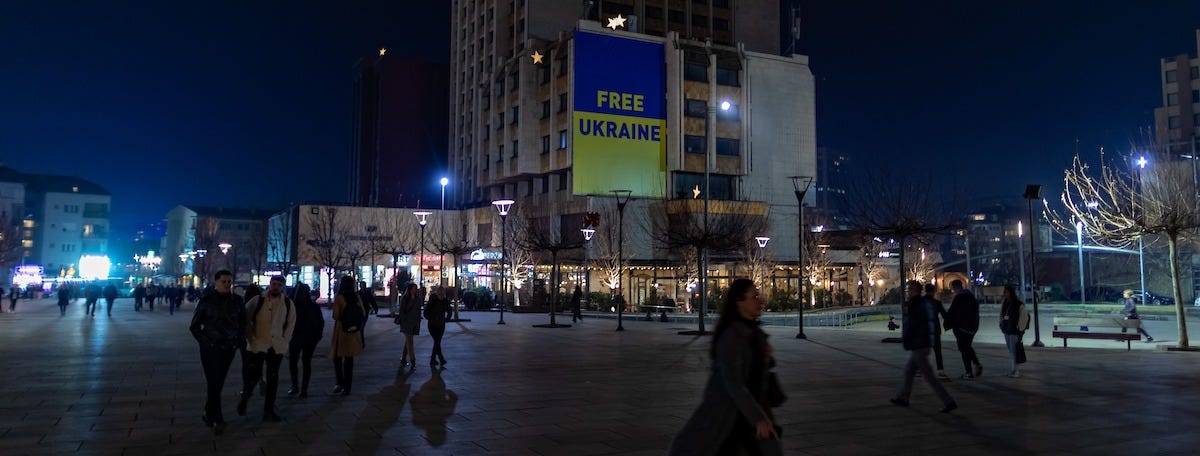
Volodymyr Zelenskyy’s first official visit to Serbia was intended to demonstrate that Ukraine could deepen relations with a traditionally Moscow friendly Balkan state while drawing Belgrade further towards Europe. Instead, the Ukrainian president left Serbia having handed Aleksandar Vucic one of the most useful diplomatic statements Belgrade could have wanted. Zelenskyy reaffirmed that Ukraine had not changed its position on Kosovo and continued to respect Serbia’s territorial integrity, allowing Vucic to publicly thank Kyiv for refusing to recognise the Republic of Kosovo. Within a day, the political cost was visible in Pristina, where Kosovo’s foreign minister issued an unusually direct rebuke1 and the capital removed2 a huge “Free Ukraine” banner that had stood as a symbol of solidarity since Russia’s full-scale invasion.

The episode amounts to more than an avoidable Balkan controversy. It exposes a deeper incoherence in Ukrainian foreign policy at precisely the moment when Kyiv depends upon the international principle that powerful states cannot use history, territorial mythology or military force to determine the political future of smaller nations. Ukraine is fighting Russia because Moscow rejects that principle in practice. Yet in Belgrade, Zelenskyy preserved a position on Kosovo that remains framed almost entirely through Serbia’s claim to territorial integrity, despite the fundamentally different historical and legal circumstances surrounding Kosovo’s independence. The result was a diplomatic performance in which Ukraine defended its own sovereignty while helping Serbia reinforce its claim over another European state.
There was a strategic logic behind the visit. Serbia remains an important Balkan state, an EU candidate and a country whose relationship with Russia has become more complicated since the full-scale invasion of Ukraine. Vucic has repeatedly supported Ukraine’s territorial integrity, including Ukrainian territory seized by Russia since 2014. Serbian manufactured ammunition has also reached Ukraine through third countries, according to reporting and Russian intelligence accusations, although Belgrade has denied directly supplying Kyiv. Zelenskyy and Vucic used the visit to discuss economic cooperation, energy, European integration and a possible free trade agreement. Drawing Serbia further away from Russian dependence would plainly serve Ukrainian and European interests.
But diplomacy is not measured only by whether two leaders shake hands or announce another agreement. It is measured by what each side gives away and what it receives. In Belgrade, Vucic reaffirmed support for Ukraine’s territorial integrity without fundamentally changing Serbia’s strategic posture towards Russia. Serbia has still not joined the European Union’s broad economic sanctions imposed over Russia’s invasion, even though it has aligned with some narrower EU restrictive measures and declarations. The European Commission has repeatedly described Serbian foreign policy alignment as insufficient and has urged Belgrade to reduce its dependence on Russian energy.
Ukraine, by contrast, gave Vucic something politically valuable and immediately usable at home. The Serbian president was able to tell his public that Kyiv continued to respect Serbia’s territorial integrity and had not recognised Kosovo. For a government that has spent years campaigning internationally against Kosovo’s recognition, that was not a minor diplomatic courtesy. It reinforced one of the central pillars of Serbian foreign policy without requiring Belgrade to abandon sanctions resistance, sever its remaining strategic relationships with Moscow or recognise Kosovo itself.
The asymmetry becomes more striking when Kosovo’s record since February 2022 is considered. Kosovo has condemned Russia’s invasion, voluntarily aligned itself with European sanctions against Russia and Belarus, offered assistance to Ukraine, hosted Ukrainian journalists and supported Ukrainian defence through military assistance and training. Kosovo did these things despite being denied recognition by Kyiv. Its support was not conditional on diplomatic reciprocity. Former foreign minister Donika Gërvalla Schwarz publicly described Kosovo’s support for Ukraine as unconditional.
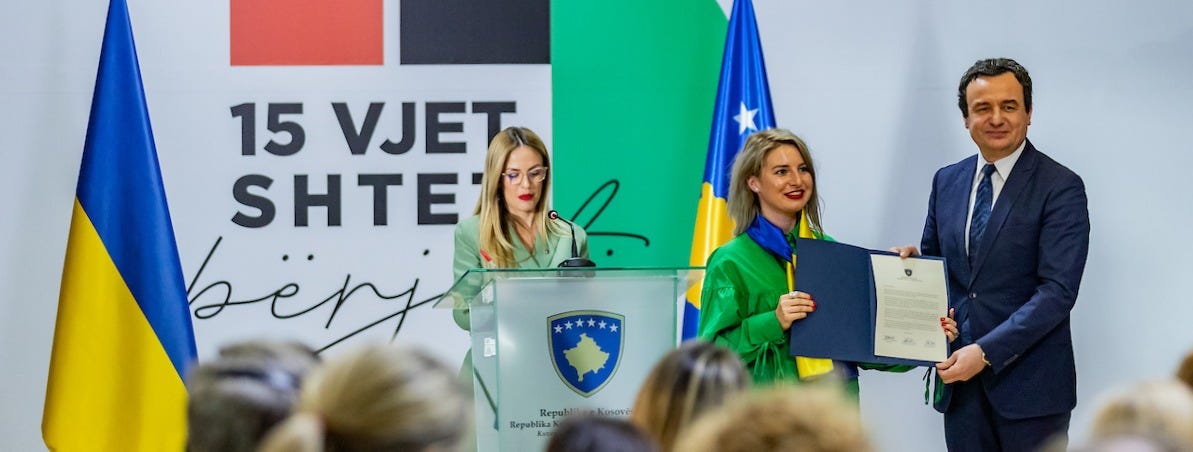
Foreign Minister Glauk Konjufca made that contradiction explicit after Zelenskyy’s august remarks in Belgrade. He said Kosovo had stood unequivocally with Ukraine from the first day of Russia’s full-scale aggression because solidarity with a nation defending its freedom and sovereignty was a matter of principle. He contrasted Kosovo’s sanctions against Russia with Serbia’s refusal to adopt the EU’s broad sanctions regime. He also rejected any attempt to frame Kosovo through Serbia’s territorial integrity and called on Ukraine to recognise Kosovo.
Konjufca’s most important point concerned the legal comparison that has haunted Ukrainian thinking about Kosovo for years. Kosovo’s independence did not result from one state invading another, occupying part of its territory and organising a referendum under military control. Kosovo emerged after years of repression and war, NATO intervention in 1999, United Nations administration and an internationally mediated process to determine its final political status. Martti Ahtisaari, the United Nations special envoy, ultimately proposed internationally supervised independence after negotiations failed to produce an agreed settlement.
The International Court of Justice later concluded in 2010 that Kosovo’s declaration of independence of 17 February 2008 did not violate international law. The court did not establish a universal right of secession and did not order countries to recognise Kosovo. Its conclusion was narrower. But it demolishes the proposition that Kosovo’s declaration itself can simply be treated as an unlawful territorial seizure equivalent to Russia’s annexations in Ukraine.
Moscow has nevertheless spent years invoking Kosovo when attempting to legitimise its own conduct. Russia cited supposed Western precedent after recognising Abkhazia and South Ossetia and later invoked Kosovo in arguments surrounding Crimea and occupied Ukrainian territory. The comparison has always depended upon removing the facts that make the cases materially different. Kosovo did not invade Serbia. Albania did not send troops across the border, occupy Kosovo and then annex it. Kosovo was administered by the United Nations for almost nine years before declaring independence. Russia’s actions in Ukraine followed Russian military intervention, occupation and attempted incorporation of Ukrainian territory into the Russian Federation.
For Kyiv, this distinction should be central rather than inconvenient. Ukraine has more reason than almost any European state to insist that Kosovo cannot be allowed to become a rhetorical hostage to Moscow’s misuse of history. Yet its existing policy produces the opposite effect. By refusing recognition largely within the vocabulary of Serbian territorial integrity, Kyiv continues behaving as though recognising Kosovo would somehow strengthen Russia’s argument over Crimea, Donetsk, Luhansk, Zaporizhzhia or Kherson.
That reasoning deserves serious reconsideration because Moscow does not require Ukrainian recognition of Kosovo to misuse Kosovo. It already does so. Russia’s argument is not strengthened because Kyiv recognises the actual distinctions between two cases. It is strengthened when democratic governments behave as though those distinctions cannot safely be acknowledged.
This is where Ukrainian foreign policy risks shooting itself in the foot. Kyiv is allowing a Kremlin constructed analogy to impose limits on its own diplomatic thinking. Russia takes Kosovo, strips away the United Nations administration, the failed status negotiations, the Ahtisaari process and the absence of annexation by a neighbouring state, then presents the remaining shell as evidence that Western governments destroyed the principle of territorial integrity. Ukraine responds by treating recognition of Kosovo as potentially dangerous to its own territorial claim. Moscow therefore succeeds in shaping the conceptual boundaries of Ukrainian policy even when Kyiv entirely rejects Russia’s conclusions.
That does not mean Ukrainian policy was literally written in Moscow. There is no evidence for such a claim. Ukraine’s caution also reflects its own experience with separatism, territorial occupation and the fear that recognition of unilateral independence elsewhere could be exploited against it. Those concerns are understandable. But foreign policy cannot remain frozen merely because an adversary has weaponised an analogy. A sovereign Ukrainian foreign policy should begin with Ukraine’s assessment of facts and international law, not with a permanent fear of how Moscow might distort them.
The Belgrade visit demonstrated the cost of failing to resolve that contradiction. Zelenskyy arrived seeking greater Serbian cooperation. Vucic obtained renewed Ukrainian deference on Kosovo. Kyiv then watched one of the strongest pro-Ukrainian societies in the Balkans react with anger.
The removal of the “Free Ukraine” banner in central Pristina was politically symbolic rather than strategically consequential. Kosovo did not withdraw its recognition of Ukraine because recognition already runs only one way. It did not announce an end to its support for Ukrainian sovereignty. Pristina Mayor Përparim Rama explicitly said solidarity remained with peoples facing war and persecution. But he also said Kosovo’s statehood had to be respected. The image of the Ukrainian flag being taken down after four years of public solidarity captured something diplomats should not dismiss. Foreign policy has consequences beyond government buildings.
The damage is particularly unnecessary because Ukraine does not need to choose between Serbia and Kosovo. Recognition of Kosovo would not require Kyiv to abandon diplomatic relations with Belgrade. Most NATO members and most European Union states recognise Kosovo while maintaining relations with Serbia. Recognition would also not require Ukraine to accept Russia’s interpretation of Kosovo as a precedent for territorial conquest. On the contrary, Kyiv could accompany recognition with an explicit legal position explaining why Kosovo and Russian occupied Ukrainian territories are not comparable.
There is also a wider European security question. Serbia has spent years trying to maintain relationships with both Moscow and the West. It condemned Russia’s invasion and supports Ukraine’s internationally recognised borders, yet it has resisted comprehensive sanctions against Russia. Its economy and energy sector have retained important Russian connections. Serbia’s former deputy prime minister Aleksandar Vulin maintained particularly close ties with Russian officials and publicly opposed sanctions and NATO membership. Russian intelligence agencies have also interacted openly with Serbian officials. None of this makes Serbia a simple Russian proxy. Vučić has demonstrated repeatedly that his policy is transactional and designed to preserve room for manoeuvre between competing powers. That makes precise Western and Ukrainian diplomacy more important, not less.
During a meeting with Russian President Vladimir Putin he described Serbia not only as a partner but as an ally of Russia.
“Serbia is not only a strategic partner of Russia, it is also an ally of Russia. Serbia will never become a NATO member and will never introduce sanctions against the Russian Federation”, Vulin said.
Video: Aleksandar Vulin tells Vladimir Putin that Serbia is “not only a strategic partner of Russia but also an ally”, pledging that Serbia will never join NATO or impose sanctions on Moscow.
There are signs that the relationship is changing. Serbia has sought alternatives to Russian gas, while Moscow has publicly complained that Serbian ammunition has reached Ukraine. Vucic has incentives to improve relations with Kyiv and Brussels, and Ukraine has every reason to exploit those openings. A successful Ukrainian policy towards Serbia could reduce Russian leverage in the Balkans, strengthen economic ties and increase support for Ukraine inside a country where pro-Russian sentiment has historically been significant.
But engaging Serbia is not the same as adopting Serbia’s regional narrative. That is the mistake exposed in Belgrade. Ukraine can recognise legitimate Serbian interests without affirming Belgrade’s claim over Kosovo. It can seek Serbian ammunition, investment, trade and political cooperation without allowing Vucic to convert Zelenskyy’s visit into evidence that Kyiv validates Serbia’s Kosovo policy.
Tirana’s response illustrated the alternative. Albania welcomed efforts to draw Serbia further from Russian influence and closer to Europe, while simultaneously rejecting any equivalence between Kosovo and Russian occupied Ukrainian territory. Those two positions are not contradictory. Serbia’s movement away from Moscow would benefit European security. Kosovo’s independence can also be defended on its own historical and legal foundations.
The distinction matters for Britain and NATO because the Western Balkans remain connected to the broader contest over European security. NATO maintains thousands of troops in Kosovo through KFOR. Russia has repeatedly used Kosovo and NATO’s 1999 intervention in its information campaigns about Ukraine and the West. Persistent instability between Serbia and Kosovo therefore gives Moscow political material it can exploit even without directly controlling events on the ground.
Ukraine should be among the states most capable of recognising that danger. Its struggle against Russia is partly military and partly a struggle over the interpretation of international law, sovereignty and historical legitimacy. Kyiv repeatedly asks governments around the world to reject Moscow’s selective use of history. It cannot effectively make that argument while leaving its own policy towards Kosovo trapped inside one of Moscow’s favourite historical comparisons.
Zelenskyy’s visit was therefore not disastrous because Ukraine spoke to Serbia. Speaking to Serbia was sensible. Nor was it disastrous because Vucic reiterated support for Ukraine. That support matters and should not be dismissed. The disastrous failure came because Kyiv sought to loosen Moscow’s grip on Serbia while simultaneously reaffirming a Kosovo policy whose underlying logic has been relentlessly exploited by Moscow.
The immediate consequences are diplomatic rather than military. Kosovo remains supportive of Ukraine. Serbia has not suddenly become a Ukrainian ally. Russia has not lost the Balkans. But the episode has exposed a weakness in Kyiv’s foreign policy architecture.
Ukraine has spent more than four years demanding that the democratic world distinguish lawful sovereignty from territorial conquest, genuine self-determination from manufactured separatism and international law from historical mythology. On Kosovo, it should apply the same analytical discipline to itself.
Kyiv ultimately has to decide whether its Balkan policy will be built around the realities created since 1999 or around the fear of a false analogy created and repeatedly weaponised by Moscow. Until it does, Ukraine risks continuing an extraordinary contradiction. It will fight Russia’s imperial interpretation of sovereignty at home while allowing that same Kremlin narrative to constrain Ukrainian diplomacy abroad.
That is not strategic consistency.
It is a foreign policy vulnerability of Kyiv’s own-making foreign policy disaster.
Mr Zelenskyy, Whose Freedom Counts?

President Volodymyr Zelenskyy has spent the years since Russia’s full-scale invasion asking the world to accept a proposition that should require little argument: a larger state does not acquire ownership of a smaller nation because of history, mythology, language, military strength or an imperial map. Ukrainians, he has insisted, possess the right to determine their own future, and
Kosovo’s acting Foreign Minister Glauk Konjufca’s X Post, August 9, 2026.