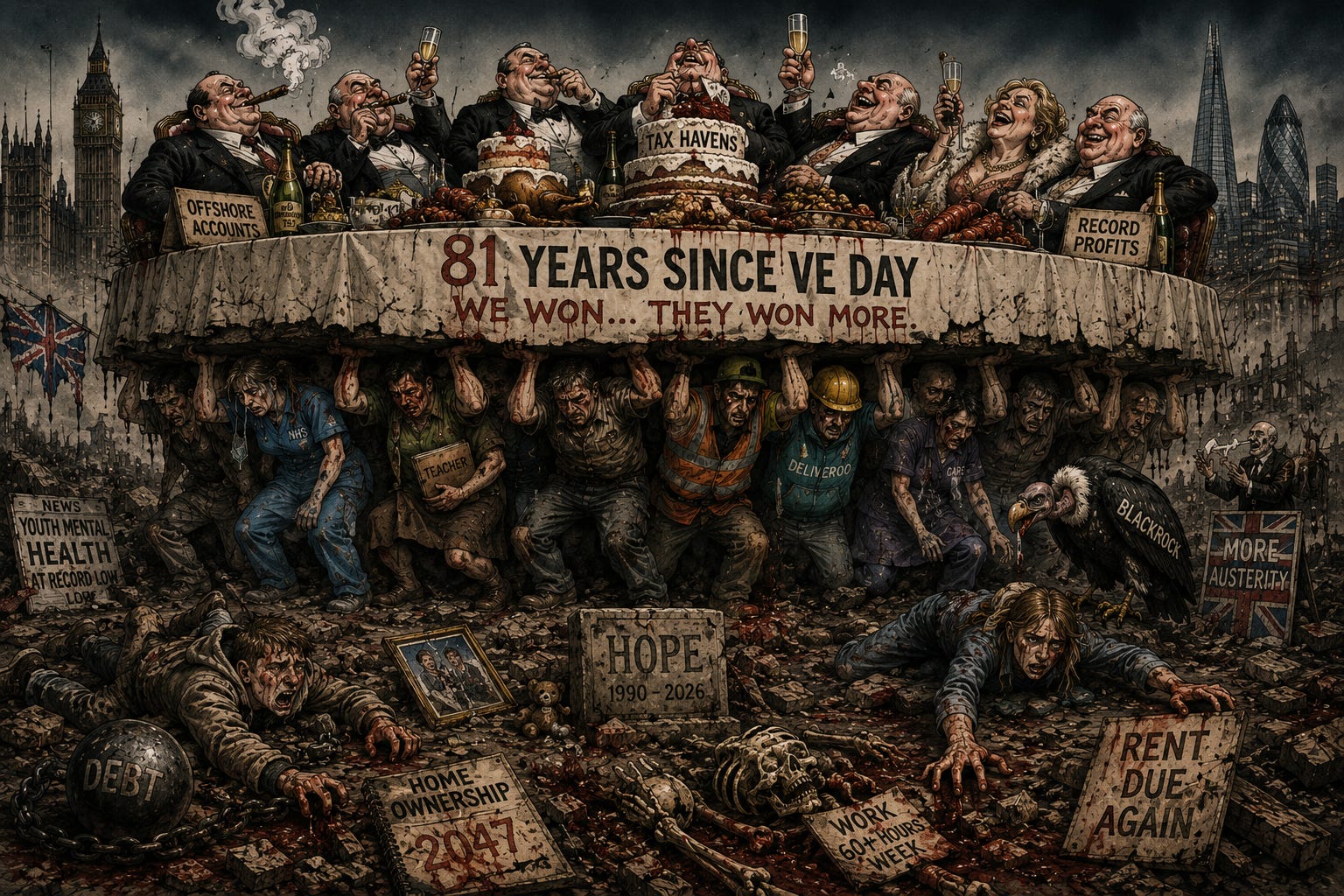
A Nation Worth Fighting For Must First Be Worth Living In
A nation where workers cannot afford homes, families or peace is not economically successful. It is morally failing beneath the polished language of prosperity.

There are old men across Britain now who still remember the sound of artillery the way other men remember hymns. They remember mud, blood, hunger, fear, and the unbearable silence after a friend stopped speaking forever. They remember what civilisation costs when it collapses. Men like Jim Gettings do not speak about war with cinematic romance. They speak about bullets “zipping about”. They speak about providence. They speak about boys who never came home. And when they say that the dead were the real heroes, one hears not patriotism in its theatrical form, but patriotism stripped naked to its bones. Grief. Duty. Sacrifice. Love of country without expectation of reward.
As Britain marks eighty-one years since VE Day, Second World War veteran Jim Gettings reminds us that freedom was not won for greed, fear or the humiliation of ordinary people, but for dignity, sacrifice and a civilisation worth defending.
That generation believed, perhaps naively, that if fascism was defeated, if Europe was rebuilt, if the camps were liberated and the tyrants buried beneath history, then ordinary people might inherit a fairer civilisation. Not a perfect one, but one decent enough to justify the graves.
Yet here we stand in the twenty first century, looking upon nations swollen with wealth and hollowed out by greed, and one begins to understand the bitterness beneath the veteran’s question. What was it all for, if oligarchy simply learned to wear a better suit. What was victory for, if millions of working people now live in permanent economic siege within the very democracies their grandfathers defended with blood.
The western world speaks constantly about freedom, but freedom without dignity is merely a decorative word. A man who works forty, fifty, sixty hours a week and still cannot afford a home is not free. A young woman drowning in rent, debt and exhaustion while billionaires race each other into space is not living inside a successful civilisation. She is surviving inside a sophisticated form of economic humiliation.
Britain in particular stands dangerously close to moral exhaustion. Not because its people are weak, but because they are tired. Tired of being told to work harder while owning less. Tired of watching entire cities become investment portfolios for foreign wealth while the people born there are pushed further outward like debris from an explosion. Tired of hearing economists explain why the impossible must continue forever. Tired of governments that speak the language of sacrifice only to demand it always from the same classes of people.
The greatest scandal of modern capitalism is not merely inequality. Inequality has existed in every age. The scandal is the normalisation of hopelessness.
A civilisation that quietly accepts that its young people may need thirty or forty years simply to secure shelter has already begun rotting from within. Shelter is not a luxury. It is not an aristocratic prize. It is the floor beneath civilisation itself. And any economic order that transforms housing into a lifelong punishment deserves not admiration, but contempt.
People should be able to afford a home within three years of honest work.
End of discussion.
The fact that this statement now sounds radical reveals how profoundly diseased the present order has become. We have allowed speculators, monopolists, financiers and inherited wealth to redefine basic human dignity as an unrealistic aspiration. Entire generations now postpone families, postpone stability, postpone life itself because markets demand eternal extraction from human beings who are already giving everything they have.
And then the same ruling classes wonder why social trust collapses. Why patriotism weakens. Why birth rates decline. Why cynicism spreads like mould through public life.
Why would a young person feel loyalty towards a system that offers them permanent precarity in exchange for obedience.
Why would they fight for a country whose economic structure increasingly resembles feudalism with smartphones.
The tragedy is that the western democratic tradition once understood something essential. Shared prosperity was not charity. It was national security. After the Second World War, Britain built homes at scale because leaders understood that despair breeds instability. They created the NHS because they understood that civilisation cannot survive when illness becomes a death sentence for the poor. They taxed the wealthy heavily because they understood that concentration of wealth inevitably mutates into concentration of power.
Now, however, modern politics often behaves as though billionaires are endangered wildlife requiring state protection while ordinary citizens are infinitely exploitable raw material.
To hell with that.
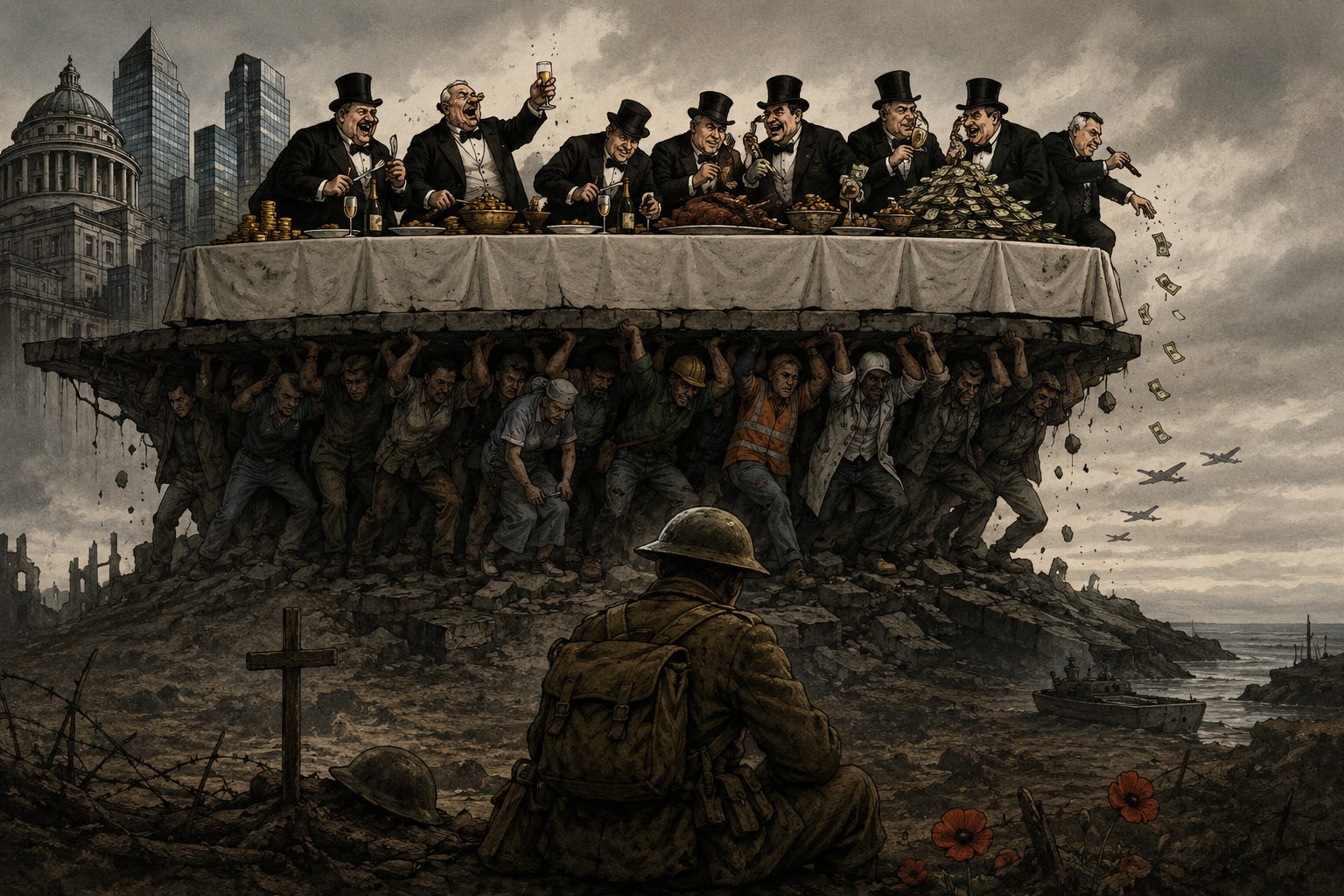
To hell with an economic morality in which nurses cannot afford housing near the hospitals they sustain. To hell with a property market that rewards hoarding over labour. To hell with corporations posting historic profits while food banks become normal architecture in wealthy nations. To hell with the absurd spectacle of men accumulating private fortunes so vast they could rebuild entire regions while children sit in cold flats doing homework beneath mould stained ceilings.
This is not meritocracy. It is organised theft wrapped in the language of efficiency.
And the danger now stretches beyond economics. Democracies facing external threats cannot survive indefinitely on internal despair. Britain and the wider western world may soon be forced once again to confront hostile powers not merely through speeches and sanctions, but through genuine societal endurance. One cannot ask populations to defend democratic civilisation while simultaneously reducing them to anxious consumers trapped between rent payments and energy bills.
A people crushed by economic hopelessness eventually lose emotional investment in the future itself.
That is the great danger of our age.
Authoritarian states understand this perfectly. They weaponise corruption, inequality, disinformation and social fragmentation because they know exhausted societies are easier to destabilise. A nation does not fall only when bombs destroy bridges. It falls when citizens cease believing the country belongs to them.
And what belonging can survive when ordinary workers are treated as disposable machinery while wealth circulates endlessly upwards into the hands of those who produce nothing except financial abstraction.
There is something grotesque about modern elite culture. Its philanthropy is performative. Its compassion is managerial. Its understanding of ordinary life is almost anthropological. The rich increasingly inhabit insulated worlds of private schools, private healthcare, private transport, private security and private influence while lecturing everyone else about resilience.
Resilience.
What a filthy word it has become.
Resilience now means teaching people how to psychologically endure conditions that should never have been permitted in the first place. It means glorifying survival instead of demanding justice. It means asking the public to adapt endlessly to exploitation while the architects of that exploitation congratulate themselves for innovation.
Enough.
A decent society cannot be built entirely around maximising profit extraction. Human beings are not livestock for quarterly earnings reports. The purpose of civilisation is not to create the highest possible number of billionaires before ecological collapse arrives. The purpose of civilisation is to create conditions under which ordinary people may live meaningful, secure, dignified lives.
Anything less is failure.
The moral obscenity of extreme wealth is not merely that some possess too much. It is that their excess exists alongside manufactured suffering that could be alleviated tomorrow if political courage existed. There is no economic law of nature demanding that teachers struggle while hedge funds flourish. There is no divine commandment insisting that housing become speculative currency instead of shelter. There is no rational civilisation in which workers who sustain society are priced out of participating in it.
These are political choices.
And because they are choices, they can be undone.
The post war generation understood sacrifice because they believed sacrifice served something larger than private accumulation. That belief is evaporating now. Not because ordinary people became selfish, but because they watched too many institutions betray the social contract while wrapping themselves in flags and ceremonial language.
People do not need propaganda. They need reasons to believe.
They need to know that if they work honestly they will live decently. They need to know that truth matters more than influence. They need to know their children will inherit stability rather than permanent economic anxiety. They need to know their country values them beyond their tax contributions and consumption habits.
Otherwise patriotism becomes theatre performed for those who can still afford tickets.
The old veterans understood something the modern elite has forgotten. A nation is not held together by markets alone. It is held together by moral trust. By the belief that sacrifice will not merely enrich parasites hiding behind patriotic rhetoric. By the belief that the country belongs equally to the mechanic, the nurse, the labourer, the teacher, the refugee who built a life honestly, the veteran who buried friends in foreign soil, and the child yet unborn.
Without that moral foundation, democracies decay from the inside long before enemies arrive at the gates.
The future cannot belong indefinitely to oligarchs who treat entire populations as economic residue. It cannot belong to politicians terrified of offending concentrated wealth while entire generations slide towards despair. It cannot belong to systems that measure national success through stock valuations while loneliness, poverty and hopelessness spread beneath the surface like cracks beneath old concrete.
There must come a point where civilised societies remember their purpose.
Not endless growth for the already rich. Not permanent austerity for everyone else. Not the worship of markets as though traders on screens are holier than workers who build the physical world.
The purpose is human dignity.
And if the democracies of the west wish to survive the century ahead, they must rediscover it quickly.
Because eventually people stop defending systems that refuse to defend them.