


On 17 February 2026, Kosovo marked eighteen years since independence with flags, speeches, and the familiar choreography of a young state insisting on its own permanence. Then, in the same capital, a second kind of procession gathered momentum. By early afternoon in Prishtina, a mass march moved under the slogan used by organisers, “Drejtësi, jo politikë”, Justice, not politics, in support of four detained former senior figures of the Kosovo Liberation Army, Hashim Thaçi, Kadri Veseli, Rexhep Selimi, and Jakup Krasniqi, who are on trial in The Hague for war crimes and crimes against humanity and who all plead not guilty1.
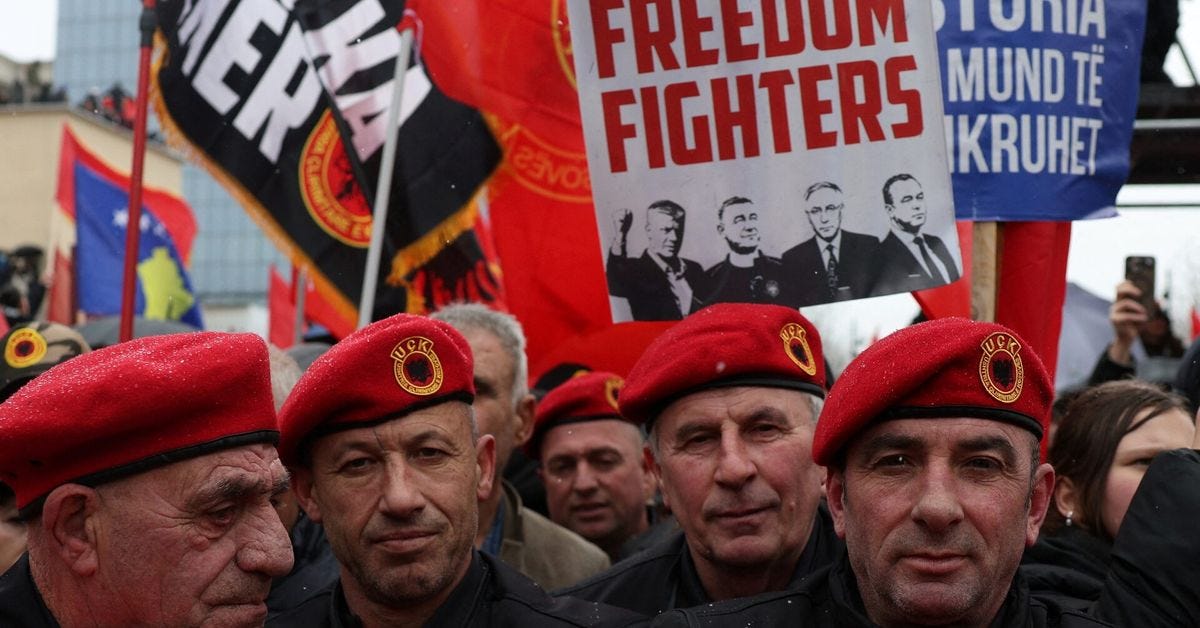
For an outside reader, the scene can look like a paradox, a country celebrating liberation while protesting a court case that is, in theory, about accountability. For many Kosovars, it does not feel like a paradox at all. It feels like a collision between two stories the country has lived with for years, the story of survival and the story of power. The first story is collective, a people pushed to the edge and then pulled back by resistance, international intervention, and statehood. The second story is more complicated, a post war landscape where the line between liberation credentials and political dominance could blur, where fear sometimes outlasted the gunfire, and where justice, delayed or selective, became part of everyday political language.
The court at the centre of this collision is often called the Special Court, although its formal name is the Kosovo Specialist Chambers, along with a companion body, the Specialist Prosecutor’s Office. These are not an international tribunal in the way that the ICTY was. They are, on paper, institutions within Kosovo’s justice system, created by Kosovo’s own Assembly through constitutional amendments and a dedicated law passed on 3 August 20152.
That origin matters because it undercuts the neatest claim that the court is simply an external imposition. It was born from an internal decision taken under heavy external pressure, which is a different thing. The pressure came from the European Union and the United States, and it was driven by a long trail of allegations, diplomatic reports, and investigative work that suggested Kosovo’s domestic institutions were not able to handle certain sensitive cases, particularly those involving alleged crimes by former KLA members and post war networks, without intimidation, political interference, or risks to witnesses. The seat in The Hague, rather than in Prishtina, was chosen largely because of witness protection concerns and the difficulty of ensuring a secure and independent process inside Kosovo3.
The allegations that fed into this architecture were not invented in 2015. The Council of Europe report referenced by legal and policy commentary about the court, published in January 2011, cast a long shadow over Kosovo’s political class. It alleged serious abuses by KLA linked actors during and after the war, and it helped set in motion a Special Investigative Task Force under EU auspices, which in turn contributed to the case for a new judicial mechanism. The Specialist Chambers were designed to address crimes allegedly committed between 1998 and 2000 and linked to that body of reporting and subsequent investigation.
This is where the moral temperature rises in Kosovo. The war with Serbia produced mass death, mass displacement, and deep trauma. Any discussion that foregrounds alleged crimes by KLA members can feel, to many citizens, like a distortion of the basic truth of the conflict, that Serbia waged a brutal campaign and Kosovo fought to survive. That is not a minor emotional reaction. It is the psychological foundation of the state. Yet the logic of transitional justice is that a just cause does not make every act within it just, and that victimhood at the national level does not erase victimhood at the individual level, including for those who may have been targeted as rivals, or as minorities, or as inconvenient witnesses.
The Specialist Chambers were built to occupy that narrow and dangerous space. They are mandated to prosecute individuals, not a liberation movement as an organisation. Prosecutors have repeatedly made the point that membership in the KLA is not, by itself, criminal, and that the purpose is not to put the KLA on trial as a collective. That claim is also reflected in human rights reporting about the case and in how the institution publicly frames its work.
Still, what a court says it is doing and what a society experiences it as doing can diverge. The divergence is amplified by the fact that the Specialist Chambers do not have jurisdiction over Serbian state crimes in Kosovo, because that was largely addressed by other mechanisms, including the ICTY, domestic prosecutions, and international investigations. The result is an unavoidable asymmetry. Kosovo sees a court, created in its name, focused on allegations against its own former fighters, while many Serbian perpetrators are dead, out of reach, or shielded by politics. The asymmetry is not, by itself, proof of bias. But it is a predictable source of resentment.
The case that dominates Kosovo’s political weather is known as “Thaçi et al4.” In procedural terms, it moved quickly at the start. The indictment against Thaçi was confirmed on 26 October 20205, and he was arrested by the Specialist Prosecutor’s Office on 5 November 2020 and transferred to the detention facilities in The Hague the same day.
Rexhep Selimi was also arrested on 5 November 2020 and transferred the same day6.
Jakup Krasniqi was arrested and transferred on 4 November 2020, a day earlier.
Kadri Veseli was transferred along with the others in early November 2020, with the court announcing his initial appearance for 10 November 20207.
Those dates matter because they are the hinge between eras. For a decade, Thaçi in particular had symbolised Kosovo’s transformation from guerrilla struggle to statecraft, prime ministerial offices, diplomatic handshakes, and the language of European integration. Then, abruptly, a prison unit in The Hague replaced the ceremonial rooms of a presidency. Human Rights Watch noted8 that Thaçi resigned as president after charges were brought in November 2020 and was promptly transferred.
From there, the case became a slow grind. Trials are not only legal processes. They are social processes that take time, reshape loyalties, and change what people dare to say. In Kosovo, time itself is a political actor. The longer the detention lasts, the easier it is for supporters to present the accused as victims of a geopolitical scheme. The longer the proceedings last, the easier it is for sceptics to suspect that a culture of intimidation is the reason the system must move so carefully. Both narratives can grow in the same soil.
By February 2026, prosecutors were seeking forty five year prison sentences for each of the four defendants, and that figure became a spark. Reuters reported on 17 February 2026 that thousands rallied in Prishtina against the trial, with prosecutors seeking forty five years and a verdict expected within months, as closing arguments were being heard.
Here is the first thing to understand about the politics of Kosovo and The Hague. Leaders can defend the moral core of the liberation war while still accepting the principle that individuals may have committed crimes. That is the balancing act a mature state tries to perform. But the balance is hard to maintain in a society where the war was not ancient history, and where many families still live with missing relatives and unanswered questions.
The march shows the emotional vocabulary in which many Kosovars interpret the trial, sacrifice, dignity, pride, a fear of history being rewritten, and a demand that the war not be equated with the aggressor. In early February, Prime Minister Albin Kurti framed the war as a struggle for survival and dignity and warned against ripping individual acts from context in a way that would deform the truth9. President Vjosa Osmani emphasised Serbia’s crimes and rejected efforts to equate the liberation war with the aggressor’s violence10. On independence day, Foreign Minister Glauk Konjufca, speaking from The Hague11, declared that nobody could trample on the liberation army and that its struggle is a foundational value of the state. These are not fringe voices. They are the state speaking about a court created by the state.
When a prime minister, a president, and a foreign minister take rhetorical aim at the Specialist Chambers, several things happen at once.
First, domestically, it signals that the leadership sees political risk in appearing indifferent to the defendants’ fate. In Kosovo, the KLA is not merely a military memory. It is a legitimacy currency. A leader who seems cold to KLA symbolism can be portrayed as unpatriotic or disconnected, especially when opponents or veteran groups mobilise crowds. The safest line is often, we believe in justice, but this process must be fair, impartial, and mindful of historical truth.
Second, institutionally, it can erode trust in the very idea of judicial independence. Even when statements do not explicitly instruct a court, they can create an atmosphere in which judges, witnesses, and domestic institutions are treated as political actors rather than legal ones. In a small society, atmosphere matters. The message received by a potential witness can be simple, if the top of the state calls this court illegitimate or unfair, what happens to me if I cooperate, what happens to my family, what happens to my reputation.
Third, internationally, it complicates Kosovo’s claim to be a rule of law aligned state. Kosovo’s foreign policy has long depended on persuading allies that it is not merely a cause but a functioning democracy, worthy of recognition, investment, and security partnership. Attacking or delegitimising a court that was created under Kosovo law and supported by key partners can read, in Washington, Brussels, and other capitals, as backsliding. It provides adversaries with talking points and makes friends uncomfortable.
This does not mean Kosovo’s leaders must praise the court. It does mean that words have consequences. The more the court is framed as a political weapon, the more any verdict will be interpreted through a political lens, whether conviction or acquittal.
There is another constituency that rarely controls the microphone, families waiting for justice. In Kosovo, “justice” is not one thing. It means, for families of the missing, knowledge, identification, and return of remains. It means, for survivors of wartime abuse, recognition and accountability. It means, for those whose relatives were killed by Serbian forces, that the world does not forget who drove the machinery of oppression. It can also mean, for families of those allegedly harmed by KLA units or post war networks12, that their suffering counts even when it complicates the national story.
When the public sphere turns the Specialist Chambers into a referendum on the KLA itself, those families are often pushed into silence. They can become collateral. If the dominant social message is that supporting the court equals insulting the liberation struggle, then victims who want accountability can be treated as traitors, even when they are simply grieving.
A credible justice system tries to make room for multiple truths. The Serbian state committed widespread crimes in Kosovo. Many Kosovars were victims. Kosovo’s liberation war had a broad moral legitimacy in resisting an oppressive regime. It is also possible that individuals within the KLA committed crimes against detainees, rivals, or minorities. A society that cannot hold all of that in mind tends to fall back into tribal accounting, where your pain cancels mine, and my hero must be your villain. That is not justice. It is politics wearing the mask of memory.
So does this court “target the KLA” ?
Legally, it targets individuals accused of specific crimes. It does not charge the organisation as a criminal enterprise simply for being the KLA, and prosecutors have said that explicitly, as Human Rights Watch summarised13.
But symbolically, it unavoidably touches the KLA as Kosovo’s sacred institution, because the accused are among the most recognisable faces of the war leadership and the post war state. That symbolic impact is real even if it is not the legal purpose. A state that values honesty has to name this tension rather than deny it.
The court’s design also reflects Kosovo’s own unresolved questions about post war power. It is not accidental that the institution sits in The Hague. A court does not leave its own country unless the country cannot guarantee the conditions a court needs. That is the implicit indictment that accompanied the explicit ones, the claim that witness intimidation and political influence were serious enough to require distance. Reuters noted that the court was based abroad due to concerns about witness safety.
This is why some Kosovars experience the court as humiliating. It implies that the state they fought for could not protect the truth inside its own borders. Yet there is a different way to read it. You can read it as a painful but necessary act of state building, an admission that sovereignty includes the responsibility to prosecute your own, and that, if you cannot do it at home, you must still do it somewhere.
What happens if there is a verdict?
Serbia, whichever way the decision goes, has incentives to use it.
If there are convictions, Serbian officials and media are likely to use them to reinforce a long running narrative that Kosovo’s liberation struggle was criminal, and to argue that Kosovo’s statehood is built on illegality. That narrative can be deployed in diplomacy, in campaigns against recognition, and in domestic Serbian politics, where Kosovo remains a central symbol. It can also be used by Russia and others who support Serbia’s position to amplify claims that the West backed the wrong side.
If there are acquittals, Serbia can still use the process. It can argue that the court was political theatre, that the West created an expensive mechanism that failed to prove its case, or that witnesses were intimidated, depending on which angle best fits the moment. In other words, Serbia can “use” almost any outcome, because the use is not legal. It is rhetorical.
Kosovo cannot control Serbia’s propaganda. Kosovo can control how it carries itself. The strongest defence against external misuse is internal seriousness. A Kosovo that insists, calmly, that the war was just, that Serbia’s crimes remain central facts, and that individual accountability is compatible with collective dignity, is harder to smear than a Kosovo that appears to panic at the idea of scrutiny.
The deeper question is what kind of state Kosovo wants to be in the eyes of its own people. A liberation story can sustain a society for a while, but it cannot substitute for institutions forever. Institutions are how a state proves it is not only a cause. They are how a state tells a citizen, you matter even when you are inconvenient.
When Kosovo’s leaders condemn or delegitimise the Specialist Chambers too broadly, they risk telling citizens something else, that justice is acceptable only when it flatters the national story. That message is dangerous because it tends to expand. Today it is about The Hague. Tomorrow it is about domestic prosecutors. The day after, it is about journalists. A democracy does not collapse in one dramatic scene. It softens around the edges until the centre cannot hold.
At the same time, the Specialist Chambers also carry responsibilities. A court that operates far from the society it affects must work harder to be understood. It must communicate clearly about what it is doing and what it is not doing. It must protect witnesses without creating a mystique of secrecy that fuels conspiracy. It must be rigorous about evidence, sceptical about politically tainted material, and scrupulous about due process, because any shortcut will be used to discredit the whole enterprise.
Kosovo’s independence anniversary is not just a date. It is a claim, that this country can govern itself. In 2026, that claim is being tested in a courthouse in The Hague and on the streets of Prishtina at the same time. The test is not whether Kosovars are allowed to love the KLA. They are. The test is whether Kosovo can love its founding story without turning it into a shield for impunity.
The families marching do not all share one motivation. Some genuinely believe the men on trial are innocent and that the court is unfair. Some fear a symbolic rewriting of history. Some are mobilised by political networks. Some carry personal grief that seeks meaning in collective solidarity. Those motivations can coexist. But the families waiting for justice also exist, including those whose pain does not fit neatly into patriotic chanting.
A mature Kosovo would make room for both sets of families without forcing either into exile from the public story. It would say, the liberation war was a just struggle, Serbia’s crimes are undeniable, and nobody is above the law. It would say, a fair trial protects the accused and it protects the victims. It would say, verdicts are not history, but they are part of how a society decides what it will tolerate in the future.
That future is also international. Kosovo’s alliances are not automatic. They are maintained through trust. A state that appears to reject accountability when it becomes uncomfortable invites scepticism abroad, even from friends. Meanwhile, a state that shows it can withstand the discomfort of law strengthens its claim to belong fully in the European democratic space.
In the end, the Specialist Chambers are a mirror Kosovo did not want but helped create. They reflect the external world’s doubts about Kosovo’s capacity to deliver justice at home. They reflect Kosovo’s internal anxieties about identity, sacrifice, and legitimacy. They reflect the unresolved truth that wars can produce heroes and victims, sometimes in the same uniform.
If Kosovo can look into that mirror without smashing it, it will not lose its founding dignity. It will deepen it. And if it cannot, the cost will not be paid only in The Hague. It will be paid in the quiet cynicism that grows when citizens learn that power, once wrapped in national mythology, is untouchable.
Thaçi’s Assassination Manual

In April 2025 our newsroom began pulling at a thread that kept resurfacing in different forms and different places. It was a claim that a Russian Serbian Kosovan entangled network had been tasked, by Hashim Thaçi and associates, with undermining the Kosovo court process in The Hague. That work started as a national security story and it stayed one. But as we mapped names, timelines and incentives, we kept returning to an older question that Kosovo never fully answered after the war. How did power consolidate so quickly, and what did it cost.
LAW ON SPECIALIST CHAMBERS AND SPECIALIST PROSECUTOR’S OFFICE — SCP Republic of Kosovo.
The Kosovo Specialist Chambers and Specialist Prosecutor’s Office — American Society of International Law.
Public Hearing: Initial Appearance of Hashim Thaçi in the case of Specialist Prosecutor vs. Hashim Thaçi, Kadri Veseli, Rexhep Selimi and Jakup Krasniqi — KSC.
Public hearing: Initial Appearance of Rexhep Selimi in the case of Specialist Prosecutor vs. Hashim Thaçi, Kadri Veseli, Rexhep Selimi and Jakup Krasniqi — KSC.
Public hearing: Initial Appearance of Kadri Veseli in the case of Specialist Prosecutor vs. Hashim Thaçi, Kadri Veseli, Rexhep Selimi and Jakup Krasniqi — KSC.
PM Albin Kurti’s Public Statement on Facebook, Feb 9, 2026.
President Vjosa Osmani’s Public Statement on Facebook, Feb 9, 2026.
Konjufca nga Haga: Askush s’mund të shkelë mbi ushtrinë tonë të lavdishme çlirimtare — KOHA Ditore.
Thaçi’s Assassination Manual
Thaçi’s strategy transformed Kosovo into a coercive state, where “assassination atmospheres” were manufactured to justify neutralising opponents and trapping loyalists in a cycle of debt. — The GPC I Unit.